
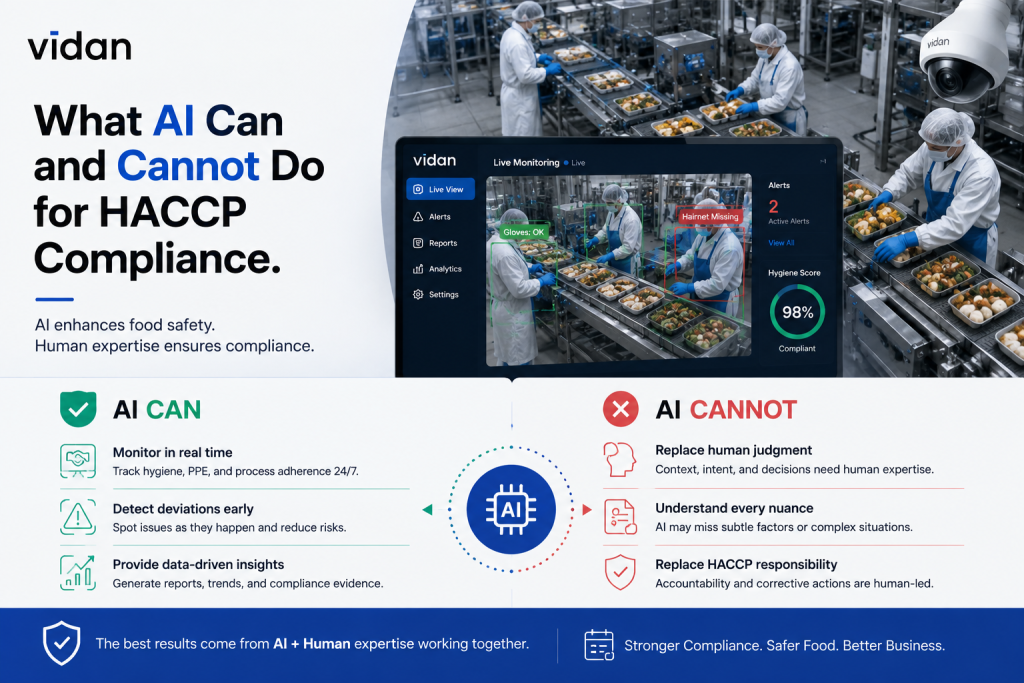
A camera catches a worker walking past a handwashing station without stopping. An algorithm flags it in under two seconds. A supervisor gets a text before the worker even reaches the production line. That is the promise of AI HACCP compliance today. It is also, quite deliberately, not the whole story.
AI can continuously monitor HACCP critical control points, detect visual deviations such as missed handwashing or PPE gaps, and send instant alerts to plant staff. AI cannot write your HACCP plan, decide what counts as a critical limit, replace a certified HACCP coordinator, or take corrective action on its own. It is a monitoring layer, not a food safety officer.
Key Takeaways
- AI for HACCP strengthens monitoring, not the underlying food safety plan itself.
- Vision AI can detect visual behaviors associated with critical control points, such as glove use, handwashing, and zone access.
- Alerts reach staff in seconds, cutting the gap between a deviation and a corrective action.
- AI cannot set critical limits, sign off on a HACCP plan, or replace human verification.
- Documentation generated by AI still needs human review before an audit.
- Plants that pair AI monitoring with trained QA staff see faster response times without losing accountability.
What Does HACCP Actually Require From a Food Plant?
HACCP is not a checklist. It is a documented system built on seven principles set by Codex Alimentarius and enforced in the U.S. under FDA and USDA FSIS rules.
A compliant plant must:
- Conduct a hazard analysis for every process step.
- Identify critical control points.
- Set critical limits for each CCP.
- Monitor those limits consistently.
- Define corrective actions for deviations.
- Verify the system is working as designed.
- Keep records that prove all of the above happened.
Most of that burden falls on people. Someone has to watch the cooler temperature. Someone has to confirm gloves were changed. Someone has to log it, every shift, every day. That is where visual behavior enters the picture.
AI Is Changing Food Safety Monitoring
According to a market analysis published by BCC Research in August 2025, the global AI in food safety and quality control market was valued at $2.7 billion in 2024 and is projected to reach $13.7 billion by 2030, growing at a 30.9% CAGR from 2025 to 2030.
That growth reflects the increasing use of AI for real-time food safety monitoring, quality inspection, contamination detection, traceability, and compliance. For food manufacturers, the technology is becoming a practical way to continuously monitor processes rather than relying solely on periodic manual checks.
How Does AI Read Visual Behavior on the Plant Floor?
Cameras already exist in most food plants for security. Vision AI turns that same footage into a food safety signal.
Here is what the software is actually trained to recognize:
- The camera captures continuous footage at each CCP, such as a handwash station, a glove change point, or an entry to a sanitized zone.
- A trained model identifies specific behaviors in that footage, like hand placement under a faucet for a minimum duration, or a worker crossing a zone boundary without PPE.
- The model compares the observed behavior against the rule tied to that CCP.
- Anything outside the expected pattern gets flagged as a possible deviation.
This is the layer where HACCP video monitoring does its heaviest lifting. It does not judge food safety outcomes. It reads behavior against a rule a human already defined.
How Does AI Detection Work in Real Time?
| Task | Manual Monitoring | AI Detection |
| Coverage | Spot checks, limited by staff hours | Continuous, every shift |
| Speed to flag | Minutes to hours | Seconds |
| Consistency | Varies by observer fatigue | Applies the same rule every time |
| Record creation | Manual entry, prone to gaps | Automatic timestamped log |
| Judgment on cause | Immediate, by trained staff | None, flags pattern only |
This continuous coverage closes a gap most plants have lived with for years. A single QA lead cannot watch six production lines at once. Reliable AI HACCP compliance monitoring can, and it never clocks out. But detection is pattern matching, not reasoning. The system does not know why a worker skipped a step. It only knows the step did not happen the way it should have.
What Happens When AI Sends an Alert?
- Does the alert stop production? No. The alert notifies a person. Production keeps running unless a human decides otherwise.
- Who receives it? Typically a shift supervisor, QA technician, or plant manager, depending on how the HACCP monitoring system is configured.
- How fast does it arrive? Within seconds of the detected deviation, usually as a mobile push notification or dashboard flag.
- What information does it include? A timestamp, the camera location, the CCP involved, and a short clip or still image of the flagged behavior.
- Is every alert a real violation? Not always. Some are false positives, which is exactly why a person reviews each one before anything is logged as a confirmed deviation.
The alert is the handoff point. Everything before it is AI. Everything after it is a person making a call.
Also Read: How to Implement AI Hygiene Monitoring in a Food Processing Plant
Who Handles the Corrective Action?
This is the clearest boundary in the whole process, and it matters for anyone evaluating AI food safety compliance tools.
AI does not retrain a worker. AI does not discard a batch. AI does not adjust a cooler setpoint or decide a product is unsafe to ship. Those are judgment calls tied to regulatory accountability, and they stay with trained staff.
What AI does is shrink the time between the deviation and the human response. A supervisor who sees a real-time alert can intervene before a fifteen-minute gap turns into a two-hour gap. Speed changes. Accountability does not.
How Does AI Support HACCP Documentation?
Recordkeeping is principle seven, and it is where inspectors spend a lot of their time. AI contributes here in a few concrete ways.
- Automatically timestamps every monitored event at a CCP.
- Stores video evidence tied to each flagged deviation.
- Builds a searchable log auditors can review by date, location, or CCP.
- Reduces gaps caused by missed manual entries.
- Supports food safety compliance technology stacks that already handle temperature logs and sanitation records.
None of this replaces the written HACCP plan. It supports the evidence trail behind it. A plant still needs a person to review the log, confirm accuracy, and sign off before an audit.
Where Does AI HACCP Compliance Fall Short?
AI can support HACCP compliance, but it has clear limits. Treating it as a replacement for food safety professionals can create regulatory problems.
- AI cannot create or approve a HACCP plan. HACCP plans still require qualified food safety professionals to develop, review, and approve them.
- AI cannot set critical limits. Critical limits must be based on scientific evidence, food safety research, and applicable regulatory requirements.
- AI cannot replace verification. Internal audits, record reviews, validation, and third-party certification still require human oversight.
- AI cannot guarantee food safety. A camera can detect whether a specific action happened at a specific time. It cannot confirm that the entire process is safe.
- AI cannot understand why a worker skipped a step. A missed procedure could result from an emergency, equipment issue, or repeated behavior. Visual AI can detect the missed step, but it may not understand the reason behind it.
The safest approach is to use AI HACCP compliance tools as support for trained QA teams, not as a replacement for them. AI can provide continuous monitoring and evidence, while food safety professionals remain responsible for decisions, verification, and corrective action.
Also Read: HACCP Compliance With AI Video Monitoring: What Food Manufacturers Need to Know
How Vidan AI Fits Into Your HACCP Process
Vidan AI adds a visual monitoring layer to your existing HACCP plan. It does not write the plan or set critical limits. Those decisions remain with your food safety team.
The platform uses cameras already installed across many plants to monitor key food safety points, including:
- Handwashing stations
- Glove change points
- Restricted zone access
- PPE compliance at line entry
Plants using HACCP video analytics can use this monitoring to:
- Respond faster to deviations: Alerts can reach supervisors within seconds, rather than waiting for the next spot check.
- Build a stronger audit trail: Timestamped video evidence can be linked to monitored CCPs and reviewed during FDA or FSIS inspections.
- Reduce manual monitoring: QA teams spend less time watching individual camera feeds and more time on verification, investigation, and corrective actions.
The idea is simple: cameras may already be watching your plant, but someone still needs to review what they capture. Vidan AI handles that visual monitoring so your team can focus on the decisions that require human judgment.
The Bottom Line
AI has earned a real role in food safety, but it is a specific one. It watches. It flags. It documents. It does not think for your QA team, and it should not be marketed as it does. The plants getting the most value from AI HACCP compliance tools right now are the ones using them exactly as designed: as a continuous, tireless second set of eyes on the CCPs that matter, backed by the trained people who still make the final call.
If your team is evaluating what visual monitoring could catch on your own floor, Vidan AI’s food safety specialists can walk through your current CCPs and show you where the coverage gaps actually are. That conversation costs nothing, and it usually surfaces at least one blind spot worth fixing.
Talk to Vidan AI about visual monitoring for your HACCP plan.