
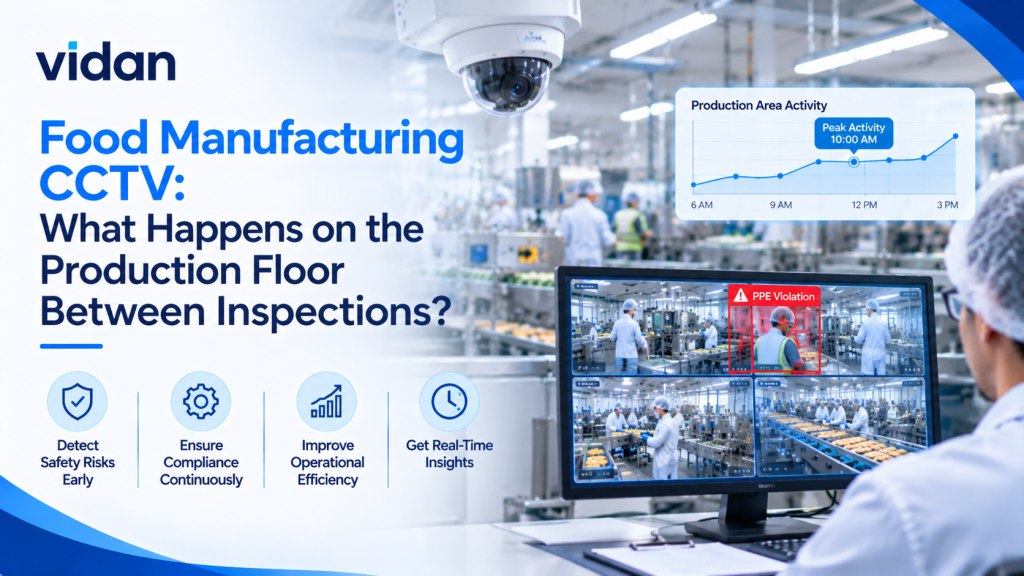
A two-shift plant runs about 4,000 hours a year. An inspector sees a few days of it. The rest sits inside food production inspection gaps, where gloves slip, and nobody logs it.
At Vidan AI, plant managers ask us the same thing. What is your line doing when the auditor leaves? This guide answers with data, a simple framework, and a practical setup for food manufacturing CCTV.
Quick answer: Regulators must inspect high-risk food plants every three years. Other plants wait up to five. Nothing independent records what happens on the line in between. AI video analytics on your existing cameras can log PPE, hygiene, and zone events on every shift. That gives you timestamped proof instead of an annual snapshot.
Key Takeaways
- FDA must inspect high-risk plants every 3 years and other plants every 5.
- HHS OIG found 26% of high-risk facilities missed their 3-year window.
- Standard CCTV records events. It does not flag them.
- AI video turns existing cameras into shift-by-shift evidence.
- Start with PPE, handwashing, and restricted zone entry.
- AI supports QA teams. It does not replace them.
Key terms to know
| Term | Meaning |
| FSMA | The Food Safety Modernization Act. It sets how often FDA inspects food facilities. |
| Cover by date | The date by which FDA must inspect a facility to stay on schedule. |
| HACCP | Hazard Analysis and Critical Control Points. A system for controlling food safety hazards. |
| Critical control point | A process step where a control prevents or reduces a hazard. |
| Event detection | Software that spots defined actions in video, such as missing PPE. |
| Audit trail | A timestamped record of what happened, where, and who responded. |
What Are Food Production Inspection Gaps, and Why Do They Exist?
An inspection gap is the stretch of time when no regulator, auditor, or recorded system verifies the line.
Gaps exist by design. Regulators cannot stand on every line. The food factory inspection process samples a plant, then moves on.
| The numbers | Source |
| High-risk domestic facilities must be inspected every 3 years. Others every 5. | FDA-TRACK, FSMA measures |
| FDA missed the 3-year window for 26% of high-risk facilities. It missed the 5-year window for 34% of the rest. | HHS OIG, June 2025 |
| About 48 million Americans get sick from foodborne disease yearly. 128,000 are hospitalized. 3,000 die. | HHS OIG, June 2025 |
| The average direct cost of a food recall is about $10 million (2012 FMI and GMA estimate). | Food Safety Magazine |
The math of an unwatched plant
Two shifts, eight hours each, 250 days a year gives roughly 4,000 hours. Over a three-year cycle, that is about 12,000 hours. One inspection covers a small slice.
Customer and third-party audits add coverage. They still sample. That is why between-inspection visibility now sits with the plant, not the regulator.
What Actually Happens on the Floor Between Audits?
Auditors review records and walk the floor. Both are snapshots. Production floor activity changes every hour, and paperwork captures only part of it.
Typical examples by shift window
| Shift window | What tends to go unrecorded |
| Start of shift | Gowning shortcuts, rushed handwashing, missed PPE checks |
| Mid shift | Skipped glove changes, propped doors, staff entering restricted zones |
| Breaks and changeovers | Re-entry without full hygiene steps, cleaning out of sequence |
| Shift handoff | Verbal notes that never reach a log |
| Overnight | Fewer supervisors, fewer eyes, same risk |
Why paper logs miss it
Checklists record what someone remembered to tick. Production shift activities that go wrong rarely get ticked.
Why Does Standard CCTV Miss What Inspectors Miss?
Most plants already own cameras. Footage usually sits unreviewed until something goes wrong. Cameras alone do not close food production inspection gaps. They only store the evidence.
Nobody can watch every feed. Unwatched feeds create inspection blind spots of their own.
| Periodic inspection | Standard CCTV | AI video on existing CCTV | |
| Watches | A few days every 3 to 5 years | Always, but passively | Every shift, actively |
| Finds issues | Sampled during the visit | After someone reviews footage | As events happen |
| Output | Findings report | Raw recordings | Alerts, clips, zone reports |
| Best use | Regulatory verification | After incident review | Daily compliance evidence |
How Do You Close the Gaps? The Window, Handoff, Drift Framework
We sort every gap into one of three types. Name the type first. Then pick the fix.
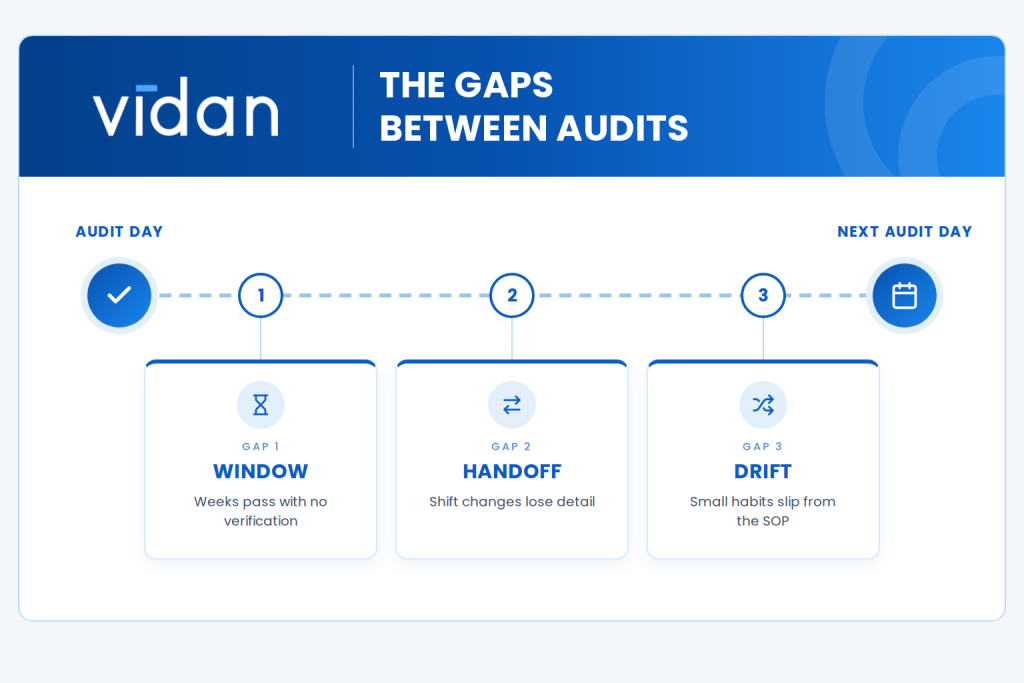
Closing food production inspection gaps works best one type at a time. Each type hides unrecorded production events that only video can recover.
| Gap | What breaks | What closes it |
| Window | Long stretches with no verification | Event detection on every shift |
| Handoff | Context vanishes at shift change | Shift summaries with timestamped clips |
| Drift | Habits creep away from the SOP | Trend reports by zone and shift |
Which Events Should You Track First?
Start where food safety risk and camera coverage overlap. AI PPE detection for food production is the easiest first step, because gloves, hairnets, and masks are visible.
- PPE compliance: gloves, hairnets, masks, and safety glasses at entry and line points.
- Handwashing: whether it happens at hygiene stations.
- Restricted zone entry: staff or visitors crossing into controlled areas.
- Repeat patterns: the same lapse in the same zone or shift.
- Alert response: how fast a supervisor acted.
Detection quality depends on camera angle, lighting, and setup.
Plants that want more can add AI hygiene monitoring in a food processing plant at critical control points.
Turn the cameras you already own into shift by shift proof of PPE, hygiene, and zone compliance.
How Does Vidan AI Watch the Line Between Inspections?
We built Vidan AI to deliver continuous production oversight on compatible existing cameras. Here is how it works.
STEP 1 → CONNECT
We link compatible CCTV at the points that matter most. Think entries, hygiene stations, and line zones.
STEP 2 → DETECT
Vidan AI watches for PPE lapses, handwashing activity, and restricted zone entry. Supervisors get real-time alerts.
STEP 3 → PROVE
Every event becomes a timestamped clip. Managers get production floor visibility across shifts and sites. Audit prep becomes a search, not a scramble.
Where we stop: Vidan AI does not write HACCP plans or set critical limits. Your QA team stays in charge. Read what AI can and cannot do for HACCP compliance for the full picture.
What Should You Ask Before You Buy Video AI for a Food Plant?
Cameras are easy to buy. Closing food manufacturing monitoring gaps takes the right questions.
- Does it run on the cameras I already own?
- How fast do alerts reach a supervisor?
- Can I export timestamped clips for auditors?
- Can I report by zone, shift, and date?
- How are false alerts tuned over time?
- Who owns the footage, and how long is it kept?
- Does the vendor say AI supports QA, not replaces it?
In Conclusion
Inspectors will return in three years, or five. Your line runs again at 6 a.m. Closing food production inspection gaps means proving good habits on every shift, not just on audit day.
Bring one line, one shift, and one worry to Vidan AI. We will show you what your existing cameras can flag.