
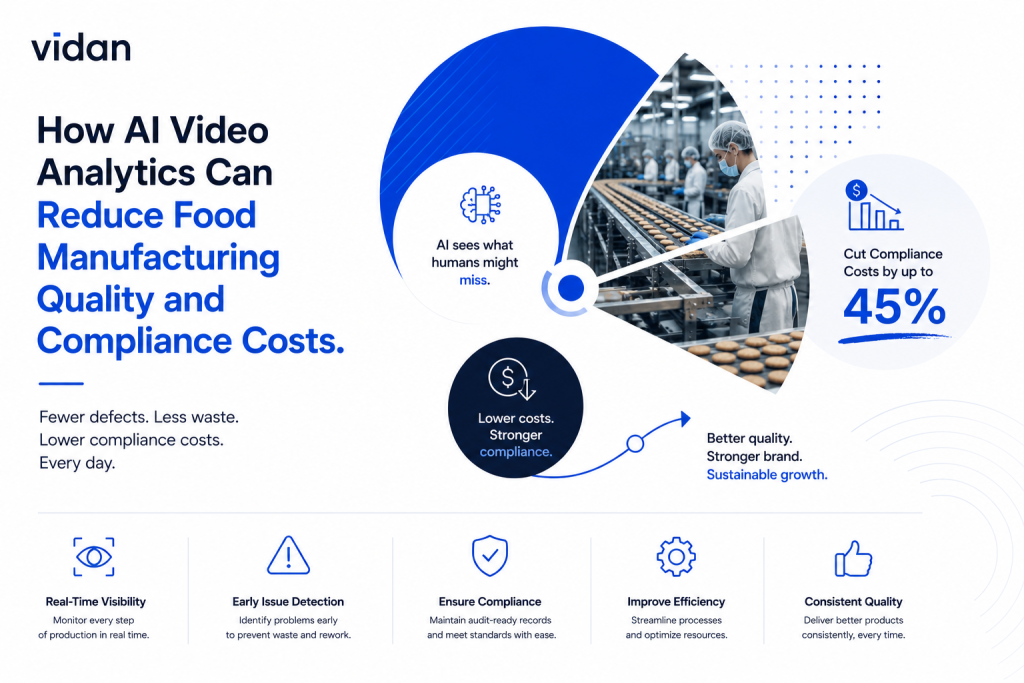
A single missed contamination event can cost a food plant more than $10 million. That total includes recall logistics, retesting, and lost retail trust. AI video analytics for food manufacturing exists to prevent that scenario.
AI video analytics for food manufacturing replaces manual checks with cameras and computer vision. These systems watch every line, every shift, without blinking. A supervisor might sample a handful of pallets per hour. The system reviews 100% of production activity instead. It flags contamination risks, PPE gaps, and process deviations the moment they happen.
Key Takeaways
- Manual inspection only catches a sample of activity. Continuous video analytics catches all of it, which lowers missed violation rates.
- The average food recall costs around $10 million once direct and indirect costs are combined.
- Unplanned downtime now averages roughly $25,000 an hour across manufacturing, and can exceed $500,000 an hour at large facilities, per MaintainX’s 2024 industry report.
- Continuous monitoring cuts audit preparation time because footage and event logs are already timestamped and searchable.
- Food plants that pair video analytics with existing HACCP plans reduce the labor hours spent on manual compliance checks.
- Vidan AI applies this technology across hygiene, PPE, and process compliance, purpose-built for food manufacturing floors.
What is AI Video Analytics For Food Manufacturing?
AI video analytics for food manufacturing uses computer vision to analyze production video and detect predefined events, behaviors, objects, and process conditions. It turns camera footage into alerts and operational data for faster review and response.
Unlike standard video surveillance, which records footage for later viewing, AI video analytics can identify specific events as they occur.
In a food manufacturing facility, it can detect:
- Missing gloves or hairnets
- Entry into restricted production zones
- Improper food or container handling
- Cross-contact risks
- Unsealed containers
- Incorrect packaging placement
- Skipped process steps
- Unusual equipment activity
- Prolonged ingredient exposure
- Sanitation violations
- Process deviations
- Visible quality issues
 Artificial Intelligence in Food Industry
Want to Keep Your Food Lines Clean, Safe, and Compliant?
AI in the food and beverage industry monitors hygiene, equipment, and restricted zones, reducing accidents and enforcing regulatory compliance consistently.

For food manufacturers, this means cameras can support hygiene monitoring, contamination risk detection, equipment compliance, restricted-zone monitoring, process deviation detection, and automated reporting without relying only on manual video review.
Why Compliance Labor Costs Keep Climbing
Compliance labor is rarely one line item. It is spread across quality technicians walking the floor, supervisors filling out paper checklists, and administrative staff re-entering that paper data into spreadsheets.
Three factors push this cost higher every year.
- Staffing shortages mean fewer trained inspectors covering more square footage.
- Regulatory scope keeps expanding under FSMA rules, adding new documentation requirements.
- Manual entry introduces errors that require rework and follow-up checks.
Food production video analytics removes the re-entry step entirely. Cameras log the event, timestamp it, and route it to the right compliance record automatically. Supervisors stop walking the floor to confirm what already happened and start managing exceptions instead. A good starting point for implementing AI hygiene monitoring in a food processing plant is to focus on specific strategies.
Manual Inspections Versus Continuous Video Coverage
A side-by-side comparison makes the labor gap obvious.
| Factor | Manual Inspection | AI Video Analytics |
| Coverage | Sampled, a few checks per shift | Continuous, every second of every shift |
| Speed of detection | Minutes to hours after the event | Seconds after the event |
| Record accuracy | Dependent on memory and handwriting | Timestamped, searchable video and metadata |
| Labor required | One inspector per zone per shift | One system monitoring many zones at once |
| Consistency | Varies by inspector fatigue and training | Applies the same rule every time |
This is where AI manufacturing video analytics earns its keep. It does not replace quality staff. It gives them full visibility so their time goes toward fixing problems instead of hunting for them.
What Downtime Actually Costs a Food Plant
Downtime is where compliance and operations budgets collide. A line might stop for an unscheduled inspection or a contamination scare. It might stop for an equipment fault tied to a hygiene failure. Either way, the cost compounds fast.
MaintainX’s 2024 industry report found something striking. The average cost of an hour of unplanned downtime sits around $25,000 across manufacturing. Larger facilities regularly see costs above $500,000 an hour.
CAMERA FEEDS
↓
AI EVENT DETECTION
↓
┌──────────┼──────────┐
↓ ↓ ↓
COMPLIANCE QUALITY PRODUCTION
↓ ↓ ↓
ALERT ALERT ALERT
└──────────┼──────────┘
↓
HUMAN RESPONSE
↓
DOCUMENTATION
↓
COST METRIC
↓
ROI MEASUREMENT
Video analytics shortens downtime in three specific ways.
- It flags a hygiene or process gap before it escalates into a full contamination event that forces a line stoppage.
- It gives maintenance and quality teams exact video evidence of what happened, cutting root cause investigation from hours to minutes.
- It removes the need to halt a line just to walk through a manual spot check.
Can AI Video Analytics Catch Contamination Before It Spreads?
Yes. Computer vision models trained on food production environments can detect risk behaviors as they happen. That includes uncovered product exposure, cross-contact between allergen zones, and pest activity near open lines.
Continuous monitoring shrinks the window between a contamination risk appearing and a human catching it. That window, not the event itself, usually turns a small issue into a full recall.
Also Read: How AI Food Safety Monitoring Lowers Recall Risks and Protects Profit Margins.
Quality Issues That Cameras Catch and Humans Miss
Quality drift rarely announces itself. It shows up as small, repeated deviations that add up over a shift.
- A filling station running slightly underweight for twenty minutes before anyone notices.
- A conveyor speed mismatch that causes inconsistent cook times.
- A packaging seal that starts failing intermittently after a machine adjustment.
- A temperature probe drifting out of calibrated range during a long run.
Food factory video analytics catches these patterns because it is always watching the same reference points. It does not get tired during hour ten of a shift the way a human inspector does.
Missed Violations and the Cost of Blind Spots
Every plant has blind spots. A supervisor cannot be in the sanitation area, the loading dock, and the packaging line at the same time. Missed violations are the compliance failures that never make it into a report because no one saw them. They are not rare. They are simply invisible until an outbreak, a customer complaint, or an external audit surfaces them.
Food processing analytics closes these blind spots by covering zones that were previously unmonitored between manual walkthroughs, so the gap between an event and its detection shrinks from hours to seconds.
Getting Audit Ready Without the Scramble
Most plants know the pre-audit scramble well. Someone spends days pulling paper logs, cross-checking dates, and hoping nothing is missing.
Here is what audit preparation looks like with a video analytics system already in place.
- Pull the date range the auditor is asking about.
- Filter recorded events by category, such as handwashing compliance or temperature checks.
- Export timestamped clips and metadata as supporting evidence.
- Hand over a complete, verifiable record instead of a reconstructed one.
This is one of the clearest ways AI video analytics for food manufacturing pays for itself. Audit prep drops from days of manual reconstruction to a targeted export.
Process Deviations and Why They Compound
A single process deviation rarely causes a crisis on its own. The risk comes from deviations stacking on top of each other without anyone noticing the pattern.
Common deviation types worth tracking include:
- Missed sanitation cycles between product changeovers.
- Skipped verification steps during shift handoffs.
- Equipment settings drifting outside documented parameters.
- Staff bypassing a required checkpoint under time pressure.
AI production monitoring tracks these events individually and in aggregate, which lets quality teams spot a pattern forming across a week, not just a single incident on a single day. Video monitoring is a powerful tool, but it has limitations that are important to understand, as explained in detail in “What AI Can and Cannot Do for HACCP Compliance.”
What Should Manufacturers Expect From Vidan AI?
Vidan AI was built for exactly this problem. Rather than adapting generic security cameras for compliance work, the platform is trained specifically on food manufacturing environments.
Detection Built For Food Floors
Models are trained on hygiene events, PPE compliance, allergen zone crossings, and process checkpoints specific to food production, not generic retail or warehouse footage.
Prioritizing Evidence Over Alerts
Every flagged event comes with a timestamped clip, so quality teams can verify context instantly instead of chasing down what actually happened.
Works With Existing Infrastructure
Vidan AI connects to camera systems already installed on most plant floors, which keeps rollout costs and downtime low.
Designed for Use by Both Auditors and Operators
Reports export in formats that match what regulators and customer auditors expect to see, cutting the translation work between raw footage and a usable record.
This is food manufacturing automation applied to compliance specifically, not just to production speed.
The ROI Case for AI Video Analytics for Food Manufacturing
Put the pieces together, and the case for video analytics stops being theoretical.
A plant avoiding even one downtime incident a year at $25,000 an hour, shaving a few hours off a single audit prep cycle, and reducing the odds of one contamination event that could trigger a multi-million-dollar recall adds up to a return that most quality budgets cannot ignore.
AI video analytics for food manufacturing is not an added compliance expense. It is a way to convert existing camera infrastructure into a continuous, searchable compliance record that reduces labor, shortens downtime, and lowers the odds of the kind of failure that makes headlines.
Conclusion
Compliance costs in food manufacturing rarely come from one dramatic failure. They build up from small, unmonitored gaps in labor, inspection, and process control. AI video analytics for food manufacturing closes those gaps by turning every camera on the floor into a compliance witness that never blinks, never forgets, and never needs a coffee break.
Vidan AI built its platform around this exact challenge, giving food manufacturers a way to protect quality, pass audits with less scramble, and keep production running without gambling on what a manual walkthrough might miss.
Ready to see what continuous monitoring could catch on your floor? Talk to the Vidan AI team about a walkthrough built around your production line.