
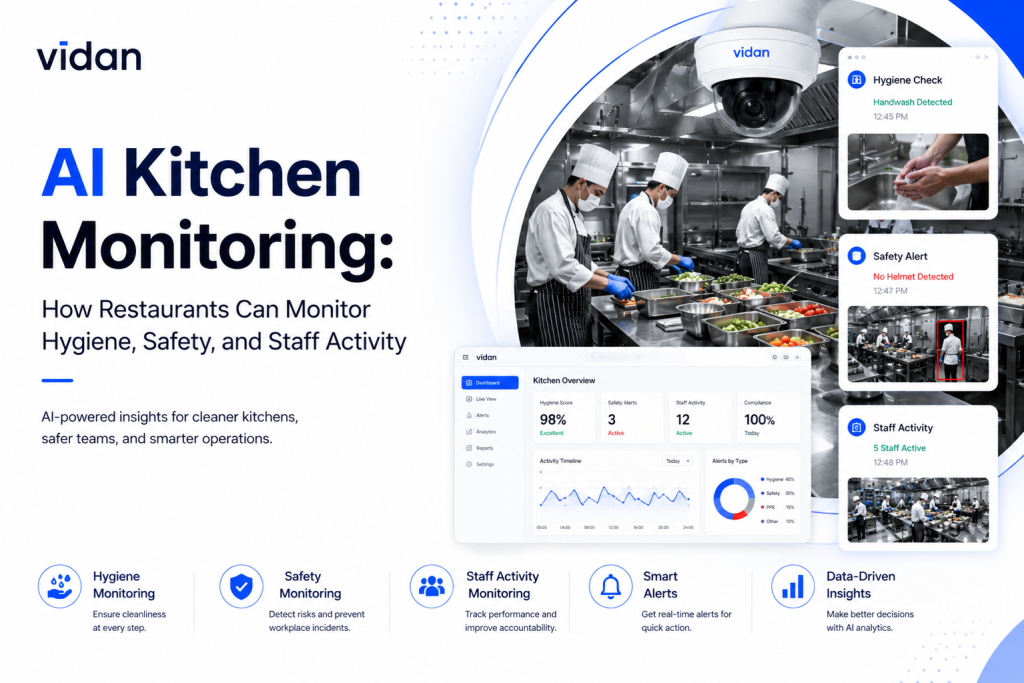
AI kitchen monitoring uses computer vision cameras and machine learning to watch hygiene practices, food handling, and staff activity inside a commercial kitchen in real time. It flags missed handwashing, unsafe temperatures, cross-contamination risks, and PPE gaps the moment they happen, instead of weeks later during a health inspection.
Restaurant kitchens move fast, and mistakes happen in seconds. A camera watching hygiene, temperature, and staff behavior around the clock catches what a manager on a busy Friday night cannot. This guide breaks down how AI kitchen monitoring works, what it catches, why restaurants are adopting it in 2026, and how Vidan AI builds it into working kitchens.
Key Takeaways
- AI kitchen monitoring turns existing kitchen cameras into a live compliance system, not just a security recorder.
- It catches hygiene and safety gaps as they happen, so managers can fix them before an inspector does.
- Restaurants use it to track handwashing, glove use, temperature logging, cross-contamination, and staff activity on the line.
- Unsafe food causes an estimated 866 million illnesses worldwide every year, according to the World Health Organization (WHO).
- Vidan AI builds this monitoring into restaurant and QSR kitchens without replacing existing camera hardware in most cases.
What Is AI Kitchen Monitoring?
AI kitchen monitoring uses cameras and computer vision to detect hygiene, safety, and operational issues in commercial kitchens. It can identify events such as missing hairnets, improper glove use, cross-contamination risks, and unsafe actions, then send alerts and timestamp the events for review.
Unlike standard security cameras, AI kitchen monitoring recognizes specific actions and objects. It gives managers visibility across kitchen stations and shifts without requiring them to be physically present.
Why Do Restaurants Need AI Kitchen Surveillance in 2026?
Health inspections happen a few times a year. Kitchens run every day. That gap is where most violations quietly build up, and it is why more restaurant groups are adding a monitoring layer that runs continuously instead of periodically.
- Unsafe food causes an estimated 866 million illnesses and 1.5 million deaths annually, a burden tied heavily to food prepared outside the home, per industry food safety data.
- In the United States, CDC estimates that foodborne pathogens cause roughly 48 million illnesses, 128,000 hospitalizations, and 3,000 deaths every year.
- Health departments are increasing inspection frequency and enforcement in 2026 as concerns grow over cross-contamination and poor sanitation practices, according to food safety compliance guides.
- A single Florida restaurant recorded 70 violations in one inspection in April 2026, the most of any location in the state that year.
- Most restaurants are inspected only one to four times per year, which means the majority of shifts happen with zero outside oversight.
These numbers are not abstract. Every violation on that list traces back to a moment inspectors never see: a missed handwash, a mislabeled container, a fridge that drifted out of range overnight. AI food safety monitoring exists to catch that moment, not the paperwork that follows it.
How Does AI Kitchen Monitoring Track Hygiene Compliance?
The clearest way to see the difference is side by side.
| Task | Manual Method | AI Kitchen Monitoring |
| Handwashing checks | Manager spot checks a few times per shift | Every handwash event detected and logged automatically |
| Glove changes | Relies on staff memory and training | Flagged in real-time when a change is missed |
| Temperature logs | Written by hand, prone to gaps or errors | Continuously monitored and time-stamped |
| Cross contamination | Caught after the fact, if at all | Flagged the moment raw and ready-to-eat items meet |
| Audit trail | Paper logs, easy to lose or falsify | Searchable video and event history |
This is the core value of kitchen hygiene monitoring built on computer vision. It does not get tired near the end of a double shift, and it does not skip a check because the kitchen is slammed.
What Kitchen Safety Risks Can AI Cameras Actually Catch?
AI kitchen cameras are trained on specific, common failure points rather than generic motion.
- Cooks reaching into the danger zone temperature range without checking a thermometer
- Raw meat, poultry, or seafood placed near produce or ready-to-eat food
- Staff skipping a glove change after touching raw protein
- Missing hairnets, aprons, or other required PPE on the line
- Spills or debris left on the floor near the cook line for an extended period
- Doors to walk-in coolers left open past a safe threshold
- Unauthorized staff or vendors entering restricted prep areas
This is where kitchen video monitoring goes beyond a standard security setup. A regular camera records footage a manager might review after a complaint. An AI system reviews footage as it happens and raises the flag before the complaint exists.
How Does AI Monitor Staff Activity Without Feeling Like Micromanagement?
This question comes up in almost every restaurant kitchen conversation, and it deserves a direct answer.
AI kitchen monitoring is built to track actions and conditions, not personal behavior for its own sake. The system flags a missed glove change or an unsafe temperature. It does not rank employees or score personalities. Most restaurant groups frame it to staff as a safety net, similar to a smoke detector: it stays quiet unless something needs attention.
The mindset shift matters here. The goal is not to watch people. The goal is to catch the few seconds where a mistake happens, before it reaches a plate. Operators who explain this framing upfront tend to see far less pushback from kitchen staff.
Used well, this kind of AI kitchen surveillance also protects staff. It creates a clear, time-stamped record if an incident is ever disputed, which cuts both ways fairly.
AI Kitchen Monitoring vs Traditional CCTV: What Actually Changes?
Traditional CCTV and AI kitchen monitoring look similar on a wall of screens, but they behave very differently.
- Traditional CCTV stores footage and waits for someone to go looking for a problem. Nothing happens until a manager pulls up a clip after a complaint or an inspection.
- AI kitchen monitoring watches the same footage in real time, understands what it is seeing, and pushes an alert the moment a rule is broken. One is a record. The other is a response system.
If you already use restaurant kitchen security cameras for theft prevention or liability, adding AI analysis can turn the same hardware into a real-time hygiene and safety monitoring system without requiring new equipment.
How Vidan AI Helps Restaurant Teams Monitor Every Kitchen
Vidan AI approaches kitchen monitoring differently from a generic security vendor bolting on an AI label.
- We work with the cameras you already have. Most kitchens do not need new hardware. Vidan AI’s computer vision runs on existing camera feeds in most installations, which keeps rollout fast and budgets realistic.
- We build for specific kitchen risks, not generic motion detection. Our models are trained on the failure points that actually show up in restaurant inspections: temperature control, glove changes, cross-contamination, and PPE gaps.
- We connect monitoring to real workflows. Alerts go to the people who can act on them, whether that is a shift manager’s phone or a compliance dashboard reviewed at close.
- We support multi-location visibility. For restaurant groups running several kitchens, Vidan AI gives ops teams one view across every location instead of a separate system per site.
How Does Implementation Work in a Live Kitchen?
Rolling out AI kitchen monitoring does not require shutting down operations. Most restaurant deployments follow a similar path.
- Camera audit. Vidan AI reviews existing camera placement and coverage across prep, cook line, walk-ins, and dish areas.
- Model configuration. The system is configured for the specific risks that matter most to that kitchen, such as allergen stations or high-volume fry lines.
- Staff orientation. Teams are shown what the system flags and why, which reduces resistance and confusion in the first week.
- Live monitoring and alerting. The system goes live, sending real-time alerts to designated managers or supervisors.
- Reporting and refinement. Vidan AI reviews flagged events with the restaurant team and tunes sensitivity to cut false alerts over time.
This same monitoring approach extends beyond hospitality kitchens.
QSR VIDEO SURVEILLANCE
Built for High Volume, Fast Moving Kitchens
Quick service kitchens run on speed. Vidan AI’s QSR surveillance solutions keep hygiene and safety checks running just as fast, without slowing down the line.
What Does AI Food Handling Monitoring Cover Beyond Hygiene?
Hygiene is the most visible use case, but AI food handling monitoring extends further into daily kitchen operations.
- Temperature drift detection across walk-in coolers, freezers, and hot holding units, flagged before food spoils.
- Portion and prep consistency checks on lines where accuracy affects both cost and customer experience.
- Delivery and receiving verification, confirming staff check temperatures and dates on incoming shipments.
- Restricted area access, alerting if someone enters a walk-in or storage area without authorization.
How Does Restaurant Kitchen Monitoring Handle Staff Privacy?
What the System Does Not Track
The software is built to detect specific actions and conditions such as a glove change or a temperature reading. It does not perform facial recognition for personal identification, and it does not follow staff outside designated kitchen and prep areas.
How Footage Is Stored and Accessed
Footage and flagged events are stored securely and accessed only by authorized managers or compliance staff. Access logs track who reviewed a clip and when.
Building Staff Trust Early
Restaurants that introduce the system with a short staff meeting see far less resistance than those that roll it out silently.
How Does Restaurant Kitchen Security Cameras Fit Into Existing Restaurant Systems?
POS and Scheduling Integration
Some deployments tie flagged events to shift schedules, so a manager can see which shift or station a hygiene flag happened on.
Temperature Sensor and IoT Integration
Where kitchens already use wireless temperature sensors, AI monitoring can pull that data alongside camera footage for a fuller cold chain picture.
HACCP Documentation Support
Flagged events and time-stamped logs can support existing HACCP documentation, giving inspectors a stronger paper trail during a review.
What Vidan AI Sees Across Restaurant Deployments
Across restaurant kitchens we have worked with, the most common finding is not dramatic. It is small, repeated slippage: a glove change skipped during a rush, a thermometer check dropped during a busy hour, a hand sink used less often near the end of a shift. None of these show up on a typical inspection because inspections happen on a single day, not across hundreds of shifts.
The kitchens that see the biggest improvement are not the ones with the worst habits going in. They are the ones that use AI kitchen monitoring data in daily huddles, not just as a compliance record pulled out during an audit. Restaurants that review flagged events weekly with staff, rather than only when something goes wrong, tend to see the sharpest drop in repeat issues within the first two months.
CUSTOM AI FOR YOUR KITCHEN
Need a Model Built for Your Exact Kitchen Layout?
Vidan AI’s machine learning engineers build custom detection models for kitchens with unique layouts, menus, or compliance needs that off the shelf systems miss.
Conclusion
Health inspectors show up a few times a year. Bacteria, bad habits, and busy shifts show up every single day. That mismatch is exactly what AI kitchen monitoring was built to solve, and it is why more restaurant groups are adding it in 2026 instead of waiting for the next violation to force the issue.
Vidan AI helps restaurants close that gap without ripping out existing cameras or retraining staff from scratch. If your kitchen is ready for hygiene, safety, and staff monitoring that actually runs in real time, talk to our team about what a rollout would look like at your locations.