
Construction sites lose up to $1 billion a year to theft in the United States alone. Even the low end of that estimate represents an enormous annual drain on contractors. Falls still kill more construction workers than any other hazard on the jobsite. Cameras have watched all of it happen for decades. They just never stopped it.
That gap is exactly where AI construction site monitoring comes in. It takes the footage sites already generate and turns it into something that actually acts: real-time alerts, automatic PPE checks, and theft detection that doesn’t wait for a human to notice. This guide breaks down how it works, where it delivers the most value, and what it actually costs to put on a jobsite.
Key Takeaways
- AI construction site monitoring uses computer vision to analyze live video and flag safety violations, intrusions, and hazards without a person watching every screen.
- Falls, struck-by incidents, electrocutions, and caught-in-between hazards cause roughly 60% of construction deaths, and AI can catch the conditions that lead to them before they happen.
- Equipment theft costs the industry $300 million to $1 billion annually, and fewer than 21% of stolen machines are ever recovered.
- Construction PPE detection systems built on modern object detection models now reach accuracy rates above 90% in field deployments.
- Costs scale with camera count, site size, and how many AI modules (safety, theft, productivity) a contractor needs running at once.
- Vidan AI positions itself as video intelligence, not another camera vendor, meaning the software does the watching, thinking, and alerting.
What Is AI Construction Site Monitoring?
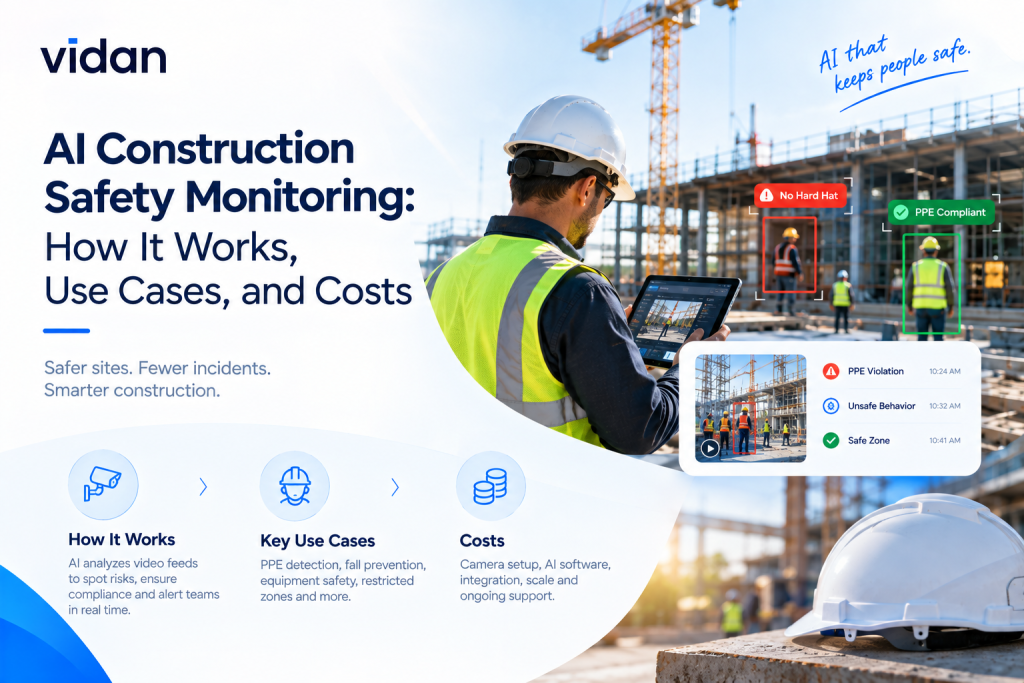
AI construction site monitoring applies computer vision to the cameras already installed on a jobsite. Instead of storing hours of footage for someone to review later, the system watches the feed live. It is trained to recognize specific events. A worker without a hard hat. A truck entering a fenced zone after hours. A person standing too close to a swinging load.
In simple terms, this is software that watches video and understands what it sees.
AI construction site monitoring is the use of computer vision to detect safety, security, and productivity events on a jobsite in real time.
How Does AI Construction Site Monitoring Work?
The process runs in four stages on most modern platforms.
- Capture. Existing IP cameras, or new ones added for the project, stream continuous video across the site.
- Detection. A trained model scans each frame for people, equipment, vehicles, and predefined risk conditions.
- Analysis. The system checks what it detects against site rules: is this person wearing a vest, is this vehicle authorized, is anyone inside a no-go zone?
- Alert. When a rule is broken, the platform pushes a notification to a supervisor’s phone, a dashboard, or an onsite speaker, often within seconds.
Some of that detection work happens close to the camera itself rather than in the cloud, which shortens response time significantly. This architecture is covered in greater depth in Edge AI in Construction Safety: How It Works and Why It Matters, with a focus on how edge processing can keep safety monitoring running when connectivity is limited.
Why Are Construction Sites Moving Beyond Traditional CCTV?
Most 2026 industry content still frames this as a camera upgrade. It is not. It is a shift from recording to understanding.
| Factor | Traditional CCTV | Video Intelligence |
| What it does | Records footage | Understands footage |
| When you learn about an issue | After someone reviews the tape | The moment it happens |
| Staffing needed | A person watching monitors | Automated alerts to the right person |
| Best used for | Proof after an incident | Preventing the incident |
This is why construction site AI surveillance keeps coming up in industry conversations this year. It is not a bigger camera network. It is a smarter one, built to act on what it sees instead of just archiving it.
Where AI Construction Site Monitoring Catches What Cameras Miss
PPE and Hazard Detection
Roughly one in five workplace fatalities in the United States happens in construction. Falls alone accounted for 38.5% of all construction deaths in 2023. Most of those incidents trace back to a missing harness, an unguarded edge, or a worker who never noticed a hazard until it was too late. Gallagher Bassett
Construction PPE detection models built on object detection frameworks now identify hard hats, vests, gloves, and boots directly from camera footage. In one peer-reviewed evaluation of an AI-powered PPE detection system in an industrial plant, researchers recorded 92% detection accuracy and a 41% drop in non-compliance incidents after deployment. Similar systems used on active construction sites report comparable results:
- Missing hard hat or vest, flagged within seconds of entering frame
- Worker inside a crane’s swing radius, flagged before the load moves
- Person standing near an open trench or unguarded edge
- Equipment operating without a required spotter present
Perimeter and Theft Prevention
Equipment theft is one of the most persistent, least discussed costs in construction. More than 11,000 incidents of construction equipment theft are reported each year, roughly 1,000 per month, and only about 20 to 21% of stolen equipment is ever recovered. Theft adds an estimated 1 to 5% to overall project costs, a figure that eats directly into contractor margin. (Source: Construction Site Theft Statistics 2026 – Building Security Services +2)
Construction site theft prevention built on AI works differently than a padlock or a static camera. It recognizes patterns: a vehicle that lingers past hours, a person walking the fence line repeatedly, movement near stored materials after the crew has left. None of that requires someone to be watching a monitor at midnight.
🚨 Theft Analytics
Once It’s Gone, It’s Gone. Stop It Earlier.
Under 25% of stolen equipment is ever recovered. Vidan AI catches the loitering and the second visit, long before the third one empties the lot.
Productivity and Pattern Insight
Beyond safety and security, construction site video analytics gives project managers something cameras never offered: trends. How long does material staging actually take? Which zones see the most near-miss activity? Where do crews bottleneck during shift changes? That data turns video from a liability record into a planning tool.
Sites with multiple active locations get an added layer of value here, since patterns across sites reveal issues a single feed would never surface. For contractors managing multiple projects, The Benefits of Monitoring Multiple Construction Sites Remotely for Better Security explains how centralized dashboards provide a real-time view of security risks across locations.
How the System Works Behind the Scenes
The mechanics are simpler than most people expect, and they run continuously in the background.
- Cameras already on site feed live video into the platform.
- Computer vision models scan each frame for defined events.
- Edge devices process much of this on site, cutting delay to seconds.
- A flagged event triggers an alert to a supervisor’s phone or dashboard.
- Every event is logged automatically for reporting and audits later.
This is the mechanical side of AI construction site monitoring, and it is exactly what makes real-time alerts possible instead of next-day reviews.
Can AI Actually Stop Equipment Theft?
Construction site theft prevention is one of the clearest financial cases for this technology. Equipment theft alone costs the U.S. construction industry an estimated $300 million to $1 billion a year, according to the National Equipment Register and National Insurance Crime Bureau, as reported by Building Security Services. Fewer than one in four stolen machines is ever recovered. Cameras that flag after-hours movement or loitering near equipment give a site owner a chance to act before that machine leaves the lot.
🏗️ Construction Site Security
Your Site Goes Quiet at 5 PM. Thieves Don’t.
Empty jobsites are the easiest target on the block. Vidan AI stays on shift overnight and flags anyone who shouldn’t be there.
What Do the Numbers Say About AI Jobsite Monitoring?
Falls caused 370 construction worker deaths in 2024, still the single largest cause of death on job sites, according to OSHA data. The four leading hazards behind construction deaths, known as the Fatal Four, account for close to 60 percent of all fatalities every year, per the Texas Department of Insurance. On the security side, more than 11,000 equipment theft incidents are reported annually in the U.S., and less than a quarter of stolen equipment is ever recovered.
None of these numbers move on their own. AI construction site monitoring is one of the few tools built to change them directly by shortening the time between a hazard forming and someone acting on it. That shift toward proactive, camera-based safety is exactly what analysts mean when they describe AI construction safety monitoring becoming standard practice on large commercial sites.
How Vidan AI Goes Beyond CCTV
Most vendors in this space still sell hardware first. A camera, a recorder, a monitor wall. Vidan AI starts from a different question: what should this footage actually do.
That means the platform is built around detection logic, not storage capacity. A camera watches. Our construction site AI surveillance interprets, decides, and notifies, whether that’s a missing hard hat at 7 a.m. or a vehicle at the fence line at midnight. The hardware is just the input. The intelligence is the product.
What sets this apart from a commodity CCTV upgrade:
- Alerts arrive in seconds, not after someone reviews footage the next morning
- Detection models are tuned for jobsite conditions: dust, low light, PPE variations, crowded frames
- One platform covers safety, theft, and vehicle monitoring instead of three separate tools
- Dashboards give project leadership a single view across every active site
What Does AI Construction Safety Monitoring Cost?
Pricing depends on a handful of factors rather than a flat rate.
| Cost Factor | What It Affects |
| Number of cameras | Base hardware and licensing cost |
| Site size and camera coverage needed | Installation complexity |
| AI modules enabled (PPE, theft, vehicle, analytics) | Software licensing tier |
| Cloud vs edge processing | Ongoing bandwidth and storage cost |
| Contract length | Monthly rate vs project-based pricing |
Once you have your camera and site count, you can use our Construction Safety ROI Calculator to estimate the potential return.
The Bottom Line
Cameras were never really the problem on a construction site. Blind spots were. AI construction site monitoring closes those blind spots today, not after the incident report is filed. It catches the missing harness, the after-hours truck, and the idle equipment before they become a cost.
Vidan AI builds this as video intelligence, not another surveillance layer bolted onto old CCTV. If your cameras are already up, the harder question is what they have been missing. Talk to our team and find out.