
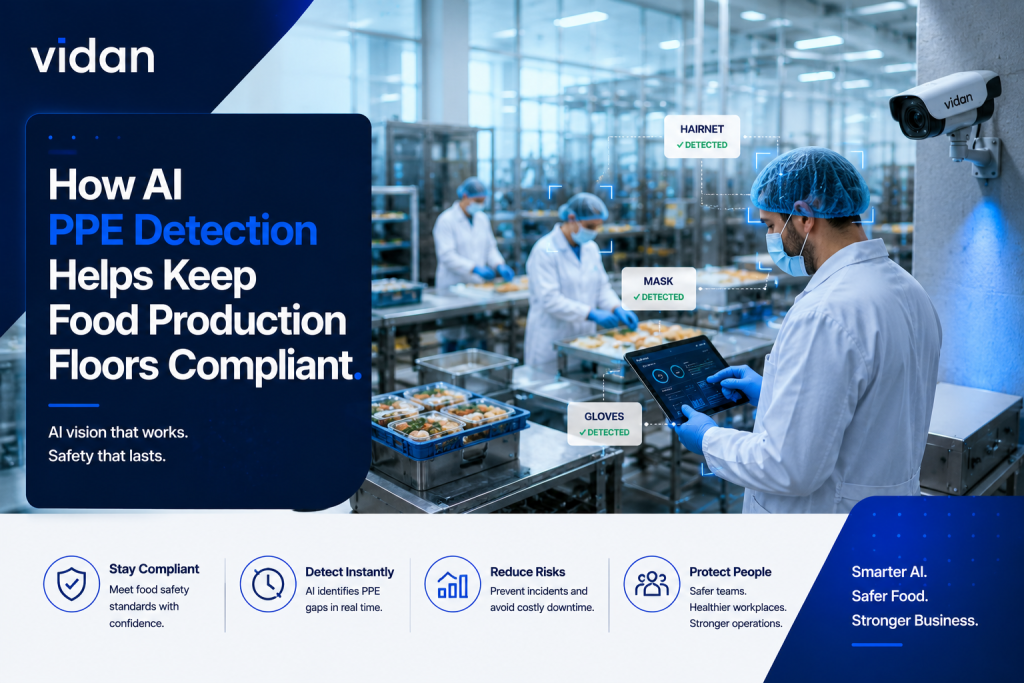
A missing hairnet costs nothing to notice and everything to miss. AI PPE detection uses cameras and computer vision to spot workers without required gear, in real time, before a health inspector or an OSHA officer does it for you. For food plants, that gap between “someone should have caught this” and “the system caught it automatically” is where compliance budgets actually get protected.
Key Takeaways
- AI PPE detection flags missing gloves, hairnets, masks, and safety gear the moment a worker enters a zone that requires them.
- Food manufacturers paid over $16 million in OSHA fines in a single recent year, much of it tied to preventable PPE and hazard control gaps.
- Manual PPE spot checks catch a fraction of violations. Cameras do not blink, take breaks, or miss the night shift.
- PPE compliance sits at the intersection of worker safety and food hygiene, which means a PPE gap can also become a recall risk.
- Vidan AI builds PPE monitoring into a plant’s existing camera network, so there is no new hardware cycle to manage.
What Is AI PPE Detection?
AI PPE detection runs on top of a plant’s existing camera feeds. A trained model scans each frame for required gear such as hairnets, gloves, masks, aprons, and safety glasses. When a worker enters a zone without the correct item, the system flags it instantly.
Definition: A PPE detection system is software layered onto camera hardware that classifies whether a person is wearing required protective equipment and triggers an alert when they are not.
Why Food Production Floors Struggle With PPE Compliance
Manual PPE enforcement has one major limitation: supervisors cannot watch every worker on every production line throughout every shift.
- 1,168 OSHA citations
Between October 2018 and September 2019, OSHA issued 1,168 citations to food manufacturers, resulting in more than $7.1 million in penalties. - 57% higher amputation rate
Food production workers in Ohio had a nearly 57% higher amputation rate than private-sector manufacturing workers overall. They also had a 16% higher fracture rate.
These figures point to a simple problem: PPE compliance cannot depend entirely on someone watching every worker. Food production teams need continuous visibility into whether required PPE is being worn correctly, especially when supervisors cannot be everywhere at once.
Manual PPE Audits vs AI PPE Monitoring
| Factor | Manual Audits | AI PPE Monitoring |
| Coverage | Scheduled spot checks | Every worker, every shift continuously |
| Speed of alert | Hours or days later | Seconds after the violation |
| Consistency | Varies by supervisor | Same standard applied every time |
| Night and weekend shifts | Often unmonitored | Covered automatically |
| Audit trail | Paper logs, easy to lose | Timestamped video record |
AI PPE monitoring does not replace supervisors. It gives them a second set of eyes that never clocks out.
What a PPE Detection System Catches
A properly trained PPE detection system is built to recognize specific, common violations on a food floor:
- Missing or improperly worn hairnets and beard nets
- Gloves removed during handling of open product
- Missing safety glasses in cutting or slicing zones
- Workers entering restricted zones without required aprons
- Face coverings slipped below the nose in packaging areas
- Missing hearing protection near high noise equipment
Each of these ties back to either OSHA worker safety rules or FDA food handling hygiene standards, which is why PPE sits at the center of two separate compliance frameworks at once.
How AI PPE Monitoring Works
- Cameras capture the floor. Existing security or new dedicated cameras cover entry points and production zones.
- The model classifies each frame. Computer vision checks each visible worker against the PPE required for that zone.
- Violations trigger an alert. Supervisors get a real-time notification with a timestamp and camera location.
- The event is logged. A record is stored automatically, building an audit trail without extra paperwork.
- Patterns get surfaced. Recurring violations by zone, shift, or line show up in reporting, so root causes get fixed, not just individual incidents.
This is also where broader video intelligence tools start to matter. Why video AI agents are the next big shift in video intelligence technology explains how PPE detection can fit into a plant’s broader move toward autonomous monitoring, rather than simply recording footage.
Where Should Cameras Be Placed for PPE Detection?
Not every camera on a production floor will provide useful PPE visibility. Placement matters because the system needs a clear view of the worker and the PPE being checked.
High Priority Camera Locations
- Production floor entrances
- Hygiene and gowning areas
- Employee changing areas
- Production line entry points
- High-risk processing zones
- Packaging areas
- Restricted access points
- Areas with frequent PPE violations
The best locations are usually points where workers enter a zone with specific PPE requirements. Checking compliance at these points can prevent workers from reaching the production area without the required gear.
PPE Detection Can Support More Than Worker Safety
PPE is not only about protecting workers. On a food production floor, a missing glove, hairnet, or other required item can also create a hygiene risk.
Computer vision PPE detection helps teams spot these gaps without relying on supervisors to watch every production line. It can also give QA teams a clearer view of PPE compliance as part of a wider hygiene program.
If your facility is exploring AI beyond PPE checks, How to Implement AI Hygiene Monitoring in a Food Processing Plant explains how video monitoring can also support handwashing checks and controlled-area compliance.
How AI PPE Detection Helps QA and Safety Teams
PPE monitoring can reduce the gap between what happens on the production floor and what gets documented later.
For Safety Teams
Safety managers can identify repeated PPE violations and see where additional training or supervision may be needed.
For QA Teams
QA teams can monitor PPE practices that affect hygiene and review documented events during internal audits.
For Operations Managers
Operations teams can see whether violations are concentrated around particular lines, shifts, or production areas.
What It Costs When PPE Violations Go Undetected
PPE violations can become more serious when they happen around high-risk equipment. OSHA reported about 1,500 injuries involving food and beverage processing and butchering machinery between 2015 and 2022, plus nearly 400 injuries involving food slicers, mixers, blenders, and whippers.
These numbers show why safety checks cannot stop at written policies or occasional inspections. Workers face hazards during normal production, cleaning, maintenance, and even when clearing machine jams.
PPE compliance is only one part of a broader food safety program, but missed violations can add to the risks already present on the production floor. When teams can spot PPE issues as they happen, they can address them before they become part of a larger safety or compliance problem.
For a closer look at the business side of food safety monitoring, How AI Food Safety Monitoring Lowers Recall Risks and Protects Profit Margins explains how earlier detection can help food manufacturers reduce the risks and costs associated with compliance failures.
What Food Plants Should Check Before Implementing AI PPE Detection
AI PPE monitoring works best when the plant has a clear idea of what it wants to monitor and where.
- Define PPE Requirements by Zone: Different areas may require different PPE. Map those requirements before configuring the detection rules.
- Review Existing Camera Coverage: Check whether current cameras provide clear views of entrances, production lines, and other areas where PPE compliance matters.
- Identify Who Receives Alerts: A violation should reach someone who can respond. Decide which supervisor, safety manager, or QA team member should receive each type of alert.
- Set Clear Response Procedures: Define what happens after a violation is detected. This could include a supervisor intervention, employee reminder, incident review, or additional training.
The Vidan AI Approach to PPE Compliance
Vidan AI builds AI safety monitoring into the cameras a plant already has. There is no separate hardware ecosystem to buy, install, and maintain.
What Vidan AI adds to an existing camera network:
- Zone-specific PPE rules, so a raw handling area and a packaging line each get their own compliance logic
- Real-time alerts routed to the right shift supervisor, not a generic inbox
- A searchable video record for every flagged event, useful for both internal audits and regulator visits
- Dashboards that show violation trends by zone, shift, and line over time
This connects to a wider category of tools. AI Video Analytics covers how the same underlying platform can also handle safety, security, and operational monitoring from one system, which matters for plants trying to avoid a separate vendor for every camera use case.
The 4 Layer PPE Compliance Stack
This is the framework Vidan AI uses when scoping a plant deployment. It is not industry standard terminology. It is how we think about the problem.
- Detection layer: Cameras and the model that classifies PPE status in real time.
- Alert layer: Routing violations to the right person within seconds, not minutes.
- Record layer: Timestamped video and logs stored for audit and regulatory review.
- Insight layer: Trend reporting that shows which zones or shifts need retraining, not just individual write-ups.
Most PPE programs stop at the first layer, if they have any camera-based detection at all. The insight layer is where compliance stops being reactive.
Conclusion
PPE compliance on a food production floor is not a paperwork problem. It is a visibility problem, and cameras solve visibility better than clipboards ever have. AI PPE detection turns every camera a plant already owns into a compliance tool that never stops watching, never gets tired, and never forgets to write the incident down.
If missing hairnets, gloves, or safety glasses are showing up in your incident reports more than once, the fix is not another training session. It is a system that catches the gap in the moment it happens. Talk to Vidan AI about mapping PPE detection onto your existing camera network, and see what your floor has been missing.