
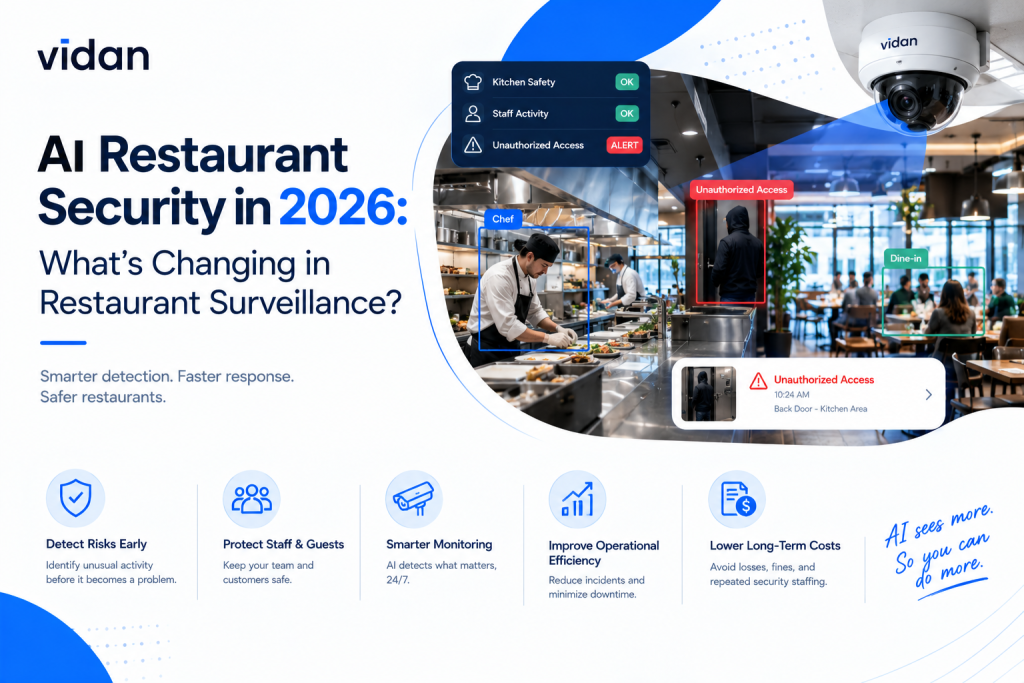
Cameras once served a simple purpose: recording what happened. AI has changed that role. In 2026, AI restaurant security can analyze video in real time, identify suspicious activity, monitor staff compliance, and help restaurant owners protect operations and brand standards across multiple locations.
Restaurants lose an estimated $6 billion a year to employee theft. Shrinkage can also account for up to 20% of profits and revenue. It includes waste, employee theft, and operational errors. AI closes that gap by watching everything, all the time, without getting tired or distracted.
Key Takeaways
- AI restaurant security now analyzes behavior in real time instead of just recording footage for later.
- Restaurants lose roughly $6 billion annually to employee theft, and internal theft drives most of that loss.
- Smart monitoring systems have cut identifiable theft by 22% in controlled restaurant studies.
- Remote restaurant security lets one manager oversee dozens of locations from a single dashboard.
- The AI video analytics market is growing over 33% year over year, and restaurants are a major driver.
- Vidan AI pairs computer vision with existing camera infrastructure, so restaurants rarely need new hardware.
Why Restaurant Security Got Harder in 2026
Restaurant margins are thin, and every dollar of shrinkage matters more than it did five years ago. Internal theft alone accounts for the majority of that loss. Internal theft is the leading cause of inventory shrinkage in restaurants, accounting for about 75% of lost resources, and most of it goes undetected for months.
Three pressures are converging at once:
- High staff turnover means new employees, new blind spots, and less institutional trust
- Multi-location brands can’t physically staff a manager at every register during every shift
- Health inspectors and franchise auditors increasingly expect continuous documentation, not spot checks
None of these pressures existed at this scale a decade ago. Traditional CCTV was never built to solve them, because traditional CCTV only records. It doesn’t notice.
What Is a Restaurant AI Security System?
A restaurant AI security system layers machine learning on top of the cameras a restaurant already has. It doesn’t just store footage. It watches for specific patterns and flags them the moment they happen.
How Is It Different?
Here’s what separates it from a standard camera setup:
| Traditional CCTV | AI-Powered System |
| Records continuously | Analyzes continuously |
| Reviewed only after an incident | Sends real-time alerts |
| Requires manual footage review | Flags suspicious behavior automatically |
| One location at a time | Centralized view across all locations |
| No transaction context | Syncs with POS data |
A restaurant doesn’t usually need to rip out its existing cameras. Most AI platforms plug into IP camera infrastructure that’s already installed, which is one reason adoption is accelerating so fast heading into 2026.
How Is AI Restaurant Security Reshaping Loss Prevention?
This is where AI restaurant security earns its budget line. Cash handling is still the biggest theft category in restaurants, and it’s the hardest to catch by eye.
Common patterns AI now catches automatically:
- Void or refund transactions that don’t match a real order
- Drawer openings with no matching sale on the register
- After-hours access to storage or cash areas
- Portion sizes that consistently drift from recipe standards
- Repeated short cash counts tied to a specific shift or employee
A well-configured system doesn’t just record these moments. It timestamps them, links them to the transaction, and pushes an alert to a manager’s phone before the shift even ends. That’s a meaningful shift from the old model, where restaurant theft prevention meant reviewing hours of footage after the fact and hoping to spot the right five seconds.
Real Time Threat Detection
Want Alerts Before the Shift Even Ends?
Vidan AI flags unusual behavior the moment it happens and sends managers a clear alert with context attached, so incidents get resolved in minutes, not after hours of footage review.
Does Restaurant Video Monitoring Actually Stop Theft?
Short answer: yes, and there’s data to back it up. Restaurant video monitoring paired with AI analytics measurably reduces theft, not just the perception of it.
A study published through Olin Business School found a 22% decrease in identifiable theft after implementing smart monitoring systems at restaurants. That number matters because it isolates theft that was specifically caught and confirmed, not just a general drop in shrinkage that other factors could explain.
The mechanism is simple. Employees behave differently when they know a system is actively analyzing behavior, not just recording it for a review that may never happen. Passive cameras rely on someone watching. Active analytics remove that dependency entirely.
What Should You Look for in Restaurant Security Cameras With AI?
Not every AI camera claim holds up in a real kitchen or dining room. Use this checklist before you commit to a vendor.
Coverage and Placement
Cameras need clear lines of sight to registers, safes, back doors, and walk-in coolers, since these are the highest-risk zones in most restaurants.
Real Transaction Integration
Choose restaurant security cameras with AI that connect directly to your POS system, so alerts include the actual transaction data, not just a timestamp.
Edge Processing
Look for systems that analyze video locally rather than sending everything to the cloud first. It’s faster, and it reduces bandwidth strain across multiple locations.
Alert Customization
A manager should be able to set specific thresholds, like flagging any refund over a certain dollar amount, instead of getting flooded with generic alerts.
Scalability Across Locations
This matters most for franchise or multi-unit operators, where AI restaurant security has to work the same way at location 3 as it does at location 30.
How Does This Work Across Different Restaurant Formats?
A quick service counter and a full service dining room don’t have the same risk points, and a good system should account for that.
Quick Service And Drive-Through
The cash register and the drive-thru window are the highest-risk zones in a QSR. Vidan AI flags void patterns and unscanned items moving through the line, since those are the two most common theft methods in this fast-paced format.
Full Service Dining
Servers handle both cash and card transactions across multiple tables, which makes comping and discount abuse harder to catch by eye. AI cross-references discounts against manager approval logs automatically.
Ghost Kitchens And Commissary Operations
These formats blend restaurant service with food production, which means security and compliance monitoring start to overlap. Shared commissary kitchens have similar security and compliance needs. For a closer look, read How AI Video Analytics Can Reduce Food Manufacturing Quality and Compliance Costs.
Is Remote Restaurant Security Realistic for Multi-Unit Brands?
Yes, and it’s quickly becoming the default rather than the exception. Remote restaurant security lets a single regional manager monitor dozens of locations from one screen, without driving between sites or waiting on emailed footage clips.
Here’s what a centralized setup typically replaces:
Before: A district manager visits each location once a week, reviews a handful of flagged incidents, and relies on store managers to self-report problems.
After: The same district manager opens one dashboard each morning, sees every flagged incident from every location overnight, and responds to real ones within minutes instead of days.
Centralized restaurant security monitoring also creates a consistent audit trail across an entire brand, which matters more every year as compliance pressure increases. Health inspectors and franchise auditors increasingly expect continuous documentation, not the occasional site visit.
Where Restaurant Security Overlaps With Food Safety Compliance
This is a gap most restaurant security content skips entirely. Security cameras and compliance cameras are increasingly the same infrastructure, just pointed at different problems.
The same computer vision that flags a suspicious register transaction can also flag a missed handwashing step or a food safety violation on the line. Restaurants that operate commissary kitchens or process their own food at scale run into the exact same monitoring questions that food manufacturers face.
If your operation includes this, it’s important to understand what AI can and cannot do for HACCP compliance, as the limitations of the technology are just as crucial as its capabilities.
What About Customer and Employee Privacy?
This question comes up in nearly every sales conversation, and it deserves a direct answer.
What The System Stores
Most platforms store flagged clips and metadata, not continuous raw footage forever. Retention windows are usually configurable, often 30 to 90 days, depending on local regulations and the restaurant’s own policy.
Employee Notification Requirements
Employees generally need to be notified that cameras are in use, and in some states that notice has to be explicit and posted. This isn’t unique to AI systems. It applies to any workplace camera, and a good vendor will flag these requirements during onboarding instead of leaving it to the restaurant to figure out.
Customer Facial Data
Reputable AI restaurant platforms don’t run facial recognition on customers by default. The analysis focuses on behavior patterns at registers and back-of-house areas, not identifying individual guests walking through the dining room.
How Vidan AI Approaches Restaurant Security
Vidan AI builds this technology differently than most vendors selling into the restaurant space.
What we don’t do
We don’t ask restaurants to replace working camera infrastructure. We don’t sell a black box that flags everything and explains nothing.
What we do instead
- Connect to existing IP cameras across every location in a chain
- Run detection at the edge, so alerts arrive in seconds, not hours
- Sync directly with POS data, so every flagged incident has real transaction context
- Give operators one dashboard for every site, whether that’s 3 restaurants or 300
- Build alert rules around each restaurant’s actual risk points, not a generic template
Restaurant operators don’t need more footage. They need fewer surprises. That’s the problem Vidan AI was built to solve, and it’s why our approach starts with what actually gets stolen, not with what a camera can technically see.
The Detect Verify Respond Loop
Here’s a simple framework we use internally at Vidan AI to explain how a modern system should actually function, and it’s one worth applying when you evaluate any vendor.
- Detect. The system identifies a behavior that deviates from normal patterns, like a register opening without a sale.
- Verify. The system cross-references that behavior against POS data or a secondary camera angle to confirm it’s a real anomaly, not a false alarm.
- Respond. A manager receives one clear alert with context attached, not a raw clip they have to interpret themselves.
Most vendors stop at detection. That’s why so many restaurant security systems generate alert fatigue instead of actual results.
Conclusion
AI restaurant security helps operators detect theft, reduce manual video review, and monitor multiple locations in real time. It gives existing cameras a more active role in restaurant security and operations.
Vidan AI can work with your existing camera setup without disrupting restaurant operations. See what your cameras can detect. Book a walkthrough with our team.