
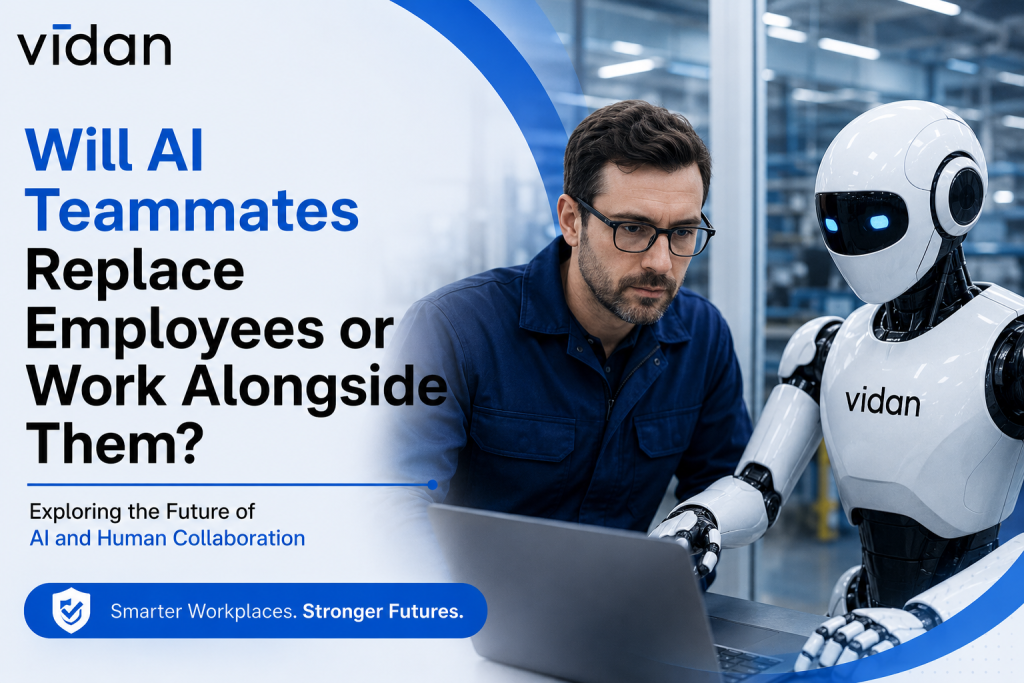
Employees are not being quietly replaced. They are getting new coworkers who never sleep, never miss a shift, and never forget a detail. AI teammates are already clocking in beside human staff, and the real question is not if they belong in the workplace. It is how far their role goes.
AI teammates can monitor activity, identify patterns, process large amounts of data, and flag events that need attention. People still provide judgment, communication, accountability, and decision-making. In physical security, this creates a simple division of work: AI watches, humans decide.
What Is an AI Teammate?
An AI teammate is an AI system that performs defined tasks alongside employees under human oversight. It can monitor information, identify unusual activity, trigger alerts, and support workflows without requiring constant human input.
Key Terms To Know
- AI Teammate: An AI system doing defined tasks alongside human workers, under human oversight.
- Agentic AI: AI that takes multi-step action toward a goal without constant prompting
- Passive Surveillance: Camera systems that only record footage for someone to review later
- Active Surveillance: AI systems that detect, flag, and respond to events as they happen
- Human in the Loop: A workflow where a person reviews or approves AI decisions before action
AI Teammates Augment Human Work
Most conversations about AI and jobs jump straight to fear. That instinct is understandable. It just does not match the data.
Adoption Is Accelerating Fast
Recent McKinsey research found that 71 percent of organizations already use generative AI in at least one business function, up from 65 percent just six months earlier. McKinsey & Company
Employees Are Driving It, Not Just Leadership
McKinsey also reported that AI usage among employees jumped from 30 percent in 2023 to 76 percent by 2025. That is a shift in daily work style, not a wave of layoffs.
But The Risk Is Real In One Specific Way
Deloitte found that leaders are 3.1 times more likely to prefer replacing employees with new AI-ready talent than retraining their existing workforce. The danger is not AI itself. It is leadership choosing replacement when retraining was possible.
For physical security specifically, the pattern is simple. AI does the watching. Humans do the deciding.
Where AI Teammates Take On More Work
Some security tasks require constant attention, fast processing, and consistent monitoring. These are areas where AI can support human teams particularly well.
Monitoring Tasks
- Watching multiple camera feeds at once without fatigue
- Catching motion at 2 a.m. when human attention naturally drops
- Covering blind spots a single operator would miss
Data Review
- Reviewing hours of footage after an incident in minutes, not hours
- Cross-referencing timestamps across cameras to rebuild a timeline
- Logging access events automatically across dozens of entry points
Pattern Detection
- Flagging loitering near restricted zones
- Catching tailgating at secure entry points
- Spotting the same repeated anomaly across different shifts
These tasks reward speed and consistency over judgment. That is exactly where AI video analytical systems outperform tired eyes on a night shift.
Where Employees Still Win
AI is fast. It is not wise. Some parts of the job still need a human brain in the loop.
-
Judgment Under Pressure
A person near a gate could be a lost delivery driver. Or a genuine threat. AI flags the anomaly. A trained officer decides what happens next.
-
De-Escalation and Communication
Security work often involves direct interaction with people. A guard may need to calm an upset visitor, communicate with a tenant, guide a contractor, or handle a sensitive situation. These interactions require context and communication skills that remain human responsibilities.
-
Accountability and Liability
Security decisions can carry legal weight. A person owns that decision. AI supports the call. It does not replace responsibility for it.
-
Relationship Building
Security teams often become the face of a facility. Tenants and visitors remember the guard who knew their name. Not a camera feed.
Why Passive Surveillance Is No Longer Enough
For decades, security meant cameras that recorded and humans who reviewed footage after something went wrong. That model is finished.
Passive surveillance is dead because it was never really security. It was documentation. A camera that only records a break-in does not stop the break-in.
What passive surveillance used to look like
- Footage sits untouched until someone requests it
- Reviews happen hours or days after the incident
- Coverage depends entirely on one operator’s attention span
- Multi-site oversight is nearly impossible to scale
What active AI surveillance looks like now
- Detection happens the instant something looks wrong
- Alerts reach a human within seconds
- Every camera gets equal, constant attention
- One operator can realistically oversee several sites
This shift is why AI video surveillance moved from a nice-to-have upgrade to a core operational requirement. The market backs this up. Analysts project the global AI in video surveillance market will grow from 6.76 billion dollars in 2025 to 8.16 billion dollars in 2026, a 20.7 percent annual growth rate. Mordor Intelligence
Meet The AI Security Guard
The phrase sounds futuristic. The function is simple.
An AI Security Guard is a system that watches continuously, detects abnormal behavior instantly, and alerts a human before an incident escalates.
What the AI Handles
AI can:
- Monitor cameras continuously
- Detect defined security events
- Filter routine activity
- Flag suspicious behavior
- Send alerts to human operators
- Support incident documentation
What the Human Handles
The security professional can:
- Review the alert
- Assess the situation
- Contact people on site
- Escalate when necessary
- Coordinate the response
- Make the final decision
A Quick Example
A warehouse runs 40 cameras with one control room operator. No person can watch 40 feeds with equal attention. An AI teammate can, and it hands off only the moments that actually need a human decision.
This change is important for security budgets this year, which also explains why Video AI Agents represent the next significant shift in video intelligence technology. The goal is not replacing headcount. It is giving existing staff a partner that catches what no person can watch alone.
Construction Sites: A Real World Proof Point
Construction is one of the clearest examples of this partnership in action. Sites are large. Often unlit at night. Staffed by rotating crews and subcontractors.
The challenge
- Every site needs eyes on it around the clock
- Hiring a guard for every location is expensive
- Crews and vendors rotate constantly, making access control harder
The AI teammate solution
- One remote operator can oversee several sites at once
- AI flags unusual movement or unauthorized access instantly
- Site managers still make every final call
Benefits of monitoring multiple construction sites remotely for better security become obvious once a company scales past a single project. This does not remove the human element. It removes the impossible math of needing eyes everywhere at once.
High Risk Industries Need This Partnership Most
Warehouses, manufacturing plants, and logistics yards carry risks beyond theft. Equipment accidents. Unauthorized access to hazardous zones. Blind spots around heavy machinery.
- Warehouses: Continuous monitoring of loading docks and restricted storage areas.
- Manufacturing floors: Instant alerts when a worker enters a zone without required safety gear.
- Logistics yards: Tracking vehicle and pedestrian movement across large, often unlit spaces.
A single safety officer cannot walk every floor at once. The rise of agentic AI in workplace safety across high-risk industries reflects that reality. AI teammates monitor continuously and escalate the moment a rule breaks. Humans still investigate, train staff, and make the safety calls.
Implementation and Integration Insights
Buying AI software does not automatically create an AI teammate. Deployment decides whether the investment pays off.
Step 1: Assess Your Existing Cameras
Start with the infrastructure already in place. Many AI video platforms can work with existing camera systems, so replacing every camera may not be necessary.
Step 2: Define Escalation Rules
Decide which events require immediate human attention. Also determine which events should simply be logged for later review. Clear rules help prevent unnecessary alerts from overwhelming operators.
Step 3: Start With a Pilot
Test the system at one site, location, or shift before expanding. A pilot allows the team to identify integration issues, adjust detection rules, and understand how operators interact with alerts.
Step 4: Train the Security Team
Employees need to understand what the system detects, why an alert appears, and what they should do next. The goal is to make AI part of the existing workflow rather than treating it as a separate system.
Step 5: Measure the Results
Review performance after deployment. Track metrics such as:
- Response time
- Alert volume
- False alarm rates
- Incidents detected
- Operator workload
- Coverage across locations
These measurements help determine whether the system is delivering useful results before expanding deployment.
How Vidan AI Supports Security Teams
Vidan AI was not designed to replace security staff. It was designed to make every existing team member more effective.
Real-time detection: Flags suspicious activity as it happens. Not hours later during a footage review.
Fewer false alarms: Smarter filtering means officers respond to real threats, not stray cats and shadows.
Remote oversight across sites: One operator can supervise multiple properties without losing situational awareness.
Clear audit trails: Every alert and response gets logged automatically, supporting compliance documentation.
Built to scale: One warehouse or a national portfolio of sites. The system grows with the business.
The goal was never fewer people on payroll. The goal is fewer blind spots, faster response times, and security teams that are not burned out from staring at forty screens.
The Bottom Line
The debate over AI teammates replacing employees misses the more accurate story. AI is not taking the badge. It is taking the burnout. Guards, operators, and safety managers are not disappearing. They are getting a partner that watches what no single person physically can, flagging only what truly needs a human decision.
Vidan AI builds exactly that kind of partnership into every deployment. If your team still relies on cameras that only record instead of respond, see what an active AI teammate looks like on your own site. Book a free demo