
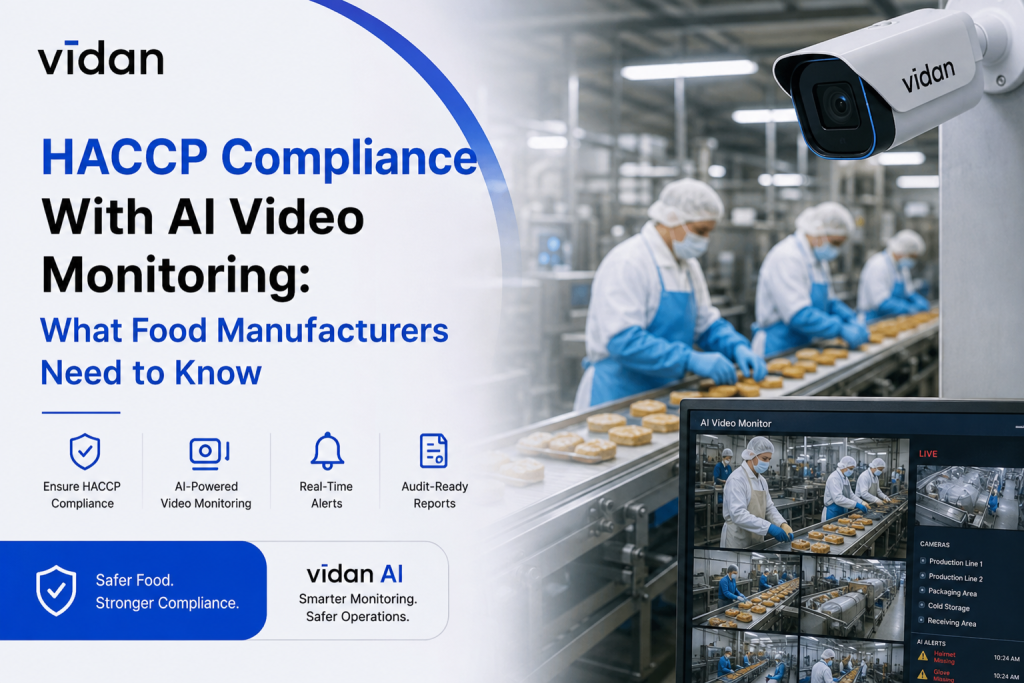
Food manufacturers can have a fully documented HACCP plan and still miss critical events on the floor. Prerequisite programs get followed, critical control points get monitored, and corrective actions get logged.
Yet many of the visual moments that matter most- a glove not changed, a door propped open, a spill left uncleaned near a filler- still depend entirely on someone noticing, remembering, and writing it down. AI video monitoring for food manufacturing closes part of that gap by giving plants a continuous, recorded layer of visual awareness that supports the human systems already in place.
Can AI Video Monitoring Support HACCP Compliance?
Yes, with limits. AI video monitoring continuously observes visual processes, detects predefined events (PPE gaps, restricted zone entry, hygiene lapses), sends real-time alerts, and generates video evidence for corrective action and documentation.
It does not replace a HACCP plan, hazard analysis, critical limit validation, lab testing, or trained personnel. It is a monitoring layer inside a food safety program, not a substitute for one. The manufacturer stays responsible for compliance regardless of what technology it runs.
Key Terms to Know
HACCP: Hazard Analysis and Critical Control Points, a preventive food safety framework that identifies and controls biological, chemical, and physical hazards.
CCP: A critical control point, a step in the process where control can be applied to prevent or eliminate a hazard.
Prerequisite programs: Baseline practices such as sanitation, pest control, and employee hygiene that support the HACCP plan.
Corrective action: The response taken when a critical limit or defined condition is not met.
Verification: Activities, other than monitoring, that confirm the HACCP plan is working as intended.
Validation: The scientific and technical evidence that a control measure, if properly implemented, can effectively control a hazard.
Computer vision: A field of AI that allows software to interpret and analyze visual information from cameras.
AI video analytics: The use of computer vision to detect specific events, objects, or behaviors within video footage.
AI video monitoring: The application of AI video analytics to continuously observe a physical environment and generate alerts based on defined conditions.
Video-based evidence: Recorded footage used to support investigation, verification, or documentation of an event.
HACCP Has a Visibility Gap
Cameras are not what most HACCP programs use to watch the floor. People are. That works when a supervisor is standing there. It breaks down between rounds.
- Manual checks cover only the moments someone is watching.
- Shift changes and low staffing periods go unrecorded.
- Reporting lags behind the actual event.
- Log quality depends on who was on shift.
- Nothing gets reviewed after the fact because there’s no footage.
Manual HACCP systems aren’t broken. Trained staff and documented procedures still carry the program. The gap is coverage, not competence. Video adds a layer that runs when no one is looking.
Where HACCP Meets AI Video Monitoring for Food Manufacturing
The connection between HACCP and video monitoring becomes clearer with a simple framework. It is the model this article returns to throughout:
HACCP Requirement
↓
Observable Behavior
↓
AI Detection
↓
Real-Time Alert
↓
Human Review
↓
Corrective Action
↓
Documentation
Each stage does specific work.
- Requirement: The underlying control, such as hand hygiene at a station.
- Behavior: The visible version of that requirement, such as a worker skipping glove use.
- Detection: A computer vision model flags the behavior against a rule.
- Alert: A responsible person is notified, not the whole plant.
- Review: A person checks the clip before deciding what it means.
- Action: Retraining, a line stop, or a product hold, if warranted.
- Documentation: Event, review, and action logged together.
This only works for requirements with a visual component. A temperature limit needs a probe. A pathogen test needs a lab. AI video monitoring for food manufacturing covers what’s visible on the floor. Nothing else.
What AI Can See on a Production Floor
Cameras cannot test for pathogens or measure internal temperature. What they can do is observe behavior, movement, and physical conditions in a defined space. Here is how that plays out across a few common HACCP-related areas.
| Area | Camera Sees | AI Detects | Goes To | Gets logged |
| PPE compliance | Presence of hairnet, gloves, smock before zone entry | Missing item against zone rule | Shift supervisor | Time, location, review outcome |
| Restricted zones | Who enters and when | Unauthorized entry or missing PPE at entry | Security or operations | Entry log paired with video |
| Hygiene steps | Hand wash or glove change before returning to line | Skipped step at a defined station | Supervisor | Clip and reviewer determination |
| Packaging behavior | Handling pattern at packaging station | Deviation from expected process | Quality team | Deviation and correction taken |
| Pest activity | Movement in monitored zones | Pattern flagged for review | Pest control contact | Time, location, response |
Every row follows the same logic: camera sees behavior, AI flags it, a person reviews it, documentation follows.
From Detection to Corrective Action
A detection is not a violation. It is a flag that something matched a defined condition and needs a person to look at it. Here is the sequence, step by step.
- Event occurs.
- Camera captures it.
- AI analyzes the behavior.
- System matches it to a defined condition.
- Alert routes to the right person.
- Person reviews the clip.
- Corrective action follows, if confirmed.
- Event is documented.
Step 6 is the one that matters. A flagged clip can be a false positive from bad lighting or a partial view. Keeping a person in the loop stops a detection from being treated as a confirmed violation.
Why Video Evidence Changes HACCP Monitoring
A log tells you an incident happened. Video shows what happened. That difference supports:
- Investigation: review the minutes before and after, not just a written note.
- Verification: spot-check footage against logged activity.
- Corrective action review: confirm the fix addressed the actual cause.
- Audits: pair footage with logs for a fuller picture.
- Training: use real examples instead of hypotheticals.
- Root cause analysis: visual context often reveals what a note misses.
Video supports these processes, but AI video monitoring for food manufacturing does not automatically satisfy every regulatory record requirement. The facility’s HACCP plan and applicable FDA or FSIS requirements determine what documentation is sufficient.
Manual Monitoring vs AI-Assisted Monitoring
| Area | Manual Approach | AI-Assisted Approach |
| Observation | Depends on staff presence and attention | Continuous, does not depend on shift coverage |
| Coverage | Limited to scheduled checks and walk-throughs | Ongoing across monitored zones |
| Alert Speed | Reporting depends on when staff notice and log the issue | Alerts can reach responsible staff shortly after detection |
| Documentation | Written logs, dependent on individual thoroughness | Video paired with logged detection and review notes |
| Event Review | Relies on memory or incomplete notes | Recorded clips available for direct review |
| After Incident Investigation | Reconstructed from interviews and partial records | Supported by footage from before and after the event |
| Human involvement | Central to every step | Still central to review and decision-making |
Manual monitoring is not being replaced here. Trained staff still perform verification, make judgment calls, and own the outcome. AI video monitoring for food manufacturing adds a continuous layer of visibility, helping teams monitor beyond scheduled checks and review events when needed.
What AI Video Monitoring Cannot Replace in a HACCP Program?
This is worth stating plainly because overstating AI’s role undermines trust rather than building it. AI video monitoring for food manufacturing does not replace:
- HACCP plan development, which requires a trained team to build and own.
- Hazard analysis, a documented process specific to each facility and product.
- Critical limit establishment, which requires scientific and regulatory grounding.
- Scientific validation of control measures.
- Food testing for pathogens, allergens, or chemical residues.
- Laboratory analysis of samples.
- Sensor-based measurements, such as internal temperature or pH.
- Human judgment, especially in ambiguous situations a model was not trained to interpret.
- Regulatory responsibility, which stays with the manufacturer regardless of technology used.
- Verification procedures required under the facility’s HACCP plan.
A microbial limit needs a lab result. An internal cook temperature needs a calibrated probe. A camera can show a worker checked a temperature. It cannot confirm the reading. This boundary is what makes the tool credible.
The Best HACCP Use Cases Start With Observable Events
Not every HACCP-related process is a good fit for AI video monitoring. A simple framework helps sort out what is.
Is it visible? → Can it be defined? → Can AI distinguish it from normal behavior? → Does detection trigger a useful response? → Can it be documented and reviewed later?
If the answer to any of these is no, video monitoring is probably the wrong tool for that specific requirement.
Good fit examples: PPE presence at a defined zone, entry into a restricted area, visible spill near a production line, a worker skipping a visible hygiene step, unusual movement suggesting pest activity.
Poor fit examples: Internal product temperature, allergen cross-contact at the molecular level, microbial contamination, chemical residue levels, pH or water activity measurements.
What This Looks Like Inside a Food Manufacturing Plant
Scenario 1: Glove Change Skipped at a Ready-to-Eat Station
Worker returns from break, resumes handling product without a visible glove change. AI flags the missed step. Supervisor gets a timestamped clip, confirms it, and addresses it directly. Event and retraining note logged together.
Scenario 2: Door Propped Open Near a Controlled Zone
Door stays open past a defined threshold. AI flags the duration. Facilities and food safety staff are both notified. Door closed, zone checked for exposure. Duration and response recorded.
Scenario 3: Unusual Movement Near Storage After Hours
Movement pattern matches pest activity near ingredients. AI flags it for pest control. Area inspected, existing pest program engaged if warranted. Clip and outcome support the pest control log.
Scenario 4: Packaging Line Deviation
Worker’s handling pattern at the packaging station deviates from baseline. AI flags the deviation. Quality reviews footage, confirms risk or clears it, and adjusts the process if needed. Logged as part of the quality record.
These examples are illustrative, not claims about guaranteed outcomes. Every facility’s actual HACCP plan, critical limits, and response procedures determine how an event like this gets handled in practice.
Building an AI HACCP Monitoring Workflow
Introducing AI video monitoring for food manufacturing works best as a deliberate process, not a single installation event.
- Identify monitoring gaps in current HACCP-related observation, especially between scheduled checks.
- Map HACCP requirements to determine which ones have a visual component.
- Identify visually observable events within those requirements specifically.
- Define detection rules clearly enough that AI can distinguish the event from normal activity.
- Determine alert recipients so notifications reach the right person, not everyone.
- Establish response procedures for what happens after an alert is reviewed.
- Connect evidence to documentation so flagged events tie into existing HACCP records.
- Test and validate the workflow before relying on it for daily operations.
- Review false alerts regularly to refine detection accuracy.
- Adjust the monitoring process as the plant’s layout, staffing, or risk profile changes.
Skipping the mapping step is the most common mistake. Cameras installed before the HACCP mapping produce generic surveillance, not a system tied to the actual food safety program.
Where AI Video Analytics Fits With Existing Systems
AI video monitoring for food manufacturing runs alongside what’s already in place: existing cameras, access control, sensors, temperature monitoring, production systems, quality systems, security systems, and human inspections. Sensors still own temperature and humidity. Video doesn’t touch that.
A facility already running AI video surveillance for security often has a head start. The camera infrastructure and network can extend into food safety use cases without a full rebuild. Actual integration depends on the vendor and the plant’s existing stack, so this is worth confirming directly.
In Conclusion
HACCP compliance still comes down to people noticing things and following through. That hasn’t changed. What’s changed is how much of that observation now runs beyond scheduled checks. AI video monitoring for food manufacturing gives food safety teams continuous eyes on what’s visible on the floor, alerts that reach the right person fast, and video evidence ready for review and documentation.
What it does is simple: it watches when no one else can, flags what matters, and hands your team a record they can actually use.
Talk to Vidan AI about mapping your floor plan and control points, and see exactly where continuous video monitoring closes your biggest HACCP gaps.