
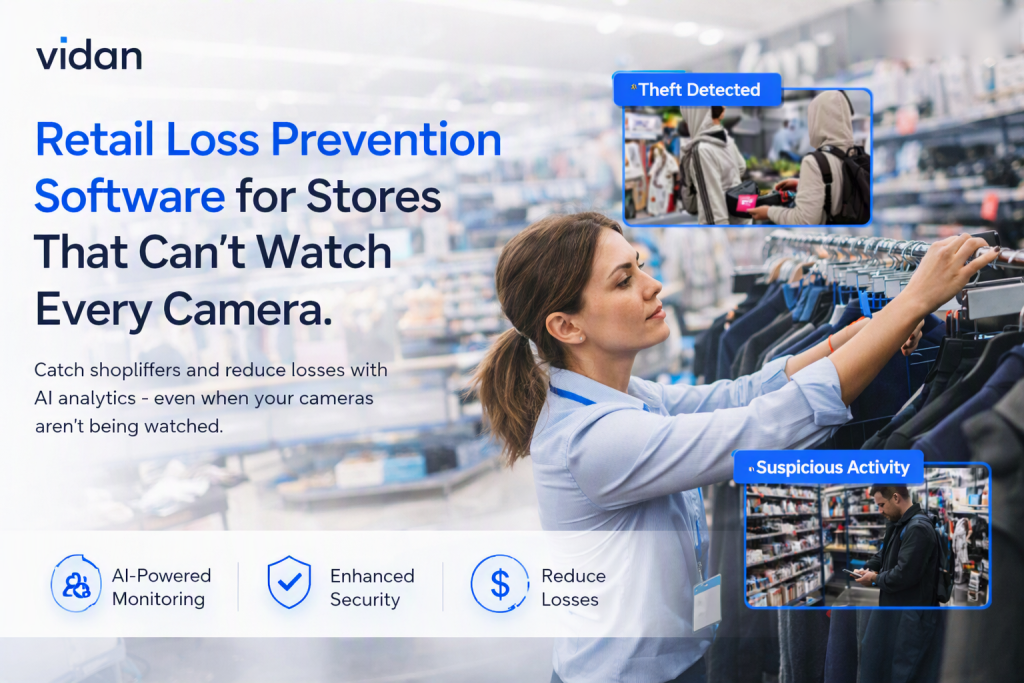
Retail loss prevention software is AI technology that watches every camera feed at once and flags theft as it happens. It replaces staff who can physically monitor only a handful of screens. Stores using it catch self-checkout theft, organized retail crime, and internal theft faster, with fewer false alarms than human review alone.
Key Terms to Know
- Retail shrink: Inventory loss from theft, error, or fraud, measured as a percentage of total sales.
- Organized retail crime (ORC): Coordinated theft by groups who resell stolen goods, often across multiple stores.
- Self-checkout theft: Loss that occurs when customers scan items incorrectly or skip scanning entirely at unmanned registers.
- Loitering detection: AI analysis that flags people who linger near merchandise or entrances longer than typical shoppers.
- Retail operation system: A unified platform that connects cameras, alerts, and analytics into one dashboard for store teams.
What Is Retail Loss Prevention Software?
Retail loss prevention software is a category of AI tools built to detect theft, fraud, and operational loss in real time. Instead of storing footage for later review, it analyzes video as it’s captured.
The software flags suspicious behavior automatically. That includes concealment, bypassed scans, and unusual movement patterns near high-value shelves. A loss prevention manager gets an alert instead of hours of footage to scrub through.
This shift matters because human attention doesn’t scale. One person can watch four or five screens closely. A single supercenter can run more than a hundred cameras. Software closes that gap.
Stop Watching Cameras
Start Catching Losses
Vidan AI monitors every register, aisle, and entrance at once, flagging theft the second it happens instead of hours later.
Why Can’t Store Staff Watch Every Camera?
Most stores run far more cameras than they run eyes.
- A typical big-box location installs 80 to 150 cameras across the sales floor, stockroom, and parking lot.
- Loss prevention teams are usually understaffed relative to camera count, especially on overnight and weekend shifts.
- Human attention drops sharply after 20 minutes of continuous screen monitoring, according to security research on vigilance decrement.
- Multi-location retailers often centralize monitoring at one office, which multiplies the camera-to-person ratio even further.
- Reviewing footage after a loss is reported takes hours and rarely leads to recovery.
The result is a blind spot that has nothing to do with staff effort. It’s a math problem. Retail loss prevention software solves it by giving every camera equal, constant attention.
How Big Is the Retail Theft Problem Right Now?
The numbers explain why retailers are moving fast on this.
According to the National Retail Federation’s 2025 Impact of Retail Theft and Violence study, 67% of retailers report that transnational organized crime groups are involved in thefts against their company. Shoplifting incidents rose 18% in 2024 compared with 2023, the same report found.
Reporting doesn’t keep pace with the problem. Sixty four percent of retailers say they report fewer than half of theft incidents to law enforcement, per the same NRF data. That means most loss never shows up in police statistics at all.
The last full dollar estimate from NRF’s National Retail Security Survey put total shrink at $112.1 billion for 2022, the final year the survey ran before being discontinued. Grocery and pharmacy chains consistently post the highest average shrink rates, since food and beverage items are frequent organized retail crime targets.
There’s a nuance worth noting. The Council on Criminal Justice found shoplifting rates across 21 US cities fell 10% in 2025, the first annual drop since 2021. Fewer incidents don’t mean less risk. It often means criminal tactics have shifted toward higher-value, harder-to-detect methods, which is exactly where AI detection earns its value.
What Does Retail Security AI Detect?
Retail security AI isn’t one feature. It’s a set of detection layers working together.
Self-Checkout Theft
Self-checkout theft happens when customers skip scans, swap barcodes, or place items in bags without ringing them up. AI at the point of sale cross-references camera footage against transaction data. A mismatch between what’s scanned and what’s placed in the bag triggers an alert before the customer leaves the lane.
Organized Retail Crime Patterns
Unlike a single shoplifter, ORC groups often work in teams, revisit the same store, and target specific product categories. AI tracks repeat visits, coordinated movement between multiple people, and rapid shelf-clearing behavior that doesn’t match typical shopping patterns.
Grocery Store Theft Prevention
Grocery store theft prevention has its own challenges. High foot traffic, dense aisles, and constant product turnover make manual monitoring especially hard. AI models trained on grocery layouts distinguish between normal browsing and concealment near high-shrink categories like meat, alcohol, and health and beauty items.
For a deeper understanding of how these detection layers differ across various theft methods, “AI Video Analytics for Retail Loss Prevention: 7 Use Cases Beyond Shoplifting“ examines each method in detail.
How Does an AI Retail Operation System Compare to Traditional Cameras?
| Factor | Traditional CCTV | AI Retail Operation System |
| Monitoring | Manual, limited screens | Every camera, continuously |
| Alert Speed | After the fact, if reviewed | Real-time, as it happens |
| Staff Workload | High, footage review required | Low, only flagged events reviewed |
| Pattern Detection | Not possible manually | Tracks repeat visits and coordination |
| Scalability | Adding cameras adds staff needs | Adding cameras adds coverage only |
The gap widens as store count grows. A single-location shop can manage with cameras alone. A multi-location chain needs a system that scales detection without scaling headcount.
How Vidan AI Builds Retail Loss Prevention Into One Platform
Vidan AI approaches this differently than a bolt-on camera add-on. The platform is built around three connected layers.
- Layer one: Unified video intelligence: Every camera feed, across every location, runs through the same AI models. There’s no separate system for self-checkout versus the sales floor versus the loading dock.
- Layer two: Real-time alerting: Loss prevention teams get flagged events as they happen, not footage to review at the end of a shift.
- Layer three: Centralized reporting: Multi-location retailers see patterns across stores, not just within one. That’s what makes organized retail crime visible, since it rarely stays confined to a single location.
For teams that want to understand the full camera-based detection setup before scaling, AI Security Cameras in USA for Retail Loss Prevention and Theft Detection takes a closer look at the hardware, camera coverage, and detection side.
THEFT ANALYTICS
Guessing Who’s a Risk vs. Knowing Who Is.
Every incident looks isolated. Repeat offenders blend into normal foot traffic.
Repeat visits, timing, and coordinated movement surface automatically.
What Results Can Retailers Expect?
Retailers who move from manual review to AI-based monitoring typically see faster incident response and fewer missed cases, since detection no longer depends on a person watching the right screen at the right moment.
The value shows up in three places:
- Faster response. Alerts arrive in seconds instead of after a loss report is filed.
- Lower false positive fatigue. AI filters routine activity, so staff only review genuine flags.
- Cross-location visibility. Patterns invisible at one store become obvious across a network.
Retailers evaluating whether they’re behind on this shift can check 8 Signs Your Business Needs Better Retail Asset Protection Technology for a quick self-assessment.
Conclusion
Watching every camera by hand was never realistic. It’s not a staffing failure. It’s a math problem, and AI is the only tool built to solve it at scale. Retail loss prevention software turns hundreds of unwatched feeds into one system that never blinks, never gets tired, and never misses a shift change.
Vidan AI builds retail loss prevention software that watches every camera so your team doesn’t have to. Talk to the team about what coverage looks like for your stores.