
Your cameras already saw the problem. Nobody was watching.
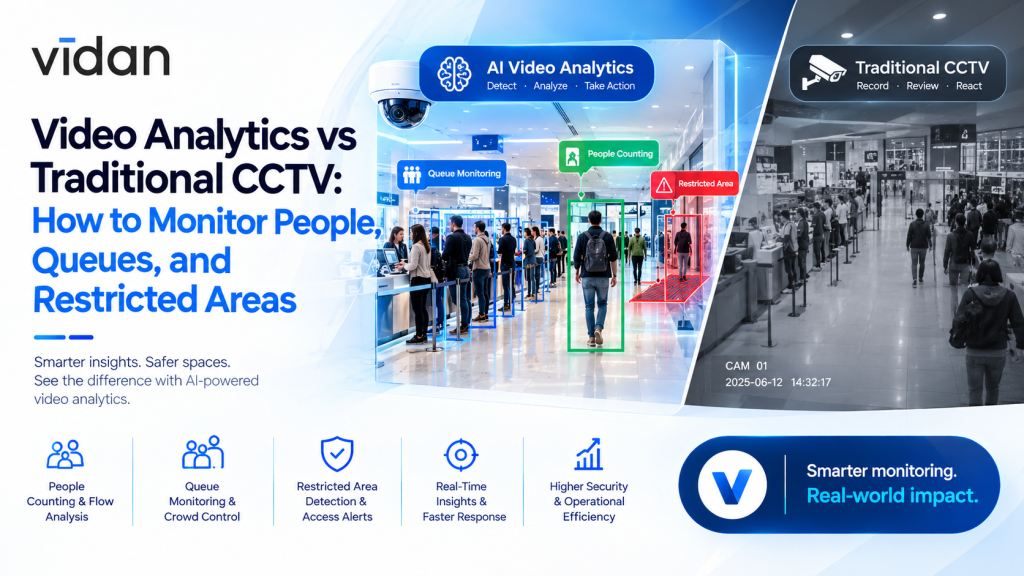
The core difference between video analytics vs traditional CCTV is who does the watching. CCTV records footage for later review. Video analytics reads every feed live, counts people, times queues, and flags anyone entering a restricted zone. At Vidan AI, we build it so cameras act instead of just record.
Quick answer: To monitor people, queues, and restricted areas with AI, connect your existing IP cameras to an analytics platform. Draw virtual zones and lines on each camera view. Set rules for counts, wait times, and access. The AI checks every frame and alerts your team the moment a rule breaks.
Key Terms to Know
- Object detection: The AI’s ability to find and label people, vehicles, or items in a video frame.
- Virtual tripwire: An invisible line on a camera view. Crossing it triggers a count or an alert.
- Occupancy: The number of people inside a space right now.
- Wait time: How long a person stays in a queue before being served.
- Edge processing: Running AI on or near the camera instead of in a distant cloud server.
- False positive: An alert fired when nothing wrong actually happened.
Video Analytics vs Traditional CCTV: What Actually Changes?
The real debate of video analytics vs traditional CCTV is not image quality. It is who does the watching.
| Question | Traditional CCTV | AI Video Analytics |
| Who spots an incident? | A human, if they happen to look | The system, instantly |
| When do you learn about it? | Hours or days later | Seconds after it starts |
| How do you find footage? | Scrub through timelines | Search by event, zone, or time |
| What data do you get? | Video files | Counts, durations, trends, alerts |
| Does it scale? | More cameras need more staff | More cameras need more rules |
Our take at Vidan AI: CCTV is not obsolete. It is the foundation. Analytics is the layer that makes that foundation pay for itself.
Adoption is climbing fast. Grand View Research estimates the global video analytics market at USD 12.71 billion in 2024. It forecasts USD 37.84 billion by 2030, a 19.5% CAGR (Grand View Research).
How Do You Monitor People Without Watching Every Screen?
People analytics uses AI to measure how many people are in a space, where they move, and how long they stay. It answers operational questions, not just security ones.
Count Who Comes and Goes
Draw a tripwire across each entrance. The AI counts entries and exits separately. Occupancy updates live, so you know when a floor nears capacity.
Dwell-Time Analysis: How Long People Stay
Dwell-time analysis tracks how long a person remains inside a defined area. Long dwell near a display suggests interest. Long dwell near a fire exit suggests a problem.
Catch Behavior That Breaks the Pattern
Once the AI learns a normal day, it notices the abnormal one. Think loitering after hours, sudden crowd formation, or a person on the floor. This is the same logic behind AI security guard solutions that cut monitoring fatigue for operators.
How Can AI Shorten Queues Before Customers Walk Out?
Queues cost money quietly. A Zynstra study found that 15% of shoppers will abandon a non-essential purchase after only one minute in line, and nearly half of those leave after 30 seconds (NACS). convenience
How does AI queue monitoring work? It counts people in a defined line zone and times how long each person waits. It alerts staff before the line becomes a problem.
Set it up in five steps:
- Map the queue. Draw a zone covering the full line, including where it overflows.
- Pick your trigger. Choose a headcount, a wait time, or both.
- Route the alert. Send it to the shift lead, not the whole team.
- Close the loop. Log when a new counter opens after each alert.
- Review weekly. Compare alert times against staffing schedules.
Rule of thumb from our deployments: Start with a wait time trigger, not a headcount. Five people at a fast counter is fine. Three people stuck for four minutes is not.
How Do You Lock Down Restricted Areas With Cameras?
Zone tracking is the practice of drawing virtual boundaries on a camera view and monitoring who enters, exits, or lingers inside them. It turns any camera into an access checkpoint.
This matters because intrusion is the core use case. Mordor Intelligence found that intrusion and perimeter protection made up 28% of the video analytics market in 2024 (Mordor Intelligence).
We recommend a three-tier zone model:
Tier 1: Open Zones
Lobbies and aisles. Monitor counts and flow only. No access alerts.
Tier 2: Controlled Zones
Stockrooms and loading bays. Alert on after-hours entry or long presence.
Tier 3: Critical Zones
Server rooms, pharmacies, chemical storage. Alert on any unapproved entry, tailgating, or missing PPE.
Hospitals use this exact model to protect wards and medication rooms. We break it down further in our guide on healthcare security solutions.
The Vidan SEE Framework: A Repeatable Rollout Model
Most analytics projects fail from rolling out too much at once. We use a three-stage loop instead.
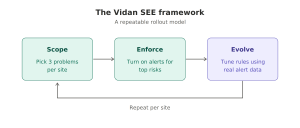
Scope. Choose three problems a camera can prove. Example: dock congestion, stockroom access, checkout wait.
Enforce. Activate alerts for those three only. Measure how many are real.
Evolve. Remove noisy rules. Add one new rule per cycle.
This keeps false positives low and trust high. Teams that trust alerts actually respond to them.
What Does This Look Like on a Real Site?
Warehouse dock
Problem: Trucks wait while staff sit idle in another bay.
Rule: Alert when a dock zone holds a vehicle for 20 minutes with no people nearby.
Result: Supervisors reassign crews in real time. See how our warehouse video surveillance system handles dock and aisle monitoring.
Retail store
Problem: Weekend lines grow before managers notice.
Rule: Alert when any checkout wait passes three minutes.
Result: A second register opens before customers give up.
Hospital ward
Problem: Visitors wander into staff-only corridors.
Rule: Alert on any entry into Tier 3 zones without a badge scan.
Result: Security responds before anyone reaches the medication room.
Factory floor
Problem: Workers step inside machine safety perimeters.
Rule: Alert when a person enters a marked zone while the machine runs.
Result: Near misses drop. We explore more cases like this in our look at AI video analytics trends in manufacturing.
How Do You Find the Right Clip in Seconds?
Alerts cover what happens next. Investigations cover what already happened.
Motion search lets you select an area of a camera view and pull only the moments something moved there. You skip eight hours of empty hallway and land on the eleven seconds that matter.
Pair it with event filters for the fastest results. Search by zone, time window, and object type together.
Where Vidan AI Fits: Built for Teams That Need Answers
We did not build Vidan to add another screen to your wall. We built it to remove screens.
You keep your cameras. Vidan connects to existing IP camera networks, so rollout starts with software, not hardware.
You define what matters. Pick the people, objects, actions, and zones. Vidan watches for exactly those.
You get alerts, not noise. Rules are tuned per site through the SEE loop, so operators trust every notification.
You scale by rule, not by headcount. Adding a new site means adding rules, not hiring a new monitoring shift.
For organizations running security and operations from one platform, our AI video surveillance software is where most teams start. It is AI video analytics software shaped around your risks, your budget, and your timeline.
What Should You Ask Before Choosing a Platform?
Use this checklist in every vendor demo:
- Does it work with our current cameras?
- Can we draw custom zones and tripwires ourselves?
- Does it support edge processing for faster alerts?
- How are false positives reduced over time?
- Can alerts route to specific people or shifts?
- Can we search footage by event, not just time?
- Who owns and stores our video data?
- Can the vendor train custom detection models for our site?
If a vendor hesitates on more than two, keep looking.
The Bottom Line
Every camera on your site already sees the queue forming, the door propped open, and the visitor who took a wrong turn. The real question in video analytics vs. traditional CCTV is whether anything responds. Analytics counts, times, guards, and alerts, so your team can focus on work only people can do.
Vidan AI turns the cameras you own into a monitoring team that never takes a break. Book a free Vidan AI demo and see your own camera feeds become live alerts in one conversation. Talk to our team today.