
Most people assume trespassing means sneaking into a fenced property at midnight. But the law sees it very differently. You can walk onto someone’s land during daylight with no criminal intent and still face arrest, fines, or civil liability. That gap between public assumption and legal reality is exactly where costly mistakes happen.
Each year, thousands of people face legal action over incidents they never considered serious. Property owners lose cases because they failed to post proper warnings. Security teams make illegal detentions. Tenants get confused about who can legally enter their homes. All of it traces back to one misunderstood concept: the trespass definition law that holds up in court.
This blog breaks down everything you need to know about trespassing: what it means legally, how it is charged, what defenses exist, and how to protect your property before a problem ever starts.
Key Takeaways
- The legal definition of trespass covers land, buildings, and even digital property
- Trespassing can be both a civil offense and a criminal charge
- Trespassing vs breaking and entering carries different penalties and legal weight
- “No trespassing” notices have specific legal requirements to be enforceable
- AI-powered security systems are now the most effective deterrent against trespass incidents
The Legal Definition That Actually Holds Up in Court
At its core, the definition of trespass in law is this: intentional, unauthorized entry onto another person’s property. Three words carry all the legal weight here: intentional, unauthorized, and property.
Under the legal trespass definition, property is broader than most people expect. It covers land, buildings, vehicles, airspace above a parcel, and in some jurisdictions, digital systems and computer networks. Courts have consistently ruled that you do not need a fence or a lock to establish a boundary. Posted signs, verbal warnings, and even implied context can be enough.
Intent is the most contested element in any trespass case. Criminal trespassing in law generally requires that the person knew they were entering unauthorized space. Civil trespass does not carry that same requirement. Even accidental entry onto another’s property can trigger civil liability for any resulting damage, which surprises most people when they first encounter it.
What “No Trespassing” Actually Means Under the Law
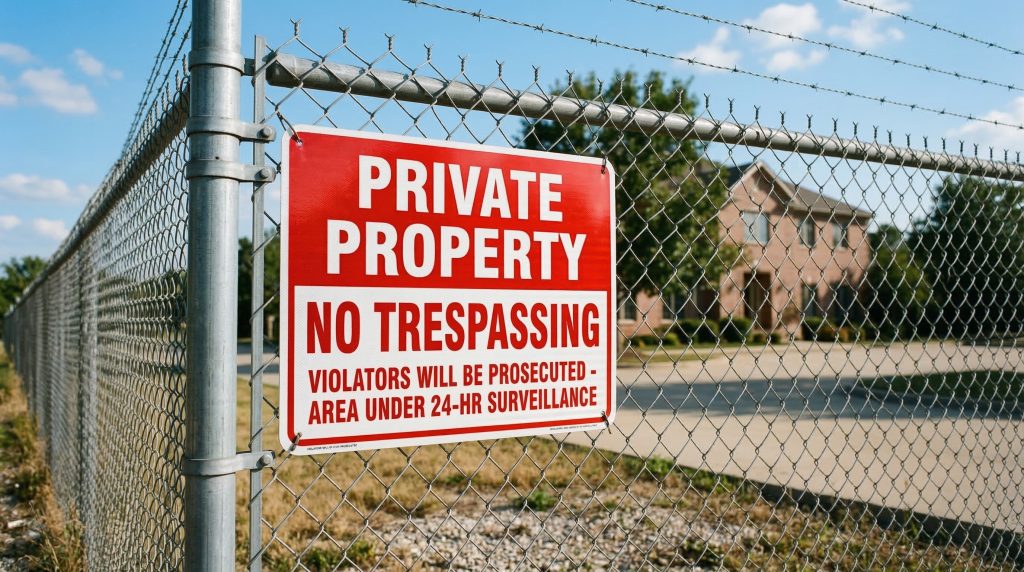
When people ask what no trespassing means in a legal sense, the answer is precise. A valid no trespassing notice must clearly communicate that entry is prohibited. Verbal notices, written signs, fencing, or purple paint markings (recognized in many US states) can all establish this legal boundary.
If a person enters AFTER receiving or seeing a no trespassing notice, the court effectively presumes criminal intent. This is why property owners should always document any warnings given to recurring trespassers; verbally, in writing, or both.
Trespassing vs Breaking and Entering: Where the Line Falls
These two terms are used interchangeably, but they represent distinct crimes with distinct legal consequences. Confusing them is a mistake that both defendants and property owners frequently make.
Trespassing is unauthorized entry onto property without force or deception. It does not require that a barrier be overcome or that any damage occur. It is often charged as a misdemeanor for a first offense and can exist as a civil matter without any criminal charge at all.
Breaking and entering requires overcoming a physical barrier, a lock, a door, a window, or a gate using force, tools, or deception. It is almost always a criminal charge and often carries felony weight, especially when paired with intent to commit another crime inside the property.
In the context of trespassing vs breaking and entering, the presence of force or criminal intent legally distinguishes the two. Walking through an unlocked gate without permission is trespassing. Cutting a padlock to open that gate is breaking and entering. The latter carries burglary-adjacent charges that dramatically increase penalties and sentencing exposure.
Both scenarios, however, share a common vulnerability: unsecured or poorly monitored access points. This is where proactive security measures, rather than reactive legal action, offer the real solution. For residential buildings, reviewing apartment security to ensure future building safety offers a comprehensive look at modern access control strategies that prevent incidents before they become legal problems.
Types of Trespassing You Probably Did Not Know Existed
The definition of trespassing is broader than most people expect. Courts recognize several distinct categories, and each carries its own legal nuances, defenses, and liability exposure.
Intentional Trespass is the most recognized form. The person deliberately enters property knowing they lack permission to do so. This is the clearest case for criminal prosecution and the easiest for a property owner to prove in court.
Negligent Trespass is caused by carelessness rather than deliberate action. A contractor who builds a fence six inches over a property line is a negligent trespasser. Civil liability applies even in the absence of criminal intent, and damages can still be significant.
Continuing Trespass occurs when a trespassing condition persists over time, such as a structure encroaching on a neighbor’s land. Every day the condition continues creates a new trespass event. This compounds liability rapidly and is often how small boundary disputes become major legal cases.
Trespass to Chattels applies when someone interferes with personal property, not land. Courts have applied this doctrine to unauthorized access of computer systems, making digital trespass a fast-growing area of law as businesses increasingly rely on cloud-based infrastructure.
Aerial and Subsurface Trespass reflects that property rights extend above and below the surface. Drones flying too low over private land and underground pipelines installed without proper easements both constitute trespass in many jurisdictions.
Defenses Against Trespass Charges That Courts Actually Recognize
Not every trespass defined in law results in a conviction. Several legal defenses exist, and a skilled attorney will evaluate each one based on the specific facts of the case.
Express or Implied Permission is the most common defense. If the property owner, tenant, or authorized agent gave permission to enter, verbally, in writing, or by conduct, no trespass occurred. Implied permission applies when a business holds itself open to the public during operating hours.
Necessity applies when a person enters property to prevent serious harm to themselves or others. Emergency responders, individuals fleeing danger, and people seeking shelter from life-threatening conditions can invoke this defense successfully.
Privilege covers law enforcement officers with valid warrants, utility workers with established easements, and certain government inspectors who have legal authority to access property. Their entry does not constitute trespass regardless of the property owner’s objection.
Lack of Notice is particularly relevant when no trespassing warnings were posted and the property boundary was neither obvious nor fenced. A defendant can argue they had no reasonable way of knowing entry was prohibited. This is precisely why proper signage is so important from the property owner’s perspective; it closes this defense entirely.
Why Most Trespass Incidents Happen After Dark
Statistically, most trespassing incidents occur at night or in low-light conditions. Trespassers exploit darkness. Traditional security measures like perimeter fencing and standard CCTV cameras fail in these conditions without proper illumination and detection technology.
Modern infrared and thermal imaging cameras have fundamentally changed what is possible for night security. Understanding how night vision cameras work gives property managers a technical grounding in what these tools can and cannot detect, and why proper camera positioning is critical for collecting footage that actually holds up as legal evidence.
Video evidence recorded during a trespass incident dramatically strengthens a property owner’s legal case, both for criminal prosecution and civil damages. Without it, most cases become a he-said-she-said situation that rarely results in a conviction, even when the property owner is clearly in the right.
How Vidan AI Stops Trespassing Before It Happens
Most property owners only learn about a trespass AFTER it happened. By then, the damage is done; literally and legally. Vidan AI changes that equation entirely.
Vidan AI is an AI-powered video intelligence platform built specifically for real-time property security. It does not simply record footage and store it. It actively analyzes live camera feeds, identifies unauthorized individuals in restricted zones, and triggers instant alerts before a trespasser has the opportunity to cause damage, injury, or liability.
Vidan AI works across single properties and multi-site portfolios. It integrates with night vision and low-light camera systems for 24/7 perimeter monitoring. It can trigger automated verbal deterrents and no-trespassing alerts in real time. And it scales to match the complexity of any security operation, from a single residential building to dozens of active commercial sites.
The Bottom Line on Trespassing: Know It, Post It, Prove It
The trespassing definition is clear in law but murky in everyday life. Most incidents begin with ignorance rather than criminal intent. The legal system, however, does not make that distinction as generously as people hope.
Vidan AI exists precisely for this purpose. It identifies unauthorized access in real time, alerts your team immediately, and builds an irrefutable evidentiary record without requiring human oversight at every moment.
Do not wait until a trespassing incident forces you into court. Schedule a free Vidan AI demo today and see exactly how AI-powered surveillance transforms your property security from reactive to unstoppable.