
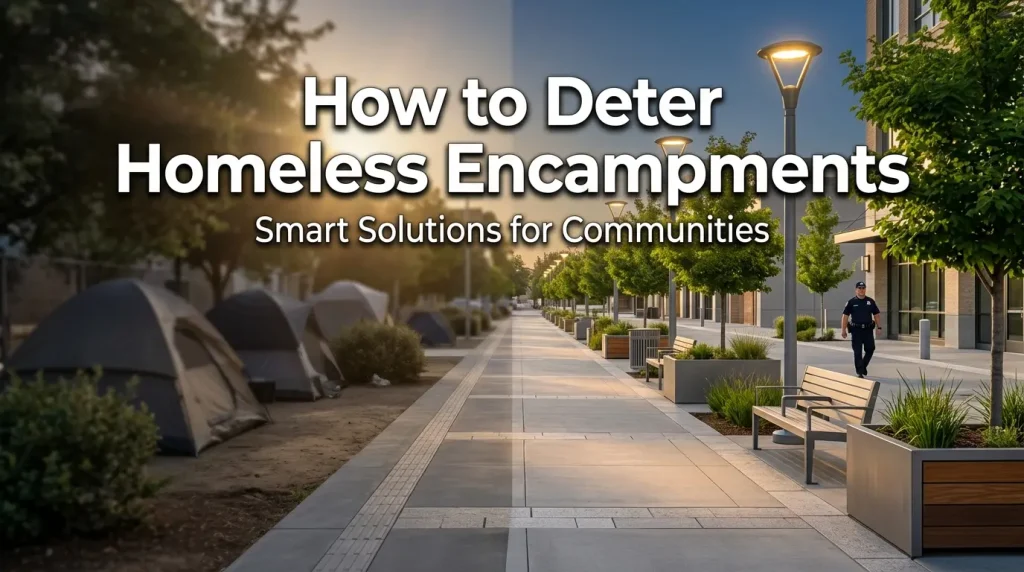
A park, a parking lot, a storefront. One morning, it looks fine. The next? A full encampment has appeared overnight. Communities across the country face this growing challenge. Business owners feel powerless. Residents feel unsafe. Local governments feel overwhelmed. Traditional enforcement alone is not working anymore.
That is where a new approach comes in. Creative ways to get rid of homeless encampments are replacing outdated tactics. These methods combine smart technology, community action, and human dignity.
This is not just about clearing spaces. It is about creating sustainable change.
What You Will Learn in This Blog
- Why traditional deterrence methods are failing communities
- Physical and environmental changes that prevent encampments
- How AI-powered surveillance changes the equation
- What Vidan AI offers communities facing this crisis
- Real outreach strategies that pair with deterrence
- FAQs answered for fast, clear information
Why Old Deterrence Tactics Are Falling Short
Most communities default to two responses: call the police or install barriers. Both have serious limits. Police calls are reactive. They move people, not problems. Barriers like spikes or cages draw public backlash. They also miss the bigger picture entirely. Encampments do not form randomly. They appear in spaces with low foot traffic, poor lighting, and limited visibility. They grow where no one is watching.
That visibility gap is the core problem. Without real-time awareness, communities respond too late. A small gather becomes a large camp before anyone acts. Communities that understand loitering and prevention methods act before issues escalate. They use a combination of physical design, community programs, and smart technology. The most effective deterrence is a layered approach. No single tactic works alone.
Redesign the Space Before It Becomes a Problem
The built environment sends powerful signals. Open, unwatched spaces invite overnight stays. Active, well-maintained spaces do not.
CPTED Principles in Action
Crime Prevention Through Environmental Design (CPTED) is the framework here. It uses physical space to reduce unwanted activity naturally.
Key CPTED principles for encampment deterrence include:
- Natural surveillance: Design spaces so activity is visible from the street. Open sightlines matter.
- Lighting: Well-lit spaces feel risky to those seeking anonymity. Motion-activated lights add an extra layer.
- Territory: Clear signage, maintained landscaping, and defined boundaries signal ownership. Uncared-for spaces feel abandoned.
Activity generators: Cafes, events, and foot traffic push away unwanted activity organically.
Practical Physical Changes
Curved benches prevent lying down without looking hostile. Landscaping with shrubs creates natural barriers. Scheduled maintenance signals that the space is monitored.
None of these changes requires confrontation. They reshape behavior through design.
Smart Technology Is Changing What’s Possible
Standard cameras are reactive tools. They capture what has already happened. Smart cameras change the dynamic entirely.
Mobile security cameras are particularly effective for encampment deterrence. They can be deployed quickly in problem areas without permanent installation. They act as visible deterrents and real-time monitoring tools simultaneously.
Visible camera presence alone reduces unwanted activity. People avoid spaces where they know they are being observed. But the real power comes from what happens after footage is captured. AI-powered systems analyze footage in real time. They flag activity before it escalates. They alert teams without requiring someone to stare at a screen.
AI video analytics transform camera footage into actionable intelligence. Instead of reviewing hours of video after an incident, systems detect patterns as they happen.
How Vidan AI Approaches This Differently
At Vidan AI, we believe deterrence should be smart, humane, and effective. Our platform combines advanced surveillance technology with real-time analytics built specifically for community safety scenarios.
Our systems do not just watch. They analyze, alert, and empower teams to respond appropriately.
The Vidan AI Difference for Encampment Deterrence
Many technology vendors sell cameras. Vidan AI delivers outcomes. Our team understands how encampments form, where they tend to migrate, and what monitoring patterns are most effective for prevention.
We work with property managers, municipalities, and business improvement districts to build customized deterrence strategies. Technology is the backbone. Strategy is the differentiator.
Communities using Vidan AI report faster response times and measurable reductions in repeat encampments at monitored sites.
Pairing Technology With Human Outreach
Smart deterrence moves people away from specific locations. It does not solve homelessness. Communities that pair technology with outreach programs see better long-term outcomes.
Outreach teams can use the same data that security teams receive. When a camera flags a gathering forming at 11 PM, an outreach worker can respond alongside security.
This dual response changes the interaction. Instead of enforcement only, people experiencing homelessness receive both a clear message about the space and information about available services.
What Effective Outreach Coordination Looks Like
Shared alert systems allow outreach and security to receive the same real-time notifications. Response protocols define who goes first and under what circumstances. Service referrals give outreach workers current shelter and service availability data.
Retail environments in particular benefit from this paired model. A retail center that manages encampments through deterrence technology and coordinated outreach maintains a safe environment while minimizing confrontational incidents.
The goal is redirection, not elimination.
Smart Cities Are Already Doing This
Forward-thinking municipalities are embedding encampment deterrence into broader public safety strategies. The concept of the smart city puts connected technology at the center of urban management.
In smart city frameworks, cameras, sensors, and AI platforms work together. Public spaces are monitored continuously. Anomalies are flagged automatically. Responses are coordinated across departments.
This is not surveillance for its own sake. It is data-driven governance. Cities using these frameworks respond faster, waste fewer resources, and create more consistent outcomes.
Night Vision Cameras Work for Round-the-Clock Coverage
Encampments typically form at night. Standard cameras lose effectiveness in low light. Understanding how night vision cameras work matters for any deterrence strategy.
Modern night vision technology uses infrared illumination to produce clear images in complete darkness. AI systems analyze this footage just as effectively as daylight images. This closes the coverage gap that most communities currently have. The hours when spaces are most vulnerable become the hours when monitoring is most effective.
A Community Action Checklist
- Assess your current situation
Walk through your problem areas at different times of day. Identify patterns. Note lighting gaps, visibility issues, and access points.
- Audit your current camera infrastructure
Are cameras positioned to see what matters? Are they monitored in real time? Do they function in low-light conditions?
- Map your response protocols
When an encampment is detected, who is notified? How fast can someone respond? What is the escalation path?
- Connect technology to outreach
Identify local service organizations willing to coordinate responses. Build a contact list. Establish shared notification protocols.
- Measure results
Track encampment locations over time. Note whether deterred encampments migrate or dissolve. Adjust strategy based on data.
Conclusion
Homelessness is a complex problem. Encampments are a visible symptom. Communities that wait for simple solutions wait forever. The most effective approach combines environmental design, smart technology, and coordinated human response. Creative ways to get rid of homeless encampments are not shortcuts. They are strategic, layered, and humane.
Vidan AI exists at the center of this approach. Our platform gives communities the visibility, speed, and intelligence to respond before situations become crises. Your spaces deserve protection. Your community deserves solutions that work.
Ready to protect your community with smarter surveillance? Try Vidan AI today and discover how our AI-powered platform creates safer, encampment-free spaces built to last.