
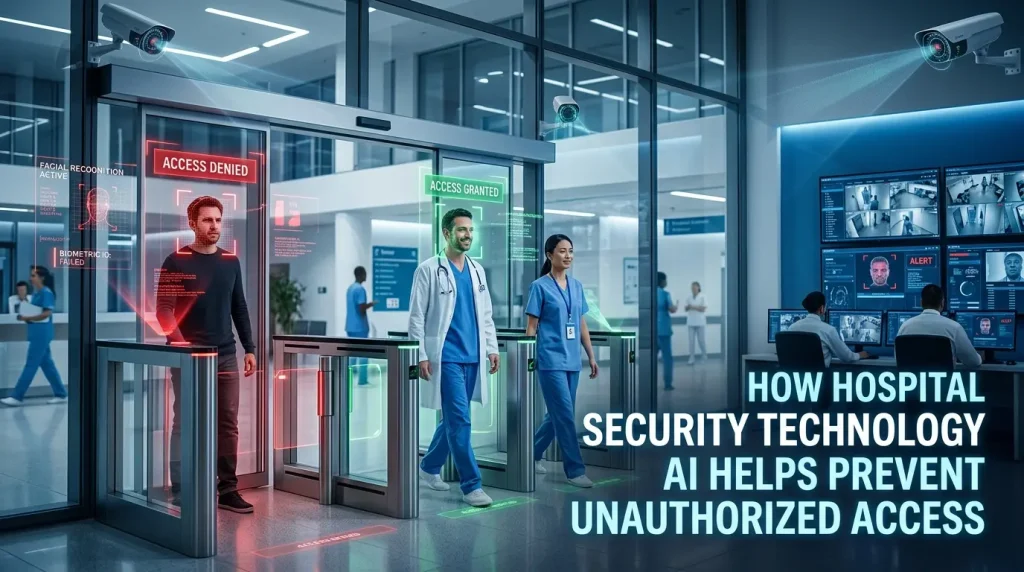
Every 30 seconds, a hospital faces a security breach attempt. Patients, staff, and sensitive data sit exposed in one of the world’s most vulnerable environments. Traditional lock-and-key systems were built for a different era. They were not built for today’s hospitals.
Hospital security technology AI has changed the equation entirely. It does not just respond to threats. It predicts them, flags them, and stops them before harm occurs.
At Vidan AI, we work with healthcare facilities that have moved beyond outdated security models. This blog breaks down exactly how AI is rewriting hospital security from the ground up.
What You Will Learn in This Blog
- Why traditional hospital security keeps failing
- How AI detects unauthorized access in real time
- The specific technologies protecting hospitals today
- How Vidan AI approaches healthcare security
- Real scenarios where AI security makes the difference
The Broken State of Hospital Security Today
Hospitals are not like office buildings. They operate 24 hours. Hundreds of people move through their doors every hour. Staff, visitors, vendors, and patients all share the same corridors.
That creates a massive security gap.
Traditional systems rely on human observation. Guards cannot watch every hallway. Badge readers miss tailgating. Security cameras record events but rarely prevent them.
The result? Unauthorized individuals reach restricted areas. Drug storage rooms get compromised. Patient records get accessed by the wrong people. Vulnerable patients face real danger.
This is the problem AI healthcare security was designed to solve.
How AI Detects Unauthorized Access in Real Time
Behavioral Pattern Recognition
AI does not just see a person. It reads behavior. When someone moves differently from normal foot traffic, the system flags it instantly. Loitering near a restricted door triggers an alert. Entering through an exit generates an immediate notification. This is not motion detection. This is intelligent analysis.
Facial Recognition and Access Verification
Modern healthcare security solutions, AI platforms match faces against authorized personnel databases. If an unrecognized face attempts entry into a sensitive zone, access is denied automatically.
The system also detects badge sharing. One badge, two people entering? The AI catches it.
Tailgating and Piggybacking Detection
This is one of the most common unauthorized access methods in hospitals.
Someone holds a door open. An unauthorized person slips through. Legacy systems miss it completely. AI-powered video analytics track individual body counts at every entry point. Two people entering on one badge scan triggers an immediate alert.
Just as AI Video analytics has transformed how construction and warehouse environments manage access, the same intelligence now protects hospital floors.
The Technologies Powering AI Hospital Security
Smart Camera Networks with Deep Learning
These are not your grandfather’s CCTV cameras.
Deep learning cameras analyze video frames continuously. They understand context. A person standing still near a pharmacy for eight minutes reads differently than a nurse checking inventory.
Security in hospitals, AI software processes this context automatically. No human needs to interpret it.
Integrated Access Control with AI Decision Making
Traditional access control systems are binary. Badge works, or it does not.
AI-integrated access control layers biometrics, behavior, and time patterns on top. An authorized nurse trying to access the oncology ward at 3 AM on their day off? The system asks for additional verification.
Real Time Alert Systems
Speed is everything in a security incident.
AI systems push alerts to security staff within seconds. Not minutes. Seconds. They include a snapshot, location, and threat level. Guards respond faster with better information.
Protecting More Than Just Doors: A Multi-Zone Hospital Security Model
Most hospitals focus security on the front entrance. That is a critical mistake.
Hospitals require layered zone protection:
Zone 1: Public Areas
Lobbies, waiting rooms, and cafeterias need behavioral monitoring. Loitering patterns and unusual movement trigger soft alerts.
Zone 2: Semi-Restricted Areas
Staff corridors and supply rooms require a badge plus behavioral verification. AI tracks who enters and how long they stay.
Zone 3: High-Security Zones
ICUs, pharmacies, and neonatal units demand the highest protection. Multi-factor biometric access with continuous AI monitoring runs at all times.
What Vidan AI Brings to Hospital Security
Vidan AI is not a generic surveillance vendor. We build intelligent security ecosystems designed for complex, high-traffic environments.
Here is what makes our approach different:
Our platform processes video feeds from every camera simultaneously. It does not sample. It does not skip frames. Every second of footage gets analyzed in real time.
We integrate with existing hospital access control infrastructure. There is no rip-and-replace. Our AI layers on top of what you already have.
Our alert system delivers context, not just notifications. When your security team receives an alert, they know the location, the threat level, and the recommended response before they even move. We have also worked with facilities managing complex key and access systems.
The Real Cost of Inadequate Hospital Security
Let these numbers land:
- Hospital drug diversion costs the US healthcare system over $72 billion annually
- Patient abductions, though rare, carry irreversible consequences
- HIPAA violations from unauthorized access average $1.5 million per breach in fines
AI healthcare security is not an expense. It is risk reduction at scale.
Hospitals Already Winning with AI Security
Facilities that have adopted hospital security technology AI report measurable outcomes:
Unauthorized access incidents drop significantly within the first three months. Staff feel safer. Response times to security alerts shrink from minutes to seconds. Compliance documentation improves because AI logs everything with timestamps.
The shift from reactive to proactive security is not theoretical. It is happening right now in hospitals, choosing intelligence over observation.
A Smarter Hospital Is a Safer Hospital
The hospitals that protect their patients best are not the ones with the most guards. They are the ones with the smartest systems. Hospital security technology AI gives healthcare facilities the ability to see everything, analyze everything, and act before a threat becomes a tragedy. From behavioral analysis to real-time alerts to layered zone protection, AI security is the standard that modern hospitals cannot afford to skip.
At Vidan AI, we believe every patient deserves a protected environment. Every staff member deserves to work without fear. Every hospital deserves security that works as hard as the people inside it.
Ready to secure your facility the right way? Contact Vidan AI today and discover what intelligent hospital security looks like in practice.