
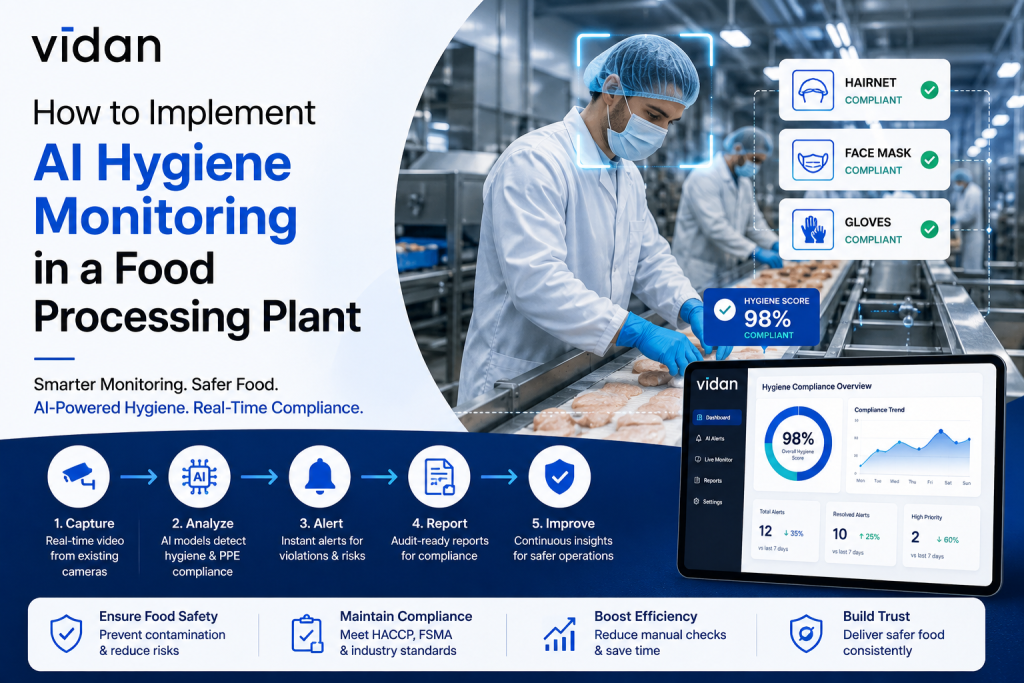
To implement AI hygiene monitoring, install computer vision cameras at critical control points, connect them to detection software that tracks handwashing and PPE use, and route real-time alerts to supervisors. A phased rollout across two or three priority zones takes four to eight weeks. Full facility coverage typically follows within three to six months.
Contamination does not wait for your next audit. It happens between inspections, on the night shift, in the corner nobody checks twice. AI hygiene monitoring fixes that gap. It watches every shift, every station, every second, and flags risks before they become recalls.
Key Takeaways
- AI hygiene monitoring uses computer vision to track handwashing, glove changes, and PPE compliance in real time.
- Implementation follows eight clear steps, from mapping control points to scaling facility-wide
- Costs depend on camera count, zone coverage, and integration needs, not plant size alone.
- Digital logs replace paper audits, cutting HACCP documentation time significantly
- Vidan AI builds hygiene monitoring specifically for food plants chasing food processing hygiene compliance
What AI Hygiene Monitoring Does
AI hygiene monitoring uses cameras and software to continuously detect hygiene behavior, not just once a quarter. It flags missed handwashing, skipped glove changes, and unauthorized access to the clean zone as they occur.
The core difference from a manual audit is coverage and speed.
| Factor | Manual Audit | AI Hygiene Monitoring |
| Frequency | Weekly or monthly | Continuous, 24/7 |
| Coverage | One inspector, limited zones | Every camera-covered zone |
| Alert speed | Hours or days later | Seconds |
| Consistency | Varies by inspector | Same standard every time |
| Documentation | Paper or spreadsheet | Automatic digital log |
| Cost over time | Rises with labor hours | Flat after installation |
Plants already running AI video surveillance for security often extend that same camera network to hygiene tracking, cutting hardware costs significantly.
🍽️ Restaurant Video Surveillance
Protect Your Restaurant With Smarter AI Surveillance
Monitor restaurant operations with AI-powered video surveillance, real-time alerts, and intelligent monitoring that helps improve security, safety, and operational visibility.
Why 2026 Is the Tipping Point
Regulatory pressure and labor shortages are pushing plants toward automated hygiene tracking now. The FDA’s New Era of Smarter Food Safety initiative expects digital, traceable records instead of paper logs.
Three numbers explain the urgency.
- The CDC estimates roughly 48 million Americans get sick from foodborne illness annually.
- A single contamination recall can cost a manufacturer millions in lost product and legal exposure.
- Fewer trained supervisors are available per shift, leaving hygiene gaps unwatched for longer stretches.
Plants adopting automated hygiene monitoring now are avoiding a scramble once tighter digital traceability rules take full effect.
The Five Components That Make a System Work
A working system needs cameras, edge processors, detection software, dashboards, and an integration layer. Skip any one, and the system either misses violations or drowns your team in unusable data.
1. Computer Vision Cameras
Positioned at each control point, these capture continuous footage and identify specific actions like handwash duration or glove changes.
2. Edge Processing Units
These analyze footage on-site instead of sending it to a remote server first. This keeps alert speed under a few seconds.
3. Detection Software
This is the layer that interprets footage. Computer vision food hygiene models are trained to recognize food-specific behaviors, not just general motion.
4. Alert and Dashboard Tools
Alerts go to the right person immediately. Dashboards turn raw footage into compliance reports your team can actually scan.
5. Integration Layer
This connects camera data to your existing HACCP records and quality management software, so nothing lives in a separate silo.
Step-by-Step Implementation
Implementation follows eight steps, starting with mapping and ending with full-scale monitoring.
- Map critical control points: Identify where contamination risk is highest across your floor plan.
- Select two or three priority zones for phase one: Do not attempt full coverage on day one.
- Install cameras and sensors: Position them for clear sightlines that do not disrupt workflow.
- Configure detection thresholds: Set rules for handwash duration, PPE checks, and restricted access.
- Train floor staff: Explain the system protects workers and product, not just the company.
- Run a thirty-to sixty-day pilot: Adjust false positive rates during this window.
- Scale to full facility coverage: Expand once the pilot proves stable and accurate.
- Review data monthly: Use trend reports to guide retraining and process changes.
Typical Rollout Timeline
| Phase | Duration | Focus |
| Planning and mapping | 1 to 2 weeks | Control point identification |
| Installation | 2 to 3 weeks | Camera and sensor setup |
| Pilot testing | 4 to 8 weeks | Calibration, staff feedback |
| Full scaling | 4 to 12 weeks | Facility-wide coverage |
Where Cameras Need to Watch
Coverage should target four zones: entry points, packaging lines, raw material handling, and break room transitions.
- Entry and Exit Points: This is where handwashing and gowning compliance either happens or gets skipped entirely.
- Packaging Lines: Product exposure peaks here, right before it reaches consumers, making violations here the costliest.
- Raw Material Handling: Cross-contamination risk spikes when raw ingredients meet processing equipment or shared surfaces.
- Break Room Transitions: Workers moving between break areas and the floor frequently skip re-sanitizing before returning to stations.
A focused food factory hygiene monitoring strategy covers these four zones before expanding anywhere else. Random camera placement wastes budget and misses the risks that matter most.
What It Actually Costs
Cost depends on camera count, zone complexity, and integration needs, not overall plant size.
Three cost drivers matter most.
- Hardware: Camera and sensor count scales with the number of control points, not square footage
- Software licensing: Detection and dashboard tools are typically priced per zone or per camera feed
- Integration: Connecting to existing HACCP or QMS software adds setup time but rarely adds ongoing cost
A small plant monitoring three zones spends far less than a multi-line facility covering the whole floor. Vidan AI structures pricing based on the actual zones monitored, so plants are not paying for coverage they do not need.
Real Results From Real Plants
A poultry processor cut glove compliance violations significantly within two months of deploying tracking at packaging stations.
A dairy facility caught a night shift handwashing lapse through an automated alert, before it reached the product line.
A frozen food manufacturer merged hygiene monitoring with its existing food and beverage safety program, combining three separate dashboards into one.
Common Mistakes That Slow Rollouts
Most delays come from three avoidable mistakes: skipping the pilot phase, ignoring staff communication, and over-monitoring low-risk zones.
- Skipping the pilot. Jumping straight to full coverage means false positives pile up before calibration happens.
- Poor staff communication. Workers assume cameras mean surveillance for punishment, which breeds resistance.
- Monitoring low-risk zones first. Coverage spread too thin delays value from the zones that need it most.
Response speed also matters once an alert fires. Findings referenced in how artificial intelligence security systems improve security response times show automated alerts cut reaction time significantly compared to manual checks, a pattern that holds for hygiene incidents too.
Compliance Without the Paperwork
Digital hygiene logs replace paper audits and cut HACCP documentation time significantly.
Every alert, response, and correction is timestamped automatically. Auditors get a searchable record instead of a stack of binders.
AI sanitation compliance also supports third-party certifications like SQF and BRC, which increasingly expect digital traceability over manual sign-off sheets. For a deeper look at how this connects to formal frameworks, see HACCP Compliance With AI Video Monitoring: What Food Manufacturers Need to Know.
How Vidan AI Builds This Differently
Vidan AI trains detection models specifically on food plant behaviors, not generic motion detection.
Three things separate the approach.
- Food-specific training data. The system distinguishes a glove adjustment from a skipped handwash, reducing false alerts.
- Direct alert routing. Notifications reach the exact supervisor responsible for that zone, not a shared inbox
- Flexible scaling. Coverage grows from one production line to a multi-site operation without rebuilding the system.
This same engineering standard is part of why manufacturers are also exploring Why Organizations Are Investing in AI Security Guard Technology in 2026, since hygiene and physical security increasingly share camera infrastructure. Vidan AI also builds for Vision 2030-aligned facilities across Saudi Arabia, where food safety modernization is a regulatory priority.
The Bottom Line
AI hygiene monitoring is no longer optional for plants chasing consistent compliance. Start with your highest risk zone. Prove the value in sixty days. Scale from there. Plants that move now spend 2026 preventing incidents. Plants that wait spend it explaining them.
Ready to see what continuous hygiene monitoring looks like on your floor? Talk to Vidan AI before your next audit finds a gap you already suspected was there.