
A license plate reader can tell you a car left the lot. It cannot tell you why, who was behind the wheel, or whether that exit should have tripped an alarm three minutes earlier. That gap is where dealerships lose inventory every night. Closing it is exactly what AI video surveillance for auto dealerships was built to do.
Plate recognition was the first step in smarter lot security. It is not the last one. A modern system needs to understand behavior, not just read characters off a bumper.
Key Takeaways
- License plate recognition only logs entries and exits. It does not judge intent or flag suspicious behavior in real time.
- AI video surveillance analyzes movement patterns across open lots, service bays, and perimeter fencing simultaneously.
- Dealerships lose inventory to organized theft rings, employee-assisted fraud, and after-hours break-ins, not just opportunistic joyriders.
- Vidan AI builds detection models around dealership-specific risks: loitering near high-value inventory, unauthorized lot access, and service bay tampering.
- A layered approach, cameras plus access control plus lighting, cuts losses more than any single tool on its own.
What Is AI Video Surveillance for Auto Dealerships?
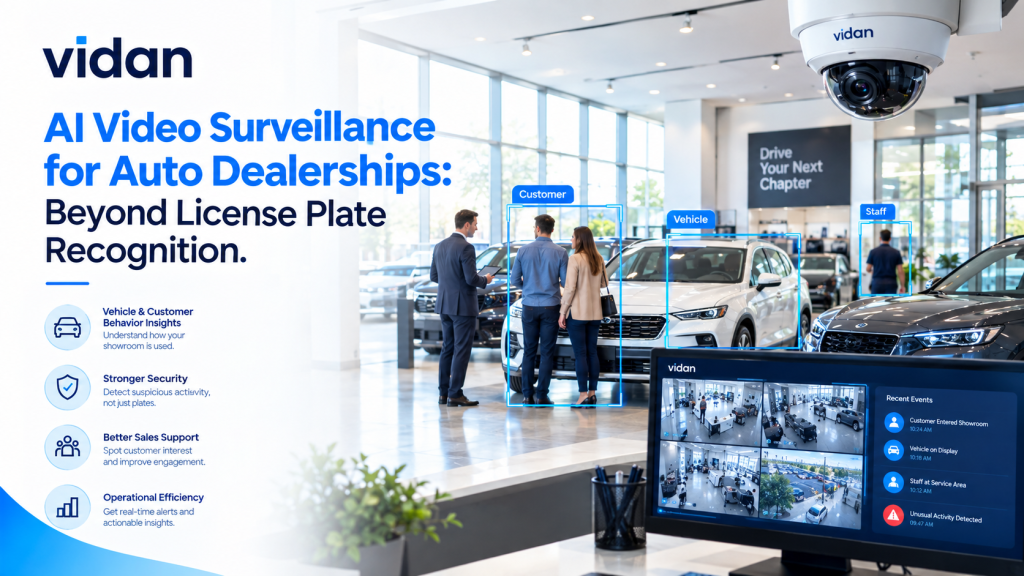
AI video surveillance for auto dealerships is a camera system that uses machine learning to interpret what it sees instead of just recording it. It identifies people, vehicles, and behavior patterns across a lot in real time.
Traditional CCTV answers one question: what happened. AI-driven systems answer a harder one: what is happening right now, and does it need a response.
Why License Plate Recognition Alone Leaves Gaps
Plate readers were built for a narrower job. They confirm which vehicles crossed a specific point at a specific time.
That is useful for after-the-fact investigations. It does nothing while the theft is in progress.
A thief walking the lot at 2 a.m. checking door handles will not trigger a plate reader at all. Neither will an employee opening a service bay after hours without authorization. Automotive dealership video surveillance built on AI closes both blind spots because it watches behavior, not just license numbers.
This is also covered in the 5 Issues Plaguing Automotive Dealerships and How to Address Them, which looks at common security challenges facing dealerships.
What Does AI Video Surveillance Actually Catch on a Dealership Lot?
Coverage needs to span more than the front row of inventory. Here is where detection actually matters.
Open Lot Monitoring
Vehicle lot surveillance tracks loitering, repeat visits, and unusual vehicle clustering near high-value inventory. A person circling the same row three times in ten minutes reads very differently to an AI model than a browsing customer.
Service Bay Activity
Cameras inside service areas flag after-hours entry, unauthorized tool or part removal, and tampering with vehicles already on the lift. Parts theft, especially catalytic converters and other metal components, is a growing line item on dealership loss reports. For a closer look at metal theft and the parts thieves tend to target, see Understanding Metal Theft: Prevention and Protection Strategies.
Unauthorized Access Points
Car dealership security cameras paired with access control flag anyone entering gated areas, key boxes, or storage buildings without clearance. The alert fires the moment the breach happens, not the next morning.
Inventory Tracking
AI counts and tracks vehicles across the lot continuously. If a car listed on the inventory system is missing from its expected location, the system flags the discrepancy instead of waiting for a manual audit.
🚗 Dealership Lot Security
Stop Watching Losses After They Happen
Vidan AI maps your lot’s actual risk points, from the front row to the back fence, and flags trouble the moment it starts instead of the next morning.
The Real Cost of Dealership Theft in 2026
Vehicle theft has actually been trending down nationally. The National Insurance Crime Bureau reported a 23.2% national decline in 2025, with reported thefts falling to 659,880 from 850,708 the year before, a drop of 190,828 fewer thefts year over year.
That decline is encouraging. It is not the whole story for dealers. Even with the improvement, NICB reports a vehicle is still stolen every 48 seconds nationwide. Dealerships remain concentrated, high-value targets precisely because dozens of vehicles sit exposed in one place.
Dealership theft prevention has to account for a different risk profile than personal vehicle theft. Organized rings scout lots, use fraudulent paperwork, and sometimes strike the same region repeatedly within weeks. A single overnight incident can total hundreds of thousands of dollars in lost inventory, plus the insurance and reputational fallout that follows.
How Vidan AI Builds Smarter Dealership Video Security
Every dealership lot is laid out differently. A generic camera package rarely fits the actual risk map of the property.
Vidan AI starts by mapping the specific pressure points on your lot: entry gates, service bays, high-value rows, and blind corners created by inventory density. From there, AI dealership security models are trained to recognize what normal activity looks like on your property specifically, so alerts stay accurate instead of flooding your team with false positives.
Three things separate this approach from a standard camera install:
- Detection models tuned to dealership behavior, not generic retail patterns.
- Real-time alerts sent to on-site staff or a remote monitoring team, not just recorded footage reviewed after a loss.
- A single dashboard covering every camera, gate, and sensor across one or multiple locations.
Multi-Location Dealer Groups: Scaling Security Across Lots
A single lot is one problem. Five lots across three counties is a different one entirely.
One Dashboard, Every Location
Staff should not need five logins to check five properties. A unified dashboard lets a security lead or GM review every location’s alerts from one screen.
Consistent Detection Standards
Detection models should not vary in quality from store to store. Every location gets the same baseline for what counts as suspicious behavior.
Faster Rollout for New Stores
Adding a new location should not mean starting from zero. Existing detection models and playbooks speed up onboarding for each additional lot.
Five Places on Your Lot Where AI Cameras Change the Outcome
- The front row: High-visibility inventory is also high-theft inventory. AI flags loitering before a vehicle is touched.
- Perimeter fencing: A breach at the fence line, not the front gate, is how many overnight thefts start. Strong auto lot security cameras paired with perimeter alerts close that route.
- Key storage: Physical key boxes are a common failure point. Camera coverage on the box itself, not just the room, catches tampering early.
- Service bay exits: Vehicles moving in or out of service after hours should trigger a review, not slip past unnoticed.
- Employee-only areas: Internal theft is uncomfortable to plan for, but it happens. Access logs paired with video give a clear record if something goes missing.
Cameras are one layer of a stronger security plan, while passive disabling devices add another by preventing a vehicle from being driven away even if its keys are taken. Learn more in How Passive Disabling Devices Improve Vehicle Security.
Buying an AI Security System? Ask These Questions First
Not every AI-labeled camera system delivers the same value. Before signing a contract, get clear answers on:
- Does the system process video on-site, or does it depend on cloud upload speed for real-time alerts?
- Can detection models be trained specifically for your lot layout, or are they generic templates?
- Who receives the alert, and how fast is the average response time?
- Does the platform integrate with your existing inventory and access control systems?
- What happens to footage and data if you switch providers later?
A dealership AI security system worth the investment should answer all five without hesitation.
What to Expect During Installation and Onboarding
Rollout timelines vary, but the process generally follows the same four stages.
Site Assessment
A walkthrough of the property identifies blind spots, entry points, and camera placement before any hardware goes in.
Camera and Sensor Placement
Cameras get positioned around the risk map built during the assessment, not just mounted at standard corners.
Model Training Period
The AI spends a short window learning what normal activity looks like on your specific lot before alerts go fully live.
Go Live and Staff Training
Staff get walked through the alert system and response workflow so the tool gets used from day one, not left running in the background.
Where AI Video Surveillance Fits Into a Full Dealership Security Plan
Cameras alone will not stop every incident. They work best as the detection layer inside a broader plan that includes lighting, fencing, access control, and vehicle-level protection.
Some dealerships already layer in hardware-based protection. The disabling device buys time. The response team closes the gap.
This is the real value of AI video surveillance for auto dealerships done right. It is not a standalone product. It is the layer that makes every other layer faster to act on.
The Bottom Line
License plate recognition tells you what already happened. AI video surveillance for auto dealerships tells you what is happening right now, on the row, in the service bay, and at the fence line, while there is still time to act on it.
Vidan AI builds that layer around your actual lot, not a generic template. If your current setup only logs plates after a car is gone, it is worth a second look before the next incident decides for you. Talk to Vidan AI about mapping your lot’s specific risk points and closing the gaps a plate reader was never designed to catch.