
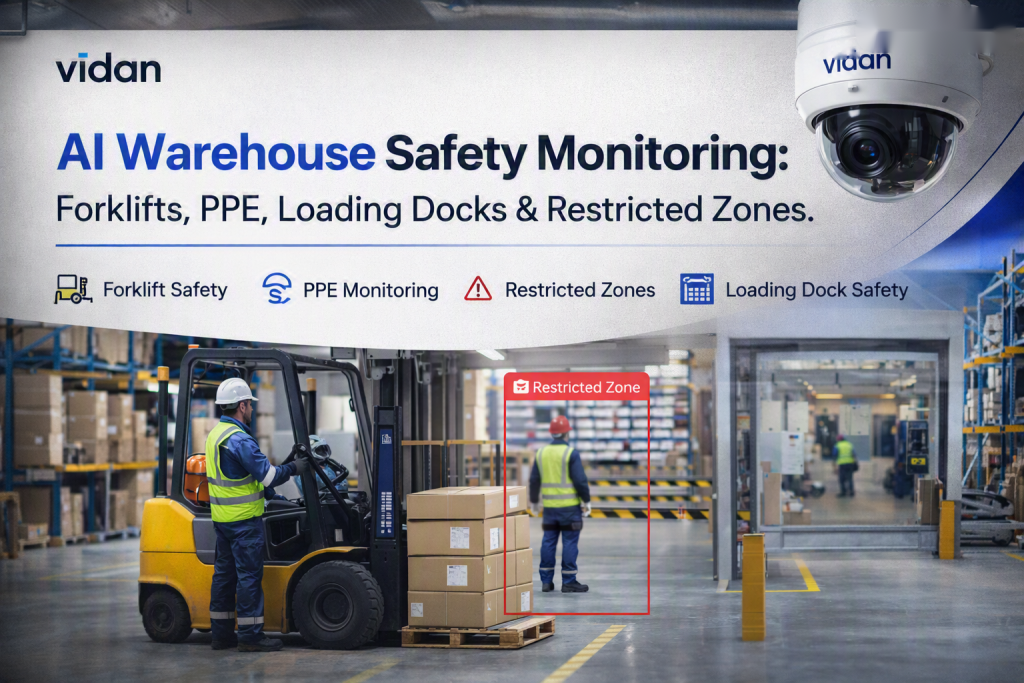
A forklift clips a rack because it never saw the pedestrian around the corner. A worker walks past a loading dock without a hard hat, and nobody notices until the incident report gets filed. These small gaps are where most warehouse injuries start, and they happen faster than any human guard can react. AI warehouse safety monitoring closes that gap by watching every zone, every shift, without blinking.
This guide breaks down exactly how it works, what it catches, and why 2026 warehouses are moving from passive cameras to active safety intelligence.
Key Takeaways
- AI warehouse safety monitoring uses computer vision to detect forklift hazards, missing PPE, and restricted zone breaches in real time.
- Forklifts cause between 35,000 and 62,000 U.S. injuries every year, according to OSHA estimates.
- Slips, trips, and falls account for 27% of nonfatal warehouse injuries reported to OSHA (BLS, 2023).
- AI systems send instant alerts to supervisors instead of relying on someone reviewing footage after an incident.
- Vidan AI turns existing warehouse cameras into a 24/7 safety layer without new hardware in most facilities.
What Is AI Warehouse Safety Monitoring
AI warehouse safety monitoring uses computer vision to scan camera footage for unsafe behavior continuously. It looks for missing PPE, forklifts operating too close to people, blocked exits, and unauthorized entry into hazard zones. The system does not replace your cameras. It reads what they already capture and turns that footage into action.
Unlike a security guard glancing at a monitor wall, the software never blinks, never takes a break, and never misses a second shift. It applies the same detection logic to every camera, every hour, at a scale no human team could match.
How It Differs From Traditional CCTV
| CapabilityTraditional | Traditional CCTV | AI Warehouse Safety Monitoring |
| Detects PPE violations | No | Yes, in real time |
| Sends live alerts | No | Yes, to phone or dashboard |
| Learns forklift traffic patterns | No | Yes, over time |
| Requires constant human review | Yes | No |
How Forklift Safety Cameras Reduce Warehouse Accidents
Forklifts are the single most dangerous piece of equipment on most warehouse floors. AI warehouse safety monitoring earns its budget here first, because the injury numbers are hard to ignore.
OSHA estimates that forklifts cause between 35,000 and 62,000 workplace injuries every year in the United States. Of those, roughly 34,900 are serious enough to require medical treatment beyond first aid (OSHA). Tip-overs alone account for close to a quarter of all forklift incidents, often because of uneven ground, oversized loads, or sharp turns.
A forklift safety camera system watches for the conditions that lead to these accidents before they happen:
- Speeding through marked aisles or intersections
- Sharp turns while carrying an unstable or oversized load
- Operating without a spotter in a blind corner
- Getting too close to a pedestrian or another vehicle
When the system flags one of these events, it sends an alert to a supervisor’s phone within seconds. That is a very different response time than reviewing footage the next morning after an incident already happened. For a deeper understanding of how automated alerts impact outcomes, see the comparison between Warehouse Security Guards and AI Video Analytics: Which Offers Better Protection?
🏭 Warehouse Video Surveillance
See Every Aisle, Dock, and Blind Spot in Real Time
Vidan AI transforms your warehouse cameras into a live safety and security layer. Track forklift zones, loading docks, inventory areas, and restricted access points from a single dashboard.
AI Forklift Detection and Restricted Zone Enforcement
Forklifts are not the only hazard moving through a warehouse. Restricted zones exist for a reason, whether it is a racking area under load, a hazardous materials cage, or a section reserved for authorized personnel only.
AI forklift detection technology maps out geofenced zones directly on the camera feed. When a forklift enters a zone it is not cleared for, the system flags it instantly. No physical barrier or manual checkpoint is required. A few common rules teams set up include:
- Alert if any vehicle enters a pedestrian-only aisle
- Alert if a person enters a high shelf racking zone without a spotter present
- Alert if a restricted door opens outside of scheduled hours
- Alert if a forklift approaches a loading dock edge without a barrier in place
Because these rules run continuously, they catch violations that happen during quiet shifts, not just when a manager happens to be walking the floor.
How Does AI PPE Detection Work In A Warehouse
Warehouse PPE detection uses the same cameras already covering your floor. The system identifies whether a worker is wearing a hard hat, high-visibility vest, gloves, or eye protection in a zone where that gear is required, then flags the gap in seconds.
This matters because manual PPE checks are inconsistent by nature. A supervisor cannot verify every worker on every aisle every hour. Most warehouses still rely on manual PPE checks, which creates gaps in day-to-day enforcement. AI removes that gap by checking constantly instead of periodically.
What Gets Flagged
- Missing hard hat in a marked overhead hazard zone
- No high-visibility vest near active forklift lanes
- Missing gloves at a material handling station
- Improperly worn safety gear, such as an unfastened harness
Supervisors receive the alert on their phone or dashboard, walk over, and correct the issue before it turns into an incident report.
Why Loading Docks Need Their Own Layer Of Protection
Loading docks are one of the most dangerous zones in any warehouse. 25% of all warehouse accidents occur at the loading dock, and for every loading dock injury there are roughly 600 near misses. That ratio shows how much risk happens quietly, without ever showing up in an incident log.
Loading dock surveillance powered by AI watches trailer positioning, dock plate placement, pedestrian crossing, and vehicle movement at once. It catches the near misses that never get reported, so patterns can be corrected before they become an actual injury.
A Typical Loading Dock Risk Sequence
A trailer backs in without a spotter confirming clearance. A worker crosses behind the trailer while it is still moving. The dock plate shifts slightly under uneven weight. No alert exists until AI flags each step as it happens, not after the fact.
Restricted Zones And Unauthorized Access
Not every part of a warehouse should be open to every worker. Chemical storage, high-value inventory cages, mezzanine edges, and automated equipment lanes all carry elevated risk. AI warehouse surveillance draws a digital boundary around these zones and alerts staff the instant someone crosses it without authorization.
This is different from a simple locked door. Doors get propped open during busy shifts. Cameras with restricted zone detection do not get tired, distracted, or bypassed by convenience.
Common restricted zone use cases:
- Keeping unauthorized staff away from automated conveyor systems
- Flagging entry into chemical or hazardous material storage
- Monitoring mezzanine and elevated platform edges for fall risk
- Confirming only trained operators access powered equipment zones
What Does A Complete AI Warehouse Safety Monitoring System Look Like
AI warehouse safety monitoring works best as a layered system rather than a single feature. Vidan AI structures deployments around four coordinated layers that share one dashboard instead of four separate logins.
The Four Layer Framework
Layer 1: Detection
Cameras feed live footage into the AI model trained on PPE, forklifts, docks, and zones.
Layer 2: Classification
The system identifies exactly what is happening, such as a missing vest or a proximity risk.
Layer 3: Alerting
Supervisors receive an instant notification with a timestamped clip, not a vague warning.
Layer 4: Reporting
Trends get logged automatically so that safety teams can see recurring issues by shift, zone, or worker group.
This structure is why warehouse video analytics outperforms scattered point solutions. One dashboard, one data trail, one team responding faster.
Vidan AI’s Approach To Warehouse Safety
Vidan AI was built around a simple idea. Your cameras already see everything. They just cannot act on what they see without the right software layer.
We deploy on the infrastructure you already have installed, so there is no camera replacement project and no months-long rollout. Our models are trained specifically on warehouse security monitoring scenarios, including forklift proximity, PPE gaps, dock activity, and zone breaches, tuned to reduce false alerts that cause teams to tune out warnings.
What sets our warehouse deployments apart:
- Real-time alerts sent directly to supervisor phones, not buried in a report
- Detection tuned specifically for forklift, PPE, dock, and zone risk, not generic motion alerts
- Works with existing camera hardware in most facilities
- Dashboard reporting that turns near misses into a pattern your safety team can actually act on
Why Passive Cameras Are No Longer Enough
Warehouses have carried cameras for decades, but a camera that only records is a camera that reacts too late. The video analytics market is projected to grow from $12.39 billion in 2025 to $15.04 billion in 2026, a signal that facilities everywhere are shifting from passive recording to active detection.
We laid out why this shift matters beyond warehousing in Why Commercial Security Cameras Need AI to Prevent Security Incidents. The core point holds here too. A recording proves what happened. AI prevents it from happening again.
Building A Compliant Safety Program Around AI
AI detection is one layer of a larger compliance picture. OSHA requirements around forklift operator training, PPE policy, and hazard zone marking still apply, and AI works best when it reinforces those existing standards rather than replacing them. We built a full breakdown of what 2026 compliance actually requires in the warehouse health and safety requirements checklist, which pairs well with the monitoring layer covered here.
Conclusion
Warehouse safety used to depend on how many pairs of eyes were on the floor at any given moment. That model breaks down fast across large facilities running multiple shifts. AI warehouse safety monitoring removes that dependency by watching every zone continuously and reacting in seconds, not the next morning.
The facilities getting ahead in 2026 are not the ones adding more cameras. They are the ones adding intelligence to the cameras they already have.
Ready to see what it looks like on your floor? Vidan AI builds warehouse safety monitoring around your existing layout, cameras, and workflows, not a generic template.