
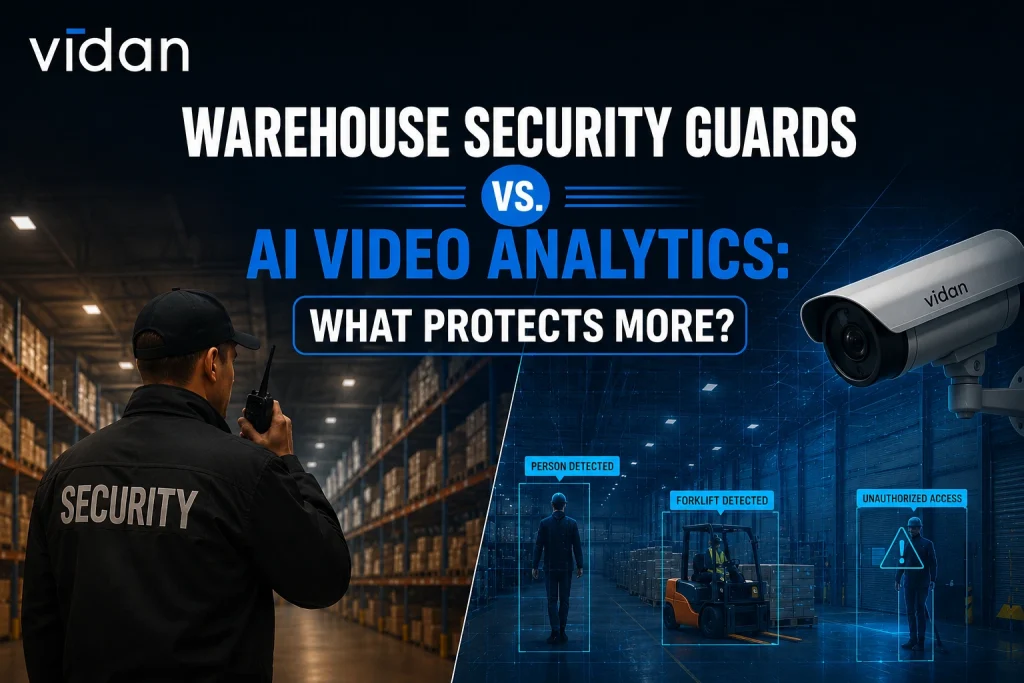
Key Takeaways
- Traditional warehouse security guards have real limitations: fatigue, blind spots, and high costs.
- AI-powered threat detection identifies risks faster and more consistently than human observation.
- Remote video monitoring delivers 24/7 coverage without the operational overhead of on-site staff.
- A hybrid approach can work, but AI analytics outperforms in speed, scale, and cost-efficiency.
- Vidan AI offers purpose-built AI video analytics for warehouses that go beyond basic surveillance.
One Incident. One Blind Spot. One Very Expensive Lesson.
Warehouse security guards remain the most widely deployed form of protection in industrial facilities. Yet breach rates, internal theft, and safety incidents continue to climb. The question is no longer whether humans can protect warehouses. It is whether they can protect warehouses well enough, at scale, and without prohibitive cost.
AI video analytics has emerged as a direct answer to that question. Not as a futuristic concept, but as deployed, operational technology that warehouses are switching to right now.
This blog breaks down both sides without hype. You will see where guards fall short, where AI outperforms, and why facilities that switch to AI-driven monitoring report fewer incidents, lower costs, and tighter compliance.
The Honest Limitations of Warehouse Security Guards
What Guards Do Well
Guards bring one thing AI cannot replicate: physical presence. They deter opportunistic threats. They respond in person to confrontations. They build familiarity with a site over time.
For facilities where physical intervention is a daily possibility, that matters.
Where the Model Breaks Down
Here is the part that rarely makes it into security procurement conversations.
The human attention ceiling is real. Research on vigilance shows that after 20 minutes of monitoring static feeds, a human observer misses up to 45% of activity on screen. Guards in large warehouses often monitor 16 or more camera feeds simultaneously. The math is not in your favor.
Shift gaps create predictable vulnerability windows. Handover periods, breaks, and schedule changes create patterns. Experienced thieves learn those patterns. According to the Warehouse Health and Safety Requirements, many facilities also face safety compliance failures that happen specifically during shift transitions, when monitoring consistency drops.
Cost scales linearly with coverage. Want to cover three more zones? Hire three more guards. Or pay overtime. Neither option is sustainable for growing operations.
Guards cannot be everywhere. A 500,000 square foot distribution center with four guards has, mathematically, enormous blind spots. Those blind spots are not random. They are the same every shift.
Documentation is inconsistent. Incident reports depend on what guards noticed, remembered, and recorded. AI systems log everything, timestamp everything, and never forget.
What AI Video Analytics Does in a Warehouse
Beyond Motion Detection: What Modern Systems See
Early CCTV systems detected motion. That was their entire intelligence layer. Modern AI-powered threat detection is categorically different.
Today’s systems can:
Detect loitering in restricted zones before any incident occurs. Identify individuals without proper PPE in real time. Flag unusual vehicle movement patterns inside the facility. Recognize crowd formation or sudden dispersal near high-value inventory. Track object removal or placement in monitored areas. Generate instant alerts with contextual footage clips, not raw timestamps.
This is not surveillance. It is situational awareness at machine speed.
The Response Time Advantage
When a traditional guard notices something and radios it in, the average response chain takes 4 to 7 minutes from detection to action. AI-powered systems alert within seconds. For facilities using remote video monitoring, a trained operator receives that alert simultaneously with local management, cutting response time further.
Security gaps most commercial property security systems still miss are often coverage gaps that AI video analytics resolves by design: perimeter blind spots, lighting-dependent detection failures, and after-hours monitoring drops.
How AI Sees in the Dark
One consistent objection from warehouse managers is nighttime coverage. Guards patrolling at night are limited by torchlight and visibility. AI systems integrated with infrared and thermal imaging do not share that limitation. How Night Vision Cameras Work in modern AI-integrated systems means threat detection does not degrade when lighting does.
The Cost Comparison That Changes the Conversation
| Cost Factor | Security Guards | AI Video Analytics |
| Monthly staffing (mid-size warehouse) | $18,000 to $35,000 | $2,500 to $6,000 |
| Coverage hours | Limited by shifts | 24/7/365 |
| Scalability | Linear cost increase | Flat rate scaling |
| Documentation | Manual, inconsistent | Automated, timestamped |
| Incident response speed | 4 to 7 minutes | Under 60 seconds |
| Fatigue factor | High | None |
The numbers above are directional, not universal. But the pattern is consistent across facilities that have made the switch.
AI video analytics does not replace every guard in every context. But for monitoring, detection, and alerting functions, it outperforms human coverage at a fraction of the operational cost.
Remote Video Monitoring: The Layer That Multiplies AI’s Value
AI video analytics generates alerts.Remote video monitoring ensures a trained human acts on those alerts immediately, 24 hours a day, without the overhead of on-site staffing. Here is how the model works in practice:
AI detects an anomaly in Zone C at 3:12 AM. The alert is immediately routed to a remote monitoring center. A trained operator reviews the live feed in real time. The operator contacts on-site personnel or emergency services within 90 seconds. The full event is logged with footage, timestamps, and operator notes.
That is faster, more consistent, and more cost-effective than any patrol-based model.
Why Organizations Are Investing in AI Security Guard Technology in 2026 comes down to this combination: AI detection plus human oversight, delivered remotely, at scale.
What a Warehouse-Specific AI System Must Cover
Not all AI video platforms are built for warehouse environments. Warehouse operations have specific demands that generic commercial security systems do not address.
- Perimeter integrity. Loading docks, emergency exits, and access gates are the highest-risk entry and exit points. AI monitoring must cover these zones with no gaps.
- Inventory zone surveillance. High-value storage areas require continuous, not periodic, monitoring. A warehouse video surveillance system built for inventory protection should flag access outside authorized hours automatically.
- Internal theft detection. Industry data consistently shows that internal theft accounts for a larger share of inventory loss than external breaches. AI behavioral analytics can identify patterns that no guard would notice across hundreds of employees.
- PPE and safety compliance. Monitoring for safety compliance failures in real time protects facilities from OSHA violations and reduces accident rates. This connects directly to the broader conversation about safety culture in warehouse operations.
- After-hours anomaly detection. Most incidents happen between midnight and 5 AM. Full-coverage AI monitoring during these hours is where the ROI case for AI is clearest.
The conversation around the security guard’s role is evolving. Guards are shifting from monitors to responders, working alongside AI systems rather than being replaced by them in all contexts.
Vidan AI Ensuring Accuracy in Every Warehouse Operation
Vidan AI does not sell generic surveillance software. The platform is purpose-engineered for industrial and warehouse environments where the stakes of a missed incident are high.
Warehouse-Native Threat Models
Vidan AI’s detection algorithms are trained on warehouse-specific scenarios: dock loitering, inventory zone breaches, unauthorized vehicle access, and PPE non-compliance. Generic AI platforms use broad training data. Vidan AI uses environment-specific intelligence.
Integrated Remote Monitoring
Vidan AI connects AI-generated alerts directly to professional monitoring operators who act on them in real time. This eliminates the gap between detection and response that most standalone AI platforms leave open.
Audit-Ready Documentation
Every alert, operator action, and resolved incident is logged automatically. Facilities using Vidan AI are prepared for insurance audits, OSHA inspections, and incident investigations without manual report compilation.
For warehouse managers who have experienced the frustration of reviewing footage after an incident and seeing exactly what happened, Vidan AI exists to make that review unnecessary because the system has already acted.
The Verdict: Which Provides Better Protection?
The answer is not guards or AI. The answer is that warehouse security built entirely on human patrols leaves predictable, exploitable gaps. AI video analytics closes those gaps.
For detection, consistency, cost-efficiency, and scalability, AI-powered systems outperform traditional guard models across every measurable dimension. The strongest facilities in 2026 use AI as the primary monitoring layer, with guards positioned where physical presence and intervention capacity actually matter.
Warehouse security guards are not obsolete. But relying on them alone, for monitoring functions that AI performs better, is a decision that costs facilities more than they realize until something goes wrong.
What AI Monitoring Cannot Do (Yet)
Fairness requires acknowledging real limitations.
AI systems cannot physically intervene in an active confrontation. They cannot make judgment calls in ambiguous situations that fall outside their training data. They cannot provide the psychological deterrent that a uniformed presence creates for opportunistic threats at entry points.
A realistic 2026 warehouse security strategy accounts for these gaps. AI handles detection and monitoring. Guards handle intervention and access control. Remote monitoring operators handle escalation.
That model is what Vidan AI is designed to support.
Final Thoughts
Every warehouse running on guard patrols alone has a number. It is the dollar value of what those guards miss each year, across shift gaps, blind spots, and attention limits. Most managers never calculate it until an incident forces them to. Vidan AI was built for the moment before that calculation becomes necessary.
Stop auditing incidents after the fact. Start preventing them with Vidan AI.
Book a free warehouse security assessment today and see exactly where your current coverage falls short and how AI video analytics closes every gap.