
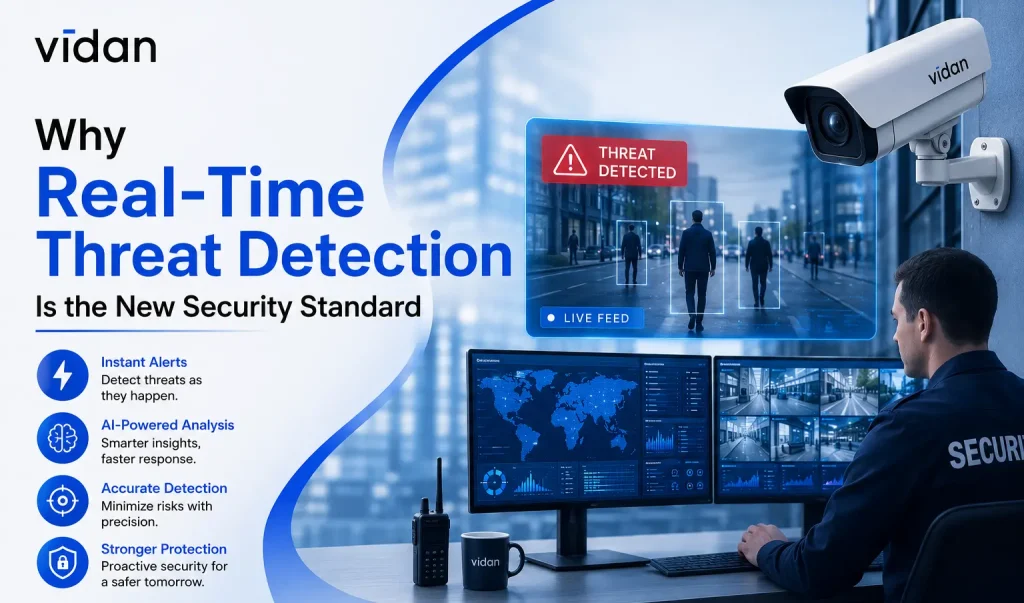
A guard cannot watch 40 cameras at once. A human blinks. A threat does not wait for shift change. This is why real-time threat detection is no longer a premium add-on. It is becoming the baseline for every serious security operation, and Vidan AI is built around that shift.
Physical security used to mean recording footage and reviewing it after something went wrong. That model is dead. Teams now expect systems that catch problems as they happen, not hours later on a monitor nobody was watching.
Key Takeaways
- Real-Time Threat Detection now defines modern security, not optional footage review
- Automated Threat Detection removes the guesswork from human monitoring
- AI physical security for modern teams cuts response times dramatically
- An AI surveillance system does more than record. It thinks, flags, and alerts
- Vidan AI applies these capabilities across warehouses, construction sites, and commercial properties
The Old Way Cannot Keep Up Anymore
For decades, physical security meant cameras, a monitoring room, and a guard hoping to notice something before it became a problem. That setup worked when property sizes were smaller and expectations were lower.
Today, facilities are larger. Staff budgets are tighter. Criminals are faster. A guard staring at a wall of screens for eight hours will miss things. That is not a flaw in the person. It is a flaw in the system design.
Where the Old Model Breaks Down
Three problems show up again and again in traditional setups.
- First, response only happens after footage is reviewed, often the next day.
- Second, one guard cannot realistically monitor dozens of camera feeds at once.
- Third, fatigue sets in fast, and attention drops sharply after just a few hours.
Why Real-Time Threat Detection Changes the Equation
Real-time threat detection flips the entire model. Instead of recording and hoping someone reviews it later, the system analyzes footage the moment it happens. If something looks wrong, it flags it instantly.
This is not about replacing people. It is about giving them useful information exactly when they need it, instead of a mountain of footage to sort through after the fact.
Facilities using real-time threat detection catch intrusions, loitering, and unauthorized access far faster than facilities relying on manual review alone.
How Automated Threat Detection Actually Works
Automated Threat Detection sounds complex, but the concept is straightforward once broken into steps.
- Step one: cameras capture continuous video across the property.
- Step two: AI models analyze each frame for movement, objects, and behavior patterns.
- Step three: the system compares what it sees against known rules and learned patterns.
- Step four: if something matches a suspicious pattern, an alert fires immediately.
- Step five: security teams receive the alert with context, not just a raw video clip.
This process happens in seconds. There is no waiting for someone to scroll through hours of footage looking for the one moment that mattered.
What Counts as a Threat
Not every alert is about a break-in. Modern systems are trained to flag a wide range of activity.
- Unauthorized entry after hours
- Loitering near restricted zones
- Vehicles parked in no access areas
- Objects left unattended in sensitive locations
- Perimeter breaches at fences or gates
Each of these triggers a different response protocol, and that flexibility is part of what makes the technology valuable.
AI Physical Security for Modern Teams Looks Different
AI physical security for modern teams is not just about smarter cameras. It is about giving lean security staff the leverage of a much larger team.
A single security manager can now oversee multiple sites remotely. Alerts come to their phone or dashboard instead of requiring someone physically present at every location around the clock.
This matters most for teams that are understaffed, budget-constrained, or managing several properties spread across a region. Instead of hiring more guards, they equip existing staff with better tools.
Three Ways Teams Are Restructuring Around AI
Security roles are shifting from passive watching to active response.
- Guards spend less time staring at monitors and more time responding to verified alerts.
- Managers get summarized reports instead of raw footage to sort through.
- Smaller teams cover larger territory without sacrificing coverage quality.
What Makes a Modern AI Surveillance System Different From a Regular Camera
A traditional camera records. An AI surveillance system interprets. That difference is the entire point.
| Traditional Camer | AI Surveillance System |
| Records footage only | Analyzes footage live |
| Requires manual review | Sends automatic alerts |
| No context on activity | Classifies behavior type |
| Storage heavy | Flags only relevant clips |
| Reactive by design | Proactive by design |
This comparison is why so many facilities are replacing legacy CCTV setups. The hardware might look similar from the outside, but the intelligence behind it is a different category of product entirely.
Real World Use Cases Across Industries
Different industries lean on this technology for different reasons, but the underlying goal is the same. Catch problems early, before they become expensive.
Warehouses
Warehouses use AI-powered monitoring to detect unauthorized entry, after-hours movement, and suspicious activity before inventory goes missing. Real-time alerts help security teams respond faster, reduce theft, protect valuable stock, and maintain continuous visibility across loading docks, storage areas, and perimeter entrances.
Construction Sites
Construction sites depend on remote monitoring to secure expensive machinery, tools, and stored materials outside working hours. Monitoring construction site storage remotely with Vidan AI helps contractors detect intrusions early, prevent equipment theft, reduce financial losses, and keep projects on schedule without constant on-site supervision.
Retail Stores
Retail stores use intelligent video analytics to recognize suspicious behavior, identify shoplifting patterns, and monitor high-risk areas in real time. Early detection enables security teams to intervene before losses occur, improve customer safety, and reduce shrinkage across multiple store locations.
Logistics Yards
Logistics yards rely on AI-powered surveillance to monitor vehicle movement, trailer access, and restricted zones around the clock. Instant alerts for unauthorized activity help prevent cargo theft, improve fleet security, strengthen operational oversight, and maintain a safer transportation environment.
The Technology Behind the Alerts
None of this works without solid computer vision underneath it. AI video surveillance relies on models trained to distinguish between a person, a vehicle, an animal, and background movement like blowing debris.
This distinction is what separates a useful system from an annoying one. Nobody wants fifty alerts a night because a moth flew past the lens.
Good systems learn the property over time. They understand what normal activity looks like at 2 AM versus what looks out of place. That contextual awareness reduces false positives significantly.
Response Time Is the Real Metric That Matters
A security system is only as effective as its response time. Detecting an incident without immediate action still leaves businesses exposed to theft, damage, and safety risks.
Why Fast Response Changes the Outcome
- The Moment a Threat Appears: AI continuously analyzes live video feeds and identifies suspicious activity the instant it occurs, eliminating delays caused by manual monitoring.
- The Alert Reaches the Right People: Instead of waiting for someone to review footage, the system immediately notifies security teams, supervisors, or designated personnel with real-time alerts.
- Action Happens Before Losses Grow: Faster notifications allow teams to intervene before an intruder escapes, equipment is stolen, property is damaged, or a workplace incident becomes more severe.
- The Business Reduces Risk: Shorter response times lead to fewer disruptions, lower financial losses, improved employee safety, and stronger overall security across every monitored location.
From Alert to Action
When AI detects a potential security threat, the response follows a structured process designed to reduce delays and help teams act quickly.
Threat Detection
The system identifies suspicious activity within seconds by continuously analyzing live video feeds for predefined risk patterns.
Instant Alert
A real-time notification, including a short video clip or image, is sent directly to the assigned security personnel or operations team.
Rapid Verification
The recipient reviews the footage immediately, confirms whether the alert is genuine, and determines the appropriate response.
Immediate Action
If the situation requires intervention, on-site security, management, or local authorities are notified without delay.
The Result
This entire process often takes less than a minute, replacing manual video reviews that can delay action by hours or even days.
How Vidan AI Builds This Into Every System
Every Vidan AI deployment is designed to move businesses from passive surveillance to proactive security. Instead of recording incidents for later review, the platform detects, analyzes, and alerts in real time.
What You Get With Vidan AI
- Property-Specific Detection: Monitoring rules are configured for each location based on its layout, operating hours, restricted areas, and operational risks.
- Live AI Analysis: Video feeds are analyzed continuously to identify suspicious behavior the moment it occurs instead of waiting for manual footage reviews.
- Smarter Alerts: Advanced AI models reduce false positives by filtering routine activity from genuine security threats, helping teams focus on what matters.
- Centralized Visibility: Manage security across one site or multiple locations through a single dashboard with real-time alerts and event tracking.
Action-Oriented Insights: Every notification includes relevant context, allowing security teams to verify incidents quickly and respond with confidence.
The Difference
Traditional surveillance tells you what happened after the fact. Vidan AI helps you act while it’s happening, reducing response times and strengthening protection across your entire operation.
What to Look For Before Choosing a System
The best AI surveillance platform is the one that performs reliably after installation, not just during a product demo. Use these five checkpoints before making a decision.
Live Detection
Ask: Does the platform analyze video in real time?
Why it matters: Immediate detection gives security teams time to respond before an incident escalates.
Alert Accuracy
Ask: How does the system minimize false positives?
Why it matters: Too many unnecessary alerts lead to alert fatigue and slower response to genuine threats.
Customization
Ask: Can detection rules be customized based on location, schedule, or activity?
Why it matters: Every property has unique risks, and generic settings often miss what matters most.
Scalability
Ask: Can multiple sites be managed from one dashboard?
Why it matters: Centralized monitoring simplifies operations and provides consistent visibility across every location.
Long-Term Support
Ask: What happens after deployment?
Why it matters: Ongoing optimization and technical support help keep the system accurate as your business and security needs evolve.
A Good Rule of Thumb
If a provider cannot clearly answer these questions, the platform may not deliver the performance your business expects once it is in daily use.
Where This Technology Is Headed Next
AI surveillance is moving beyond simple motion detection. The next generation of security platforms will connect cameras, access control, sensors, and analytics into a single intelligent system that delivers faster, more accurate responses.
What’s Changing
Today → Detects movement and sends alerts.
Next → Understands behavior, context, and potential intent before an incident escalates.
Today → Security tools operate independently.
Next → Cameras, access control, alarms, and analytics work together through one connected platform.
Today → Teams spend time verifying alerts manually.
Next → AI filters routine activity and highlights events that require immediate attention.
Today → Video footage explains what happened.
Next → Predictive analytics identify emerging risks before they become security incidents.
What This Means for Businesses
As AI continues to improve, real-time threat detection will become a standard capability rather than a premium feature. Organizations that adopt intelligent surveillance early will benefit from faster response times, better operational visibility, and stronger protection, while those relying on traditional systems may struggle to keep pace with evolving security demands.
Final Thoughts
Physical security is no longer just about having cameras. It is about having cameras that actually do something useful with what they see. Real-time threat detection is not a trend. It is the direction the entire industry is moving, and facilities that delay adoption are accepting a risk they no longer need to carry.
Vidan AI was built for exactly this shift. Not another camera vendor, but a security partner focused on catching problems while they can still be stopped.
If your current setup only tells you what happened after the fact, it is time for an upgrade. Book your free demo