
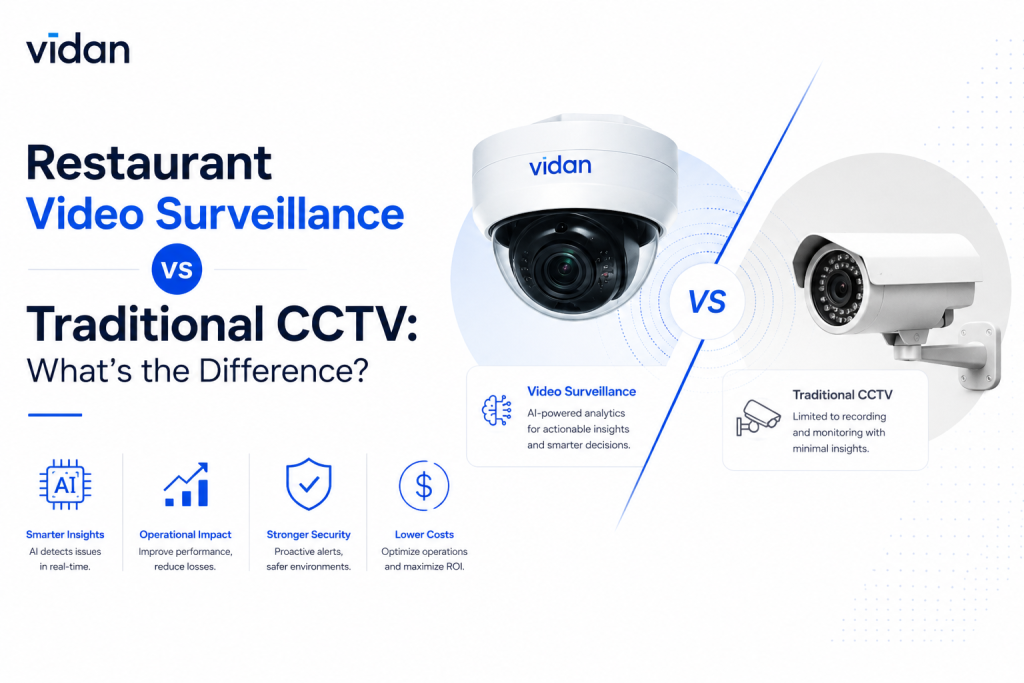
Traditional CCTV records footage for someone to review later. Restaurant Video Surveillance vs Traditional CCTV comes down to one thing: AI systems detect events, analyze behavior, and send alerts in real time, while CCTV just stores video and waits for a human to watch it.
That gap between recording and reacting is exactly what separates legacy camera systems from modern restaurant AI cameras vs CCTV setups. This guide breaks down the real differences, the numbers behind them, and what actually changes on the floor of a restaurant when cameras start thinking instead of just watching.
Key Takeaways
- CCTV passively records footage; AI video surveillance detects, analyzes, alerts, and enables a response
- A modern restaurant security camera system can flag PPE violations, loitering, and safety hazards in real time.
- AI systems cut review time from hours of footage to seconds of searchable events.
- Restaurants using AI monitoring report faster incident response and fewer repeat safety issues.
- Vidan AI builds detection models specifically for food service environments, not generic retail cameras.
What Does Traditional CCTV Do in a Restaurant?
CCTV has been the default restaurant security tool for decades, and its job description hasn’t changed much.
- Captures continuous video across dining rooms, kitchens, and back doors
- Stores footage locally on a DVR or NVR box
- Requires a manager to scrub through hours of video after an incident manually
- Has no built-in understanding of what it’s actually recording
A CCTV camera pointed at a walk-in freezer records the door opening at 2 am. It does not know that’s unusual. It does not tell anyone. It just keeps recording until someone thinks to check.
This is the core limitation. AI CCTV for restaurants exists precisely because plain recording stopped being enough for operators managing multiple locations, thin staffing, and rising liability costs.
How Is AI Video Monitoring Different From Traditional CCTV?
AI video monitoring follows a four-step process that CCTV was never built for: detect, analyze, alert, respond.
- Detect: Cameras identify a specific event, like a person without a hairnet in a prep area.
- Analyze: The system checks the event against preset rules or trained models.
- Alert: A notification goes to a manager’s phone, email, or dashboard within seconds
- Respond: Staff act on the alert while the situation is still happening, not hours later
This is what a true restaurant video monitoring system does that a DVR box never could. The camera isn’t just a witness anymore. It’s a first responder.
One Platform for Every Location, Every Kitchen, Every Shift
From single restaurants to multi-site chains, Vidan AI gives food and beverage operators one dashboard to monitor safety, hygiene, and security across every location.
Restaurant Video Surveillance vs CCTV: Key Differences at a Glance
| Feature | Traditional CCTV | AI Video Surveillance |
| Function | Records footage only | Detects, analyzes, alerts, responds |
| Review process | Manual, hours of footage | Automated, searchable by event |
| Real-time alerts | None | Yes, sent to staff instantly |
| PPE and hygiene checks | Not possible | Automated compliance flags |
| Loitering or theft detection | Requires a human watching live | Automatic detection and alert |
| Data usefulness | Raw video only | Structured incident data and trends |
| Staffing dependency | High, needs someone monitoring | Low, alerts replace constant watching |
The difference between restaurant video surveillance vs traditional CCTV comes down to what the system can do with the footage it captures. Traditional CCTV primarily records activity for later review, while AI-powered surveillance can analyze events in real time, identify potential security concerns, and alert staff when action may be needed. This gives restaurant teams greater visibility without relying on someone to watch cameras continuously.
Why Restaurants Are Moving Away From CCTV-Only Setups
The Cost Of Reviewing Footage Manually
A manager spending 30 minutes a day scrubbing footage loses over 180 hours a year to a task that finds problems after they’ve already happened. Restaurant Business reports that operators cite labor and food safety compliance among their top ongoing cost pressures in 2025, which makes any time sink around manual review harder to justify.
The Liability Problem
Slip and fall claims in food service are common and expensive. The National Floor Safety Institute states that slip and fall incidents account for over 1 million emergency room visits annually across all industries, with restaurants among the highest risk environments due to grease, spills, and high foot traffic.
CCTV can show a lawyer what happened after the fact. Smart restaurant security cameras can flag a spill the moment it happens, prompting cleanup before anyone gets hurt.
The Food Safety Angle
The CDC estimates that foodborne illness affects roughly 48 million people in the United States each year, with improper food handling and hygiene lapses as leading contributors. Cameras that can flag missed handwashing or PPE gaps in real time address the problem at the point it starts, not weeks later in a health inspection report.
Built for the Speed of Drive-Thru and Counter Service
High traffic, fast turnover, tight staffing. Vidan AI’s QSR surveillance flags crowding, safety risks, and compliance gaps in real time, without slowing your line down.
What Can AI Restaurant Surveillance Detect?
Modern AI restaurant surveillance models are trained on restaurant-specific scenarios, not generic retail footage. That distinction matters because a kitchen looks nothing like a store aisle.
Common detection use cases include:
- Staff not wearing required hairnets, gloves, or masks in food prep zones
- Unauthorized entry into walk-in coolers or storage areas after hours
- Loitering near back doors or dumpster areas
- Crowding near entrances during peak hours
- Slip hazards from spills left unaddressed
- Equipment left running outside operating hours
Each of these turns into an instant alert instead of a footnote in a video nobody watches.
Also Read: AI Restaurant Security in 2026: What’s Changing in Restaurant Surveillance?
How to Choose Between CCTV and AI Video Surveillance
Not every restaurant needs the same setup. The right choice depends on a few operational factors.
If you run a single location
- A basic AI overlay on existing CCTV hardware can cover most safety and hygiene gaps.
- Focus on PPE detection and back door access alerts first
- Skip enterprise dashboards you won’t use with one site
If you run multiple locations
- Centralized dashboards matter more than camera count
- Look for systems that flag trends across sites, not just single incidents
- Ask whether alerts can route to regional managers, not just on-site staff
If you’re opening a new location
- Build AI detection into the initial camera layout instead of retrofitting later.
- Placement matters more for AI systems since detection zones need clear sightlines.
- Budget for training time so managers know how to act on alerts, not just receive them
What Implementation Actually Looks Like
Rolling out AI video monitoring is not a one-day swap. It typically follows four phases.
- Site assessment. A team reviews current camera placement, lighting, and network capacity.
- Model configuration. Detection rules get tuned to the specific layout, like prep zones, storage rooms, or drive-thru lanes.
- Staff training. Managers learn how alerts arrive and what response steps to follow for each alert type.
- Monitoring and adjustment. False alert rates get reviewed in the first few weeks, and models get refined accordingly.
Most restaurants see the system stabilize within the first month, once false alerts get tuned out, and staff trusts the notifications they’re getting.
Beyond the Dining Room: Where This Technology Extends
Surveillance upgrades don’t stop at the front of house. Kitchens have inherent risks related to hygiene, staff activities, and safety compliance. This is why many operators implement front-of-house monitoring alongside AI kitchen monitoring to oversee hygiene, safety, and staff activities.
Across production areas: Multi-unit restaurants, commissary kitchens, and food production facilities face even broader compliance requirements. PPE detection can help identify missing or improperly worn protective equipment before it becomes a recurring issue.
The result is a security system that can watch more than entrances, dining areas, and cash registers. It can help teams monitor the spaces where everyday safety and compliance happen.
How Vidan AI Approaches Restaurant Surveillance
Vidan AI didn’t build a generic security camera and slap “AI” on the label. The models running behind Vidan AI’s restaurant deployments are trained on food service-specific events: PPE compliance in prep zones, loitering near back entrances, crowding at host stands, and safety hazards unique to kitchen environments.
Here’s what that looks like in practice:
- Detection layer: Cameras identify restaurant-specific events using models trained on food service footage, not warehouse or retail data.
- Alert layer: Notifications reach shift managers through mobile and dashboard alerts within seconds of an event.
- Response layer: Staff act on live alerts, closing the loop between detection and correction in real time.
- Insight layer: Recurring incidents get logged into trend reports so that multi-location operators can spot patterns across sites, not just single events.
This is what separates Vidan AI from a plain AI CCTV setup for restaurants that only adds motion alerts. It’s a full detect, analyze, alert, and respond pipeline built specifically for how restaurants operate.
The Bottom Line
CCTV was never designed to think. It was designed to record, store, and wait for someone to press play. Restaurant Video Surveillance vs Traditional CCTV isn’t really a debate about camera quality anymore. It’s a debate about whether your security system reacts in real time or shows up after the damage is already done.
If your current setup only tells you what happened, it’s time to find out what a system that tells you what’s happening can do instead. Talk to Vidan AI about a restaurant surveillance system built to detect, analyze, alert, and respond, not just record.