
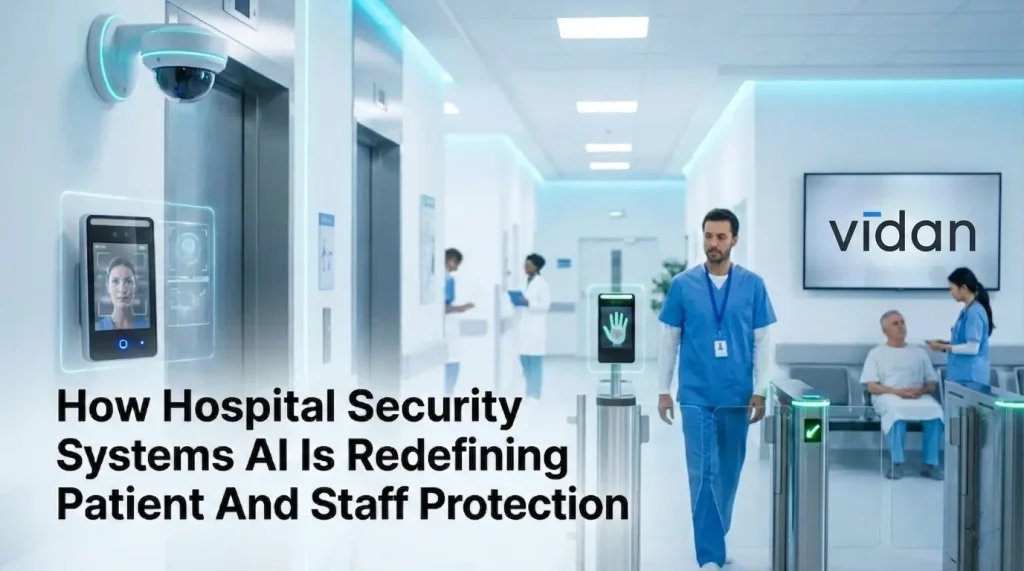
A patient slips out of a monitored ward. A staff member faces a threat in an empty hallway. A restricted area gets accessed without clearance. These are not edge cases. They happen in hospitals every single day.
Traditional CCTV and security guards react after the damage is done. Hospital security systems AI changes that entirely. It detects, analyzes, and alerts in real time, before threats escalate. At Vidan AI, we have built our entire platform around this shift from reactive to proactive protection.
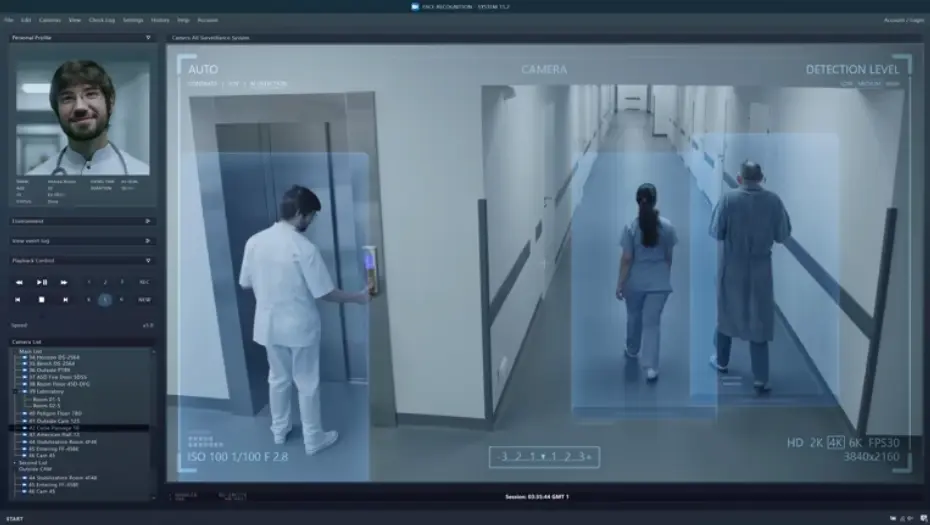
Healthcare environments are uniquely complex. Patients are vulnerable. Staff is stretched thin. Visitors move freely. AI-powered security was built for exactly this kind of environment.
What You Will Take Away From This Blog
- Why traditional hospital security is no longer enough
- How AI detects threats before they become incidents
- What makes AI patient monitoring different from basic surveillance
- How Vidan AI’s approach protects both patients and staff
- Real-world use cases across different hospital zones
- Answers to the most asked questions about hospital AI security
The Security Crisis Hospitals Are Not Talking About Enough
Threats Are Evolving Faster Than Security Budgets
Hospital security incidents have surged globally. Violence against nurses and doctors has increased. Patient elopement cases lead to tragic outcomes. Medication theft from pharmaceutical storage is rising. Drug diversion, unauthorized visitors, and after-hours access breaches are all creating a dangerous environment.
Yet most hospitals still rely on static cameras and human patrol rounds. A guard cannot watch 50 feeds at once. A camera cannot call for help.
This is the gap that healthcare safety and security AI software fills.
Why Human-Only Security Falls Short
Human attention fades. Blind spots exist in every facility. Shift changes create vulnerability windows. AI does not blink, tire, or miss a pattern. It flags the unusual before it becomes the unthinkable.
How AI Turns Every Camera Into an Intelligent Sensor
Standard cameras record. AI cameras think. AI video analytics processes every frame in real time. It identifies behavioral patterns, unusual movements, and access anomalies the moment they occur. A person lingering near a medication room. A patient is moving toward an exit without a staff escort. A visitor entering a restricted corridor. Each of these triggers an instant alert, not a next-day review.
What Behavioral Detection Actually Catches
AI is trained to recognize specific behaviors that signal risk: Aggression postures and raised voices near nursing stations. Patient falls before they fully occur, based on body position shifts. Unauthorized individuals in staff-only areas. A crowd formation that suggests a confrontation is building.
This is not science fiction. This is what Vidan AI’s platform does every hour of every day in healthcare settings.
Protecting Patients: The Most Vulnerable People in the Building
Cognitive patients, post-surgical patients, and pediatric patients all carry specific risks. An AI patient video monitoring system tracks movement patterns across wards without requiring a nurse to watch every feed manually.
When a patient crosses a defined zone boundary or exhibits movement patterns linked to fall risk, the system instantly alerts the right staff member. Response time drops. Outcomes improve.
Knowing Who Should and Should Not Be There
Not every person in scrubs belongs in every room. How hospital security technology AI helps prevent unauthorized access is one of the most critical topics in modern healthcare, and it starts with AI being able to cross-reference access credentials with real-time camera feeds. If a badge says one thing and behavior says another, the system flags it.
Protecting Staff: The People Who Protect Everyone Else
Violence Prevention in High-Risk Zones
Emergency departments, psychiatric wards, and triage areas carry the highest staff assault risk. Security in hospitals, AI software detects escalating behavior patterns before physical contact occurs.
Body language analysis, raised voices detected via audio sensors, and positioning data allow the system to alert security teams seconds before a situation turns violent. Those seconds matter enormously.
After-Hours Safety in Low-Traffic Areas
Parking lots, stairwells, and service corridors are where staff are most exposed after dark. How night vision cameras work in tandem with AI analytics means these zones are never truly dark or unmonitored. Motion, presence, and behavioral analysis work around the clock regardless of light conditions.
Securing the Physical Infrastructure of a Hospital
Pharmaceutical and Controlled Substance Storage
Drug diversion is one of the costliest and most dangerous security failures in healthcare. Pharmaceutical video surveillance does not just record who enters a medication room. It tracks access frequency, flags unusual patterns, and cross-checks against dispensing logs automatically.
This level of oversight is impossible with human-only monitoring.
Controlling Who Enters and When
Visitor management, contractor access, and staff credential verification all create access vulnerabilities. AI systems monitor all entry points simultaneously. They flag tailgating, credential sharing, and after-hours access in real time.
Hospitals also have another persistent threat that is often overlooked. Why you should worry about loitering and how to prevent it matters deeply in healthcare settings, where individuals with harmful intent often spend extended time in public areas before acting. AI detects loitering patterns and triggers soft alerts long before a situation escalates.
How Vidan AI Approaches Hospital Security Differently
Built Specifically for Healthcare Complexity
Most security platforms are built for retail or commercial real estate and then adapted for healthcare. Vidan AI is different.
Our platform is designed with healthcare workflows, compliance requirements, and patient dignity at the center. We understand that a hospital camera does not just watch a corridor. It monitors human beings in their most vulnerable moments.
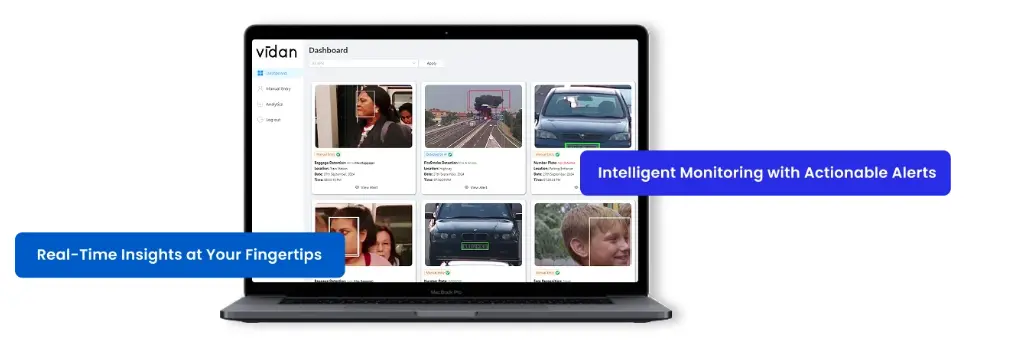
Our healthcare video surveillance is built on three principles: accuracy, speed, and respect for privacy. Our models are trained on healthcare-specific scenarios. Our alert logic is calibrated to reduce false positives that cause alarm fatigue. Our dashboards are designed for security teams who need clarity under pressure.
Real-Time Alerts, Not Morning Reports
Vidan AI delivers alerts to the right person at the right time through the right channel. Security officers receive mobile push alerts. Nursing supervisors receive zone-specific notifications. Administrators receive incident summaries.
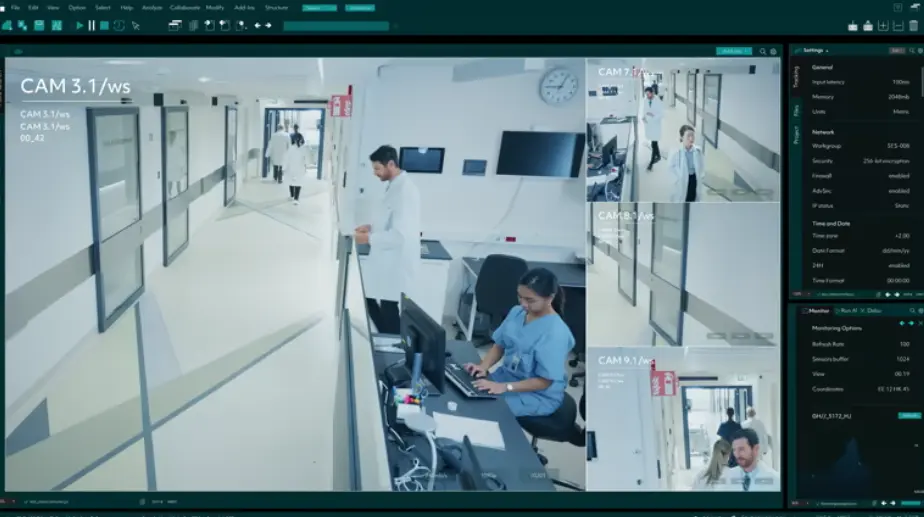
No one is wading through hours of footage trying to find the moment something went wrong. The system surfaces it immediately.
Integration Without Disruption
Vidan AI integrates with existing hospital access control systems, nurse call systems, and incident management platforms. Hospitals do not need to rip out infrastructure. They need intelligence layered onto what they already have.
The Measurable Impact of AI Security in Healthcare
A few outcomes hospitals using AI security consistently report:
Incident response times drop significantly when real-time alerts replace manual monitoring. Patient elopement events are caught earlier, often before the patient reaches an exit. Staff assault incidents in AI-monitored zones decrease as behavioral detection enables early intervention. Pharmaceutical diversion cases surface faster through access pattern analysis.
These are not projections. These are patterns Vidan AI sees across healthcare deployments.
The Shift Every Hospital Leadership Team Needs to Make
Hospital security systems AI is not a luxury for large health systems. It is rapidly becoming a baseline expectation for any facility that takes patient and staff safety seriously.
The question is no longer whether hospitals need AI security. The question is how quickly they can deploy it before the next preventable incident occurs.
Every hour a hospital operates with passive surveillance is an hour of unnecessary risk.
Conclusion
Hospitals are not just buildings. They are places where lives hang in the balance every minute of every shift. Hospital security systems AI is not about surveillance for its own sake. It is about giving healthcare teams the ability to act before harm occurs, protect staff who cannot always protect themselves, and ensure every patient is safe, whether or not someone is physically watching their room.
Vidan AI was built to make that possible. Not eventually. Right now. If your hospital is still relying on yesterday’s security tools to face tomorrow’s threats, it is time for a conversation.
Try Vidan AI today and see what real-time, AI-powered healthcare protection looks like in practice.