
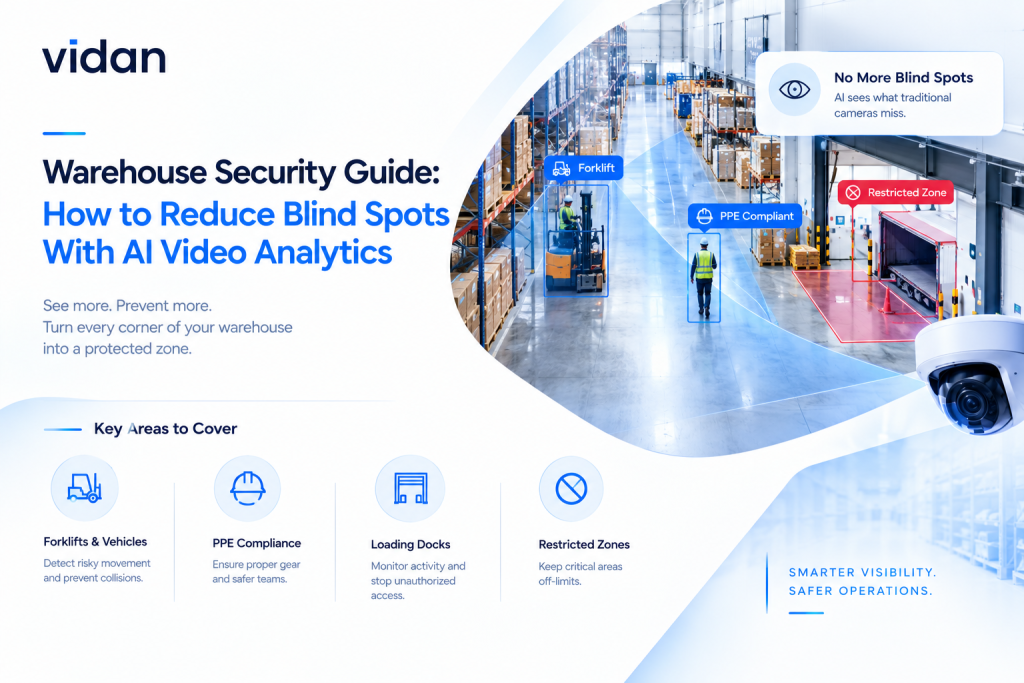
Blind spots do not steal your inventory. People do. But blind spots are exactly where they choose to do it.
A warehouse security system built around fixed cameras and human review misses the gaps between camera angles, the loading dock at shift change, and the aisle behind the last pallet stack. Those gaps are where losses happen. AI video analytics closes them by watching every angle, every second, without needing a person glued to a monitor.
Warehouses and distribution centers remain one of the most frequently targeted location types for theft in the United States, based on CargoNet data cited in industry loss reports. Closing blind spots is not a nice-to-have. It is the difference between catching a theft in progress and finding an empty pallet the next morning.
Key Takeaways
- A blind spot is any area a camera or guard cannot see in real time, and most warehouses have more of them than owners realize.
- Loading docks are the single most exploited blind spot, tied to the majority of reported warehouse theft incidents.
- AI video analytics does not just record. It detects loitering, unauthorized access, and unusual movement, then alerts staff before a loss occurs.
- A layered warehouse security system combining cameras, access control, and alarms closes far more gaps than any single tool alone.
- Vidan AI applies computer vision trained specifically on warehouse and logistics environments, not generic retail footage.
What Counts as a Blind Spot in a Warehouse?
A blind spot is anywhere a camera cannot see, a guard cannot reach fast enough, or a system cannot flag activity in real time.
Common blind spots include:
- Corners behind tall racking or pallet stacks
- Loading dock edges just outside a camera’s field of view
- Employee entrances used during shift changes
- Exterior perimeter gaps between fixed camera zones
- Areas covered by older analog cameras with poor night vision
Each of these gaps gives someone a window to act unseen, even for just a few minutes.
Why Blind Spots Cost More Than You Think
The financial case for closing blind spots is not abstract. Cargo and warehouse theft losses climbed sharply in 2025, rising 60% year over year to nearly $725 million, with the average loss per theft reaching $273,990, according to Verisk’s CargoNet division. Cargo theft losses in Q2 2026 alone reached $304.6 million, more than double the same quarter the prior year, with metal and high-value technology among the most targeted goods.
Warehouses and distribution centers sit near the top of the list of targeted facility types for these incidents. Loading docks alone are tied to a large majority of reported warehouse theft events, since goods sit exposed during transfer and staff attention is split across multiple trucks.
Internal theft compounds the problem. Employee-related losses account for a significant share of total warehouse shrinkage, often more than external theft, because internal actors already know where the blind spots are.
How a Warehouse Security System Closes Blind Spots
A modern warehouse security system does three things older setups cannot. It sees the whole facility at once. It understands what it is seeing. And it acts on that understanding immediately.
Full Coverage Mapping
Cameras are placed based on a floor plan analysis, not guesswork. Every dock door, aisle end, and entry point gets assigned coverage, and gaps are identified before installation, not after a loss.
Real-Time Detection
AI video analytics scans footage continuously for defined behaviors. Loitering near high-value inventory, a door propped open after hours, or a person entering a restricted aisle all trigger instant alerts.
Automated Response
Instead of a security team reviewing hours of footage, the system flags the exact moment something needs attention. Response time drops from hours to seconds.
This approach differs fundamentally from relying on staff to monitor multiple screens, as explored in detail in the article “Warehouse Security Guards vs. AI Video Analytics: Which Provides Better Protection?”
Traditional Cameras vs AI Video Analytics
| Feature | Traditional Camera System | AI Video Analytics |
| Monitoring | Requires a person watching or reviewing later | Monitors continuously, no human required |
| Detection | Only what a person notices in real time | Flags specific behaviors automatically |
| Response speed | Minutes to hours after the fact | Seconds, with live alerts |
| Coverage | Fixed angles, common blind spots | Full coverage with gap analysis |
| Cost over time | Rises with added guard hours | Scales with software, not headcount |
A basic warehouse video surveillance setup records everything but understands nothing. Analytics turns that raw footage into actionable warnings.
Building a Layered Warehouse Security System
No single tool closes every blind spot. A layered approach stacks multiple defenses so a gap in one layer gets caught by another.
Perimeter layer
Exterior warehouse security cameras, motion-activated lighting, and fencing deter intrusion before it starts.
Access layer
Keycard or biometric access control limits who can enter specific zones, creating a record of every entry and exit.
Interior layer
Indoor cameras paired with a warehouse security camera system running analytics catch what happens after someone is already inside.
Response layer
A connected warehouse alarm system triggers immediate notifications to on-site staff or a remote monitoring team the moment a rule is broken.
For facilities managing compliance obligations, addressing physical security gaps often aligns with broader operational requirements outlined in the Warehouse Health and Safety Requirements: A Practical Compliance Checklist for 2026.
What to Look for in a Warehouse Video Security System
Not all platforms are built the same. Before choosing a warehouse video security system, confirm it covers these basics.
- Does it support both indoor and outdoor camera integration on one platform?
- Can it flag loitering, tailgating, and unauthorized access without manual review?
- Does it retain footage long enough to cover claims, which can surface weeks after an incident?
- Can alerts reach mobile devices in real time, not just a central control room?
- Does the vendor understand logistics environments specifically, or is it repurposed retail software?
That last question matters more than it sounds. Generic detection models trained on storefronts do not read forklift traffic or pallet movement the same way.
⚙️ Custom Detection Models
Off the Shelf Models Don’t Know Your Facility. Ours Learn It.
Vidan AI’s machine learning engineers build detection models trained on your environment, not generic footage from somewhere else.
How Vidan AI Approaches Warehouse Security
Vidan AI was built around one idea. Security software should understand the environment it is watching, not just record it.
Instead of adapting retail loss prevention tools to warehouse floors, Vidan AI’s computer vision models are trained specifically on logistics and distribution footage. That means the system already recognizes forklift paths, dock door activity, and staging area patterns most platforms treat as noise.
A few things set the approach apart:
- Detection tuned for warehouse-specific risks like dock theft, unauthorized staging area access, and after-hours entry
- Alerts sent directly to operations teams, not buried in a dashboard nobody checks
- Deployment that works with existing camera infrastructure in many cases, reducing hardware replacement costs
- Coverage gap analysis before installation, so blind spots are identified on paper before they become losses in practice
The goal is not more footage. It is fewer blind spots and faster answers when something goes wrong.
Final Word
Closing blind spots is not about buying more cameras. It is about making sure every camera, sensor, and alert works together as one warehouse security system instead of separate tools that do not talk to each other.
Facilities that pair full coverage with real-time analytics catch problems while they are still preventable, not after the loss is already booked.