
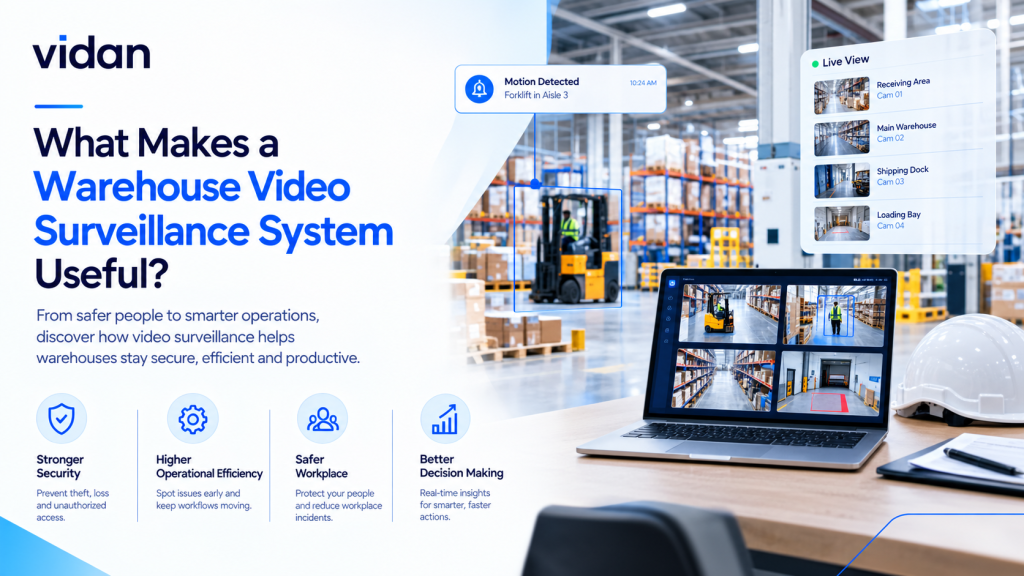
Cameras alone don’t stop theft. Cameras that think do. A warehouse video surveillance system only earns its cost when it can spot a threat, flag it in real time, and hand your team proof instead of hours of raw footage. Most warehouses already have cameras. Few have a system that actually works for them.
Key Takeaways
- A useful system combines AI analytics, real-time alerts, and searchable footage, not just recording.
- Warehouse theft costs businesses hundreds of millions annually, and most incidents happen in blind spots.
- AI forklift safety monitoring can catch near misses before they become injuries or OSHA violations.
- Coverage, integration, and response speed matter more than camera count.
- Vidan AI builds surveillance around detection and action, not passive recording.
The Core Requirements of a Warehouse Video Surveillance System
A useful warehouse video surveillance system does three things well. It sees every high-risk area. It understands what it sees. And it tells the right person fast enough to act.
Coverage without intelligence just creates more footage to review after the fact. Intelligence without coverage leaves blind spots that thieves and unsafe drivers both exploit. The two have to work together.
The Three Pillars of a Functional System
- Full coverage of loading docks, storage aisles, entry points, and yard perimeters
- Real-time analytics that classify people, vehicles, and behavior automatically
- Instant alerts routed to security staff or managers, not buried in a daily log.
Miss any one of these and the system becomes a camera archive rather than a security tool.
Analytics That Run on Your Existing Cameras
Vidan AI’s software applies real-time video analytics to your current camera infrastructure, detecting and classifying events without new hardware.
Why Coverage Alone Isn’t Enough
Cargo theft hit 1,778 reported cases in 2022, with an average loss of roughly $214,000 per incident, according to CargoNet data reported by DeepSentinel. CargoNet recorded 1,778 theft instances in 2022 with an estimated loss of just over $223 million, and the average value from a single cargo theft event was $214,104. Warehouses and distribution centers were the single most targeted location type, ahead of parking lots. Warehouses and distribution centers ranked as the number one targeted location for cargo theft.
Most of these losses trace back to gaps a basic camera setup never catches. A warehouse security camera system with fixed angles and no analytics records the theft. It rarely prevents it.
What Coverage Gaps Usually Look Like
| Blind Spot | Common Risk |
| Dock doors during shift change | Unrecorded pallet movement |
| Yard perimeter at night | Trailer breaches |
| Aisle intersections | Forklift and pedestrian near misses |
| Employee exits | Internal theft |
Our warehouse security guide explains how to spot blind spots across your facility and figure out where your cameras may be missing critical activity.
Forklift Safety Is a Surveillance Problem Too
Forklift incidents remain one of the most persistent injury sources in warehouse operations. OSHA data shows roughly 97,000 forklift-related injuries occur annually in the United States, including about 35,000 classified as serious.OSHA data confirms 97,000 annual forklift injuries, including 35,000 serious and 62,000 non-serious, happen each year across American workplaces. Fatalities from forklift incidents have also trended upward alongside e-commerce growth. Fatalities have climbed 30% over the past ten years, coinciding with increased e-commerce demand and expanded warehouse operations.
AI forklift safety monitoring changes this equation. Instead of reviewing footage after an accident, the system flags unsafe speed, blocked sightlines, or pedestrian proximity as it happens.
Facilities using proactive vehicle monitoring have seen dramatic results. Organizations implementing AI-powered site intelligence have cut forklift safety events by 86% within three months of deployment. That’s the difference between a camera and a warehouse video surveillance system built for prevention.
Staying Ahead of OSHA Requirements
Warehouse OSHA compliance depends on documented safety practices, not good intentions. A surveillance system that timestamps incidents, records near misses, and logs equipment checks gives safety teams something inspectors and insurers both accept.
Documentation: A Strong System Should Provide
- Timestamped footage of any reportable incident
- Searchable logs by zone, shift, or equipment ID
- Automated alerts for PPE or safety zone violations
- Exportable reports for audits or insurance claims
For a full breakdown of requirements by facility type, see our Warehouse Health and Safety Requirement Checklist for 2026.
Guards, Cameras, or Both?
Security guards catch what they happen to see. Cameras with AI catch what happens everywhere, all the time, without fatigue. Neither replaces the other completely, but the economics have shifted.
A single guard covers one physical location at a time and costs a recurring salary. An AI-powered warehouse video surveillance system covers every camera feed simultaneously and never clocks out. We take a closer look at guards and AI video analytics in our guide, Warehouse Security Guards vs. AI Video Analytics: Which Provides Better Protection?
How Effective Camera Solutions Perform
Not every logistics camera solution delivers real protection. Effectiveness comes down to detection accuracy, alert speed, and how well the system integrates with existing operations. The short version: a system is only as effective as its false positive rate is low and its alert routing is fast.
Vidan AI’s Approach to Warehouse Surveillance
Most vendors sell cameras. Vidan AI builds a security layer.
Our platform runs AI directly on live video feeds across docks, aisles, and yards. It classifies people, vehicles, and behavior in real time, then routes alerts to the right team member in seconds, not after a review session the next morning.
What this looks like in practice:
- Automatic detection of unauthorized personnel or vehicles
- Forklift proximity and speed monitoring tied to safety zones
- Theft pattern recognition across loitering and repeat access attempts
- Centralized dashboards for multi-site operations
This is what separates a functional warehouse video surveillance system from a wall of screens nobody watches.
How to Choose the Right Setup for Your Facility
Not every warehouse needs the same setup. Matching the system to your actual risks matters more than chasing the highest camera count.
Start With Your Coverage Gaps
Walk your facility and mark every point where footage currently goes dark. Loading docks, aisle intersections, and after-hours yard access are the usual suspects.
Match Analytics to Real Risks
A retail distribution center needs different detection than a cold storage facility. Prioritize the analytics that address your specific loss patterns, not a generic feature list.
Plan for Integration, Not Just Installation
A setup that can’t talk to your access control or existing cameras creates more silos, not less risk. Confirm integration capability before signing anything.
What This Actually Costs, and What It Saves
Budget conversations stall projects more than any other factor. Here’s how to think through it.
| Factor | What Drives the Cost |
| Facility Size | Number of zones and square footage |
| Existing Hardware | Reusable cameras cut installation cost |
| Analytics Depth | Basic motion detection vs. full behavior analysis |
| Integration Needs | Access control, alarms, or ERP connections |
The payback typically comes from three places. Fewer theft losses, fewer forklift incidents, and faster incident investigation when something does happen.
Mistakes That Quietly Waste the Investment
Plenty of facilities install cameras and still get surprised by losses. Usually one of these is why.
- Buying more cameras instead of better analytics
- Routing alerts to an inbox nobody checks in real time
- Leaving the yard and parking areas uncovered
- Skipping staff training on how to act on alerts
Rollout Timeline: What to Expect
A properly scoped install doesn’t happen overnight, but it shouldn’t take months either.
- Site assessment to map blind spots and risk zones
- Installation and calibration of cameras and analytics models
- Staff training so alerts turn into action, not noise
- Go live with ongoing monitoring and tuning
Most facilities move from assessment to full operation within a few weeks, depending on site size.
Conclusion
A warehouse video surveillance system earns its place in your budget when it prevents losses instead of just recording them. That means real coverage, real analytics, and alerts that reach a person fast enough to matter.
Theft, forklift injuries, and compliance gaps all trace back to the same root cause: blind spots and delayed response. Close those gaps, and the rest follows.
Ready to see what AI-powered coverage looks like on your floor? Talk to Vidan AI and get a walkthrough built around your facility, not a generic demo.