
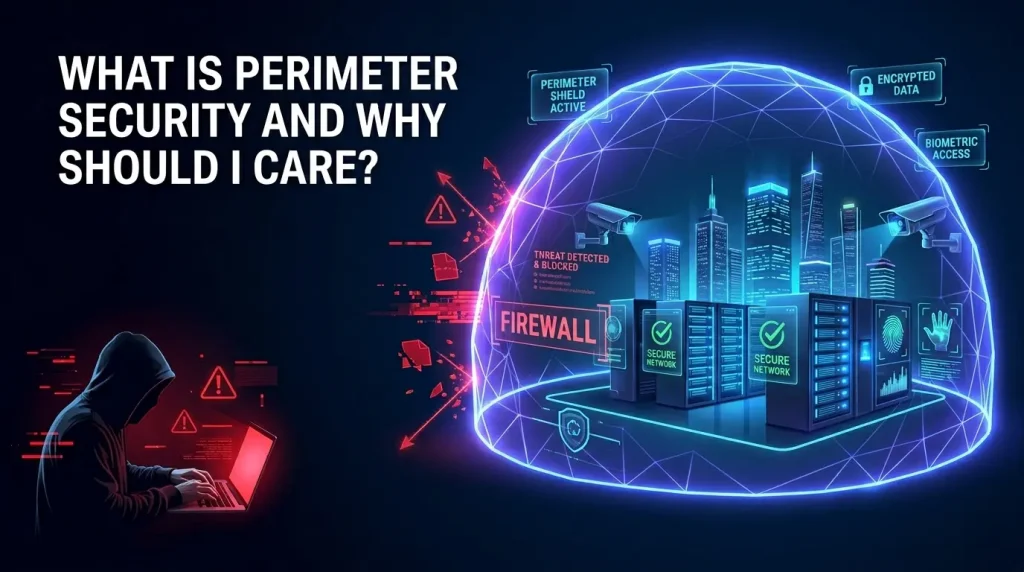
A locked gate stopped threats in 1995. Today, intruders study your blind spots before you even know they exist.
Perimeter security is no longer about walls and wire. It is about knowing what approaches your boundary before it becomes a problem. Businesses that rely on physical barriers alone are operating on borrowed time.
At Vidan AI, we see this gap every day. A perimeter check should not be a manual walkthrough at 2 AM. It should be continuous, intelligent, and automated.
This blog breaks down what perimeter security really means, why most setups fail, and what actually works in today’s threat environment.
Key Takeaways
- What perimeter security actually means in 2026
- Why a single breach can cost more than your entire security budget
- How smart technology has replaced outdated methods
- What Vidan AI does differently to protect your boundary
The Real Definition Most Security Guides Get Wrong
It Is Not Just a Fence
Perimeter security is the first layer of protection around any physical space. It includes everything designed to detect, delay, or deny unauthorized access before someone reaches your core assets.
That includes fencing, lighting, cameras, sensors, and access control. But the layer most businesses skip is intelligence.
The Three Zones You Must Protect
- Zone 1: The outer boundary: This is where threats first appear. Detection here gives you maximum response time.
- Zone 2: The buffer zone: This is the space between your outer boundary and your building or critical infrastructure. This zone buys you time.
- Zone 3: The inner perimeter: This is your last line. By the time a threat reaches here, you have already lost the advantage.
Most businesses only protect Zone 3. That is like locking your bedroom door but leaving your front door wide open.
Why Traditional Perimeter Methods Are Failing Right Now
The Human Attention Problem
Security guards are valuable. But human attention fades. Studies show guard effectiveness drops significantly after 20 minutes of routine monitoring.
A single guard watching 40 camera feeds cannot catch everything. Something will slip through.
The Technology Gap
Old motion sensors trigger false alarms constantly. Businesses start ignoring alerts. Then a real threat occurs and the alert gets dismissed as another false positive.
This is the boy-who-cried-wolf problem. It is more dangerous than having no alert at all.
Facilities managing multiple locations face this even more acutely. The benefits of monitoring multiple construction sites remotely for better security are impossible to achieve without intelligent, centralized perimeter visibility.
What a Modern Perimeter Check Looks Like
A proper perimeter check today involves layered detection, not a single trigger point.
Detection Technologies That Actually Work
AI-Powered Video Analytics
Traditional cameras record. Smart cameras analyze. AI video analytics can distinguish between a blowing paper bag and a crouching person. That difference is the gap between a false alarm and a real response.
Thermal Imaging
Visible light cameras fail in darkness. Thermal cameras detect heat signatures regardless of lighting conditions. For outdoor perimeters, this is non-negotiable after sunset. How Night Vision Cameras Work directly impacts whether your outer zone is visible or effectively blind for eight hours a day.
Acoustic Sensors
These detect sounds associated with intrusion: glass breaking, fence cutting, or footsteps on gravel. Combined with video, they create a multi-sensory detection layer.
Industries Where Perimeter Security Is Not Optional
Automotive Dealerships
Vehicle theft is sophisticated today. Groups scout dealerships for days before acting. Automotive Dealership Security Solutions require perimeter detection that catches surveillance behavior, not just the theft itself.
Warehouses and Distribution Centers
Large perimeters. High-value inventory. Minimal overnight staff. This combination creates serious vulnerability. A warehouse surveillance solution must cover every access point with intelligent detection, not just camera coverage.
Shared Facilities
Even smaller spaces have perimeter needs. Consider access-controlled areas like laundry rooms or lockers in apartment buildings. Tracking who enters and exits matters.
The Cost of Getting Perimeter Security Wrong
Let’s be direct. A perimeter failure is not just a theft. It is:
A liability event. A compliance issue. An insurance problem. A reputation crisis.
The average commercial burglary costs businesses between $8,000 and $25,000 per incident when you factor in property damage, inventory loss, and operational disruption.
For businesses handling sensitive data, vehicles, or specialized equipment, that number multiplies quickly.
One incident that a proper perimeter check system would have prevented can cost more than five years of a proper security solution.
How Vidan AI Approaches Perimeter Security Differently
Most security companies sell you cameras. Vidan AI builds your intelligence.
What Sets Vidan AI Apart
Behavioral Detection, Not Just Motion
Our system does not just detect movement. It analyzes behavior. A person pacing your fence line at 3 AM triggers a very different alert than a delivery driver at noon.
Real-Time Alerts With Context
When Vidan AI detects a perimeter event, you receive an alert with video context. Not a siren. Not a generic notification. Actual visual intelligence that tells you what is happening and where.
Scalable Across Every Facility Type
Whether you manage a single dealership or a multi-site operation, our platform scales without adding complexity.
No False Alarm Fatigue
Our AI filters environmental noise. Wind, rain, animals, and lightning changes do not trigger alerts. Only genuine threats do.
Vidan AI is built specifically for businesses that cannot afford to guess. Every perimeter check is automated, documented, and actionable.
Your Perimeter Is Only as Strong as Your Weakest Detection Point
This is the truth most security vendors do not tell you.
You can spend hundreds of thousands on fencing, lighting, and cameras. But if your detection logic is weak, a determined intruder will simply find the gap.
Perimeter security is not about building an impenetrable wall. It is about making every approach visible, every anomaly detectable, and every alert meaningful.
The businesses that get this right do not just protect their assets. They reduce insurance premiums, meet compliance requirements, and create environments where employees feel genuinely safe.
Conclusion
Every business that has suffered a serious security breach had one thing in common: they were reacting to a threat instead of detecting it early.
Vidan AI exists to change that. Our intelligent perimeter security solutions are built to catch threats before they become incidents.
If your current setup relies on a morning perimeter check walkthrough and a basic camera system, you are not protected. You are just hoping.
Try Vidan AI today and find out what intelligent perimeter security looks like for your specific facility.