
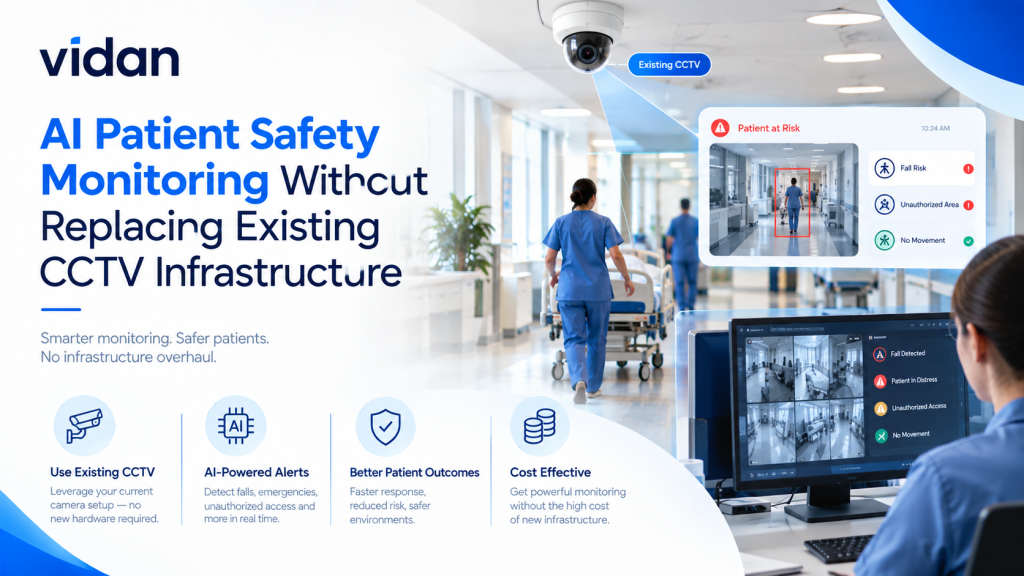
A patient falls in an unmonitored room. Staff finds out three minutes later. That gap is where most preventable injuries happen. AI patient safety monitoring closes it by turning cameras hospitals already own into a live risk detection layer, without a forklift upgrade or a new wiring project.
Key Takeaways
- AI patient safety monitoring runs on top of existing hospital CCTV. No camera swap required.
- Fall detection alerts staff in seconds, not minutes.
- Wandering detection flags patients who leave a designated zone, especially in dementia and behavioral health units.
- Integration typically takes days, not months, because it uses software layered over current video feeds.
- Hospitals report faster response times and lower liability exposure after deployment.
- Vidan AI builds this specifically for healthcare environments, with HIPAA-aligned data handling.
What Is AI Patient Safety Monitoring?
AI patient safety monitoring is a software system that watches hospital video feeds for safety events. It detects falls, wandering, and unusual movement patterns. It then sends an alert to staff, usually within seconds.
Unlike traditional CCTV, which only records for later review, this system acts in real time. A nurse does not need to be watching a monitor. The software watches instead, and only flags what matters.
This matters because most hospital cameras today are passive. They capture footage that gets reviewed after an incident, not before one. Patient video monitoring built on AI changes that timeline entirely.
Why the Distinction Matters
Passive CCTV answers “what happened.” Active AI monitoring answers “what is happening right now.” That shift is the entire value proposition for safety teams under pressure to reduce incident response time.
🏥 Healthcare Video Surveillance
Give Your Hospital Cameras a Second Set of Eyes
Vidan AI adds real-time fall detection, wandering alerts, and restricted zone monitoring to the CCTV your hospital already runs. No new cameras, no rip and replace.
How Does AI Fall Detection Work in Hospitals?
Fall detection is the most requested feature among hospital security and clinical operations teams. Here is the basic sequence.
- Existing cameras feed video into the analytics platform.
- The software tracks patient posture and movement in each frame.
- A sudden change in body position triggers a fall signature.
- An alert routes to the nearest staff device within seconds.
- Staff confirm the event and respond, often before the patient tries to stand.
This is where AI fall detection hospital teams rely on most heavily, because falls remain one of the top causes of inpatient injury nationwide. A well-tuned hospital fall detection system reduces both injury severity and the paperwork that follows a fall event.
Response speed is the whole point. A three-minute delay can turn a minor stumble into a hip fracture. A ten-second alert usually does not.
Why Do Hospitals Need Patient Wandering Detection?
Wandering is a distinct risk from falling, and it deserves its own detection logic. Patients with dementia, delirium, or certain behavioral health diagnoses can leave a unit unnoticed.
Patient wandering detection works by defining a virtual boundary around a care zone. If a patient crosses that line without staff nearby, the system sends an immediate alert. No physical fence, no extra hardware, just a software rule applied to video already being captured.
Facilities that have read our article on why hospital security access controls need AI to remain effective will recognize the pattern. Static rules and manual checks fail quietly. Automated detection does not.
What Wandering Detection Prevents
- Elopement from behavioral health or memory care units
- Delayed discovery of a patient in a restricted area
- Missed handoffs between shift changes where a wandering risk goes unflagged
Which Hospital Units Benefit Most From AI Monitoring?
Not every unit needs the same detection profile. Coverage should match the risk pattern of each floor.
Intensive Care Units
- Immobility alerts for sedated or post op patients
- Rapid fall detection where staff ratios are already stretched
Behavioral Health Units
- Wandering and elopement alerts across every exit point
- Unusual movement patterns flagged for staff review
Medical-Surgical Floors
- Fall detection for post-surgical and elderly patients
- Bed exit alerts before a patient attempts to stand alone
Pediatric and NICU Units
- Restricted zone monitoring around incubators and cribs
- Unauthorized visitor alerts near vulnerable patients
Each profile runs on the same underlying platform. Only the zone rules and alert thresholds change.
Can AI Monitoring Work With Existing CCTV Infrastructure?
Yes. This is the question hospital IT and facilities teams ask first, and it deserves a direct answer.
Most healthcare facilities already operate hundreds of CCTV cameras across floors, hallways, and patient rooms. Ripping that out and replacing it is expensive and disruptive. AI monitoring platforms are built to avoid that entirely.
| Traditional CCTV Upgrade | AI Overlay Approach |
| New cameras and cabling required | Uses cameras already installed |
| Weeks to months of installation | Days to configure and deploy |
| High upfront capital cost | Software licensing, lower entry cost |
| Passive recording only | Real-time alerts and analytics |
AI healthcare surveillance software connects to existing video management systems through standard integrations. Most deployments do not touch a single camera on the wall.
What Does Healthcare Video Analytics Actually Detect?
Beyond falls and wandering, healthcare video analytics covers a wider range of safety and operational signals. Breaking it down by category helps clarify scope.
Clinical safety events
- Falls and near falls
- Prolonged immobility, which can signal a medical event
- Patient wandering outside a defined zone
Security events
- Unauthorized access to restricted areas
- Loitering near medication rooms or NICU units
- Tailgating through badge-controlled doors
Operational signals
- Room occupancy trends
- Staff response time to alerts
- Bottlenecks in hallway traffic during shift changes
When developing a comprehensive security roadmap, teams often use our guide, “How Hospital Security Systems AI Is Redefining Patient and Staff Protection,” because patient safety and facility security typically rely on the same foundational platform.
What Should Hospitals Look for When Choosing a Vendor?
Not every AI monitoring vendor builds for healthcare specifically. A few criteria separate a strong fit from a poor one.
Integration capability
- Works with your existing camera brands and video management system
- Does not require new network infrastructure or rewiring
Compliance and data handling
- HIPAA-aligned storage and access controls
- Retention policies set by the facility, not fixed by the vendor
Alert accuracy
- Low false positive rate, tuned per unit type
- Clear escalation paths so alerts reach the right staff member
Support and rollout
- A defined go-live timeline, not an open-ended project
- Ongoing tuning after launch, not a one-time setup
Facilities that skip this checklist often end up with alert fatigue, or a system nobody fully trusts within a few months.
How Vidan AI Approaches Patient Safety Monitoring
“The goal was never to replace what hospitals already trust. It was to make it think.”
Vidan AI was built around one constraint hospitals gave us directly: do not force a hardware overhaul. Every deployment starts with an assessment of the cameras already in place, followed by a software integration that activates detection without new wiring.
AI hospital monitoring through Vidan AI includes fall detection, wandering alerts, restricted zone monitoring, and audit-ready incident logs. Data processing follows HIPAA-aligned handling standards, and footage retention policies are configured per facility, not forced by the vendor.
Why facilities choose this path:
- No camera replacement cycle
- Deployment measured in days
- Alerts routed directly to existing staff devices
- Configurable zones per unit, not a one-size-fits-all rule set
MACHINE LEARNING ENGINEERING
Build AI That Can Spot Risk Before Staff Do
What could your existing hospital cameras detect if they could recognize falls, wandering, and restricted zones in real time? Our ML engineers build and tune computer vision models for your environment.
What Is the ROI of AI Hospital Monitoring?
Cost avoidance is the clearest way to frame return on investment here. A single serious inpatient fall can cost a hospital tens of thousands of dollars in extended stay, treatment, and liability exposure, according to reporting from the Joint Commission on patient safety events.
Where the savings typically show up:
- Reduced fall-related injury claims
- Fewer prolonged hospital stays tied to preventable incidents
- Lower staffing burden from manual video review
- Faster incident documentation for compliance audits
The Bottom Line
AI patient safety monitoring is not a hardware project. It is a software layer that makes the cameras hospitals already own actively protective instead of passively recording. Fall detection, wandering alerts, and restricted zone monitoring all run without a single new camera on the wall.
Ready to see what your existing cameras can actually do? Vidan AI turns the system you already have into a real-time safety net, no rip-and-replace required. Book a Demo