
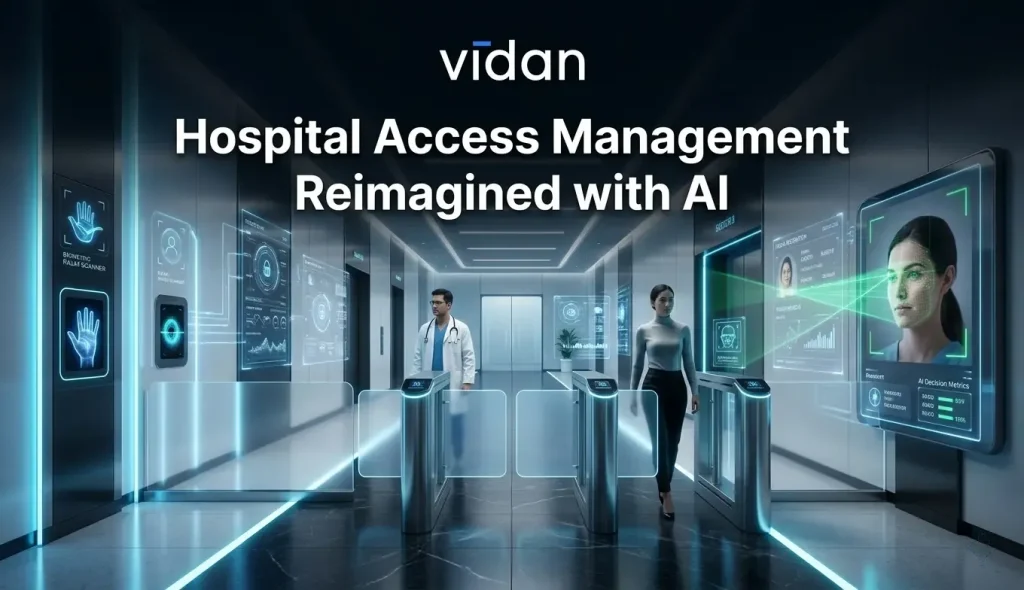
Every 39 seconds, a healthcare data breach or unauthorized access incident occurs somewhere in the world. Yet most hospitals still rely on keycards issued years ago, PIN codes shared between shifts, and security guards stretched thin across massive facilities.
That is not a security strategy. That is a risky proposition.
Hospital security access controls are no longer a passive checkbox on a compliance form. They are the difference between a safe patient environment and a headline no hospital wants to make.
The problem is not that hospitals do not care. They care deeply. The problem is that traditional access systems were never designed to handle the complexity of modern healthcare. AI changes that entirely.
Vidan AI works directly at this intersection of healthcare operations and intelligent security. This blog breaks down exactly why hospitals need AI-powered access control now, not later.
What You Will Take Away from This Blog
- Why traditional access systems are breaking down in real hospital environments
- The specific threats that only AI can detect and stop in real time
- How AI transforms every layer of hospital access management
- What smarter access control looks like when it is working correctly
- How Vidan AI is building the future of healthcare security today
The Cracks in the Old System Are Getting Bigger
Keycards Were Not Designed for This
A hospital is not an office building. It is a living, breathing environment operating 24 hours a day, 7 days a week, across dozens of departments, hundreds of staff members, and thousands of daily visitors. Traditional access control for hospitals relied on magnetic keycards, PIN-based locks, and manual visitor logs. These tools worked reasonably well in simpler times.
Today, they are a liability.
Staff shares access badges informally. Contractors receive temporary credentials that never get deactivated. Visitors wander into restricted zones. Medication storage areas get accessed during shift changes without anyone noticing. None of this shows up on a legacy system report.
The Numbers Tell a Serious Story
Healthcare remains the most targeted sector for physical and digital breaches. The average cost of a healthcare data breach exceeds $10 million. A significant portion of those breaches begin with unauthorized physical access.
Stolen credentials. Tailgating through secure doors. Unauthorized access to pharmaceutical storage. These are not rare events. They are weekly occurrences in under-secured facilities. The old access model was built on trust and schedules. Modern threats do not follow schedules.
What AI Does Differently
It Thinks in Real Time, Not in Retrospect
Traditional systems log what happened. AI-powered systems act on what is happening right now.
When an unauthorized person enters a restricted zone, a legacy system generates a report entry that a security manager might review tomorrow morning. An AI system flags the anomaly instantly, triggers an alert, and can initiate a lockdown protocol within seconds. That difference in time is measured in seconds. The consequences of that gap can last for years.
Behavior Is the New Access Badge
AI does not just check credentials. It evaluates behavior patterns across the entire facility. Is a staff member accessing a pharmaceutical storage room at 3:00 AM for the first time? Is a visitor lingering near the ICU longer than typical patterns suggest? Is someone attempting multiple access points in a short window?
These behavioral signals are invisible to a keycard reader. They are exactly what AI is designed to detect.
Hospital access management systems powered by AI build behavioral profiles over time. Deviations from those profiles trigger intelligent alerts rather than passive log entries.
Layer by Layer: How AI Secures Every Access Point
Entrances and Lobbies
The first line of hospital security is the entrance. AI-powered cameras and facial recognition systems can verify identity, flag watchlisted individuals, and detect unusual crowd behavior before it escalates.
For deeper insight into how this technology works at hospital entrances and in corridors, “How Hospital Security Technology AI Helps Prevent Unauthorized Access“ provides a detailed breakdown of prevention-first AI deployment.
Emergency Departments
Emergency departments are among the most vulnerable areas in any hospital. They operate under chaos by design. Visitors arrive in distress. Staff rotate constantly. Doors open frequently.
AI monitors these conditions continuously. It differentiates between a worried family member and an individual exhibiting threat indicators. It does not slow emergency care. It protects it.
Pharmaceutical and Supply Storage
Drug diversion is one of the most financially and clinically costly problems in healthcare. Traditional lock-and-key systems do not prevent it. They simply create paperwork after it happens.
AI-integrated access control cross-references who entered a pharmaceutical storage area, when, for how long, and whether that access aligns with their role and shift schedule. For facilities looking to close this specific vulnerability, pharmaceutical video surveillance explores how AI surveillance directly addresses drug diversion risks.
Patient Floors and Restricted Wards
Pediatric wards, psychiatric units, and ICUs require layered access restrictions. AI systems enforce these restrictions dynamically.
Role changes update access permissions automatically. Temporary contractors have time-limited credentials that expire without manual intervention. Anomalous access attempts generate immediate escalations rather than end-of-day reports.
After Hours and Low-Traffic Periods
Hospitals do not sleep. But security staffing levels often drop at night. This creates a window that bad actors exploit. Healthcare Video Surveillance maintains the same level of vigilance at 3:00 AM as it does at 3:00 PM.
AI systems integrated with night-monitoring capabilities enhance security without adding staffing costs. How night vision cameras work in AI-enhanced environments demonstrates how low-light surveillance closes the overnight vulnerability that hospitals often overlook.
The Intelligence Behind the Access: AI Video Analytics
Access control does not exist in isolation. It is most powerful when it is connected to a broader intelligence layer.
AI Video Analytics sits at the core of truly intelligent security hospital systems. It does not just watch. It interprets. It correlates access events with video data, movement patterns, and historical behavior to build a complete picture of what is happening across a facility at any given moment.
A staff member who badges into a restricted area and then lingers near medication storage while repeatedly checking the corridor triggers a multi-signal alert. No single event alone would cause a flag. The combination does. This is the difference between surveillance and intelligence.
Why Human Guards Alone Cannot Fill This Gap
The human brain is not designed for sustained vigilance. Studies consistently show that security personnel miss a significant percentage of critical events during extended monitoring shifts. This is not a criticism of security staff. It is a biological reality. AI does not get tired. It does not get distracted. It processes every frame of every camera simultaneously, every minute of every day.
The Scale Problem
A mid-sized hospital might have 50 to 100 camera feeds, dozens of access points, and multiple secure zones. No human team can monitor all of this effectively in real time.
AI scales without friction. Adding a new wing to a hospital does not require hiring additional monitoring staff. It requires expanding the AI coverage layer.
The Speed Problem
Human response to a security event averages several minutes from detection to action. AI-powered systems can detect, classify, and alert within seconds.
In a hospital environment, seconds matter in ways that few other industries understand.
Compliance, Privacy, and Patient Rights: AI Gets This Right
One concern hospitals raise is patient privacy. AI surveillance must be implemented in ways that respect HIPAA and local privacy regulations.
Responsible AI access control systems are designed with privacy as a core constraint, not an afterthought. They anonymize behavioral data. They apply access controls to surveillance footage itself. They generate audit trails that satisfy compliance requirements without exposing unnecessary personal data.
How hospital security systems AI is redefining patient and staff protection addresses the balance between security effectiveness and privacy compliance in detail, a balance that Vidan AI builds into every deployment.
The Vidan AI Difference
Most security technology companies build general-purpose tools and then adapt them for healthcare. Vidan AI takes a different path entirely.
Every access control solution Vidan AI develops is built with healthcare operational realities in mind. Shift rotations. Role-based access hierarchies. Emergency protocol overrides. Visitor management workflows. Regulatory compliance requirements. These are not add-on features. They are foundational design principles.
Real-Time Intelligence Across the Entire Facility
Vidan AI’s platform connects access control data, video surveillance, behavioral analytics, and alert management into a single unified intelligence layer. Security teams do not switch between five different dashboards. They work from one unified view. Threats surface automatically. Responses are faster. Patterns become visible over time.
The Cost of Waiting Is Higher Than the Cost of Acting
Hospitals that delay modernizing their access control do not avoid the cost of security investments. They simply trade a predictable investment for an unpredictable and far more expensive crisis.
A single drug diversion incident. One unauthorized access to patient records. A breach in a restricted clinical area. These events carry financial, legal, reputational, and most importantly, human costs that no hospital budget is designed to absorb comfortably.
The ROI on intelligent hospital access management is not speculative. It is documented in breach prevention, compliance maintenance, operational efficiency, and staff confidence.
Conclusion
Traditional hospital security access controls served their purpose in a simpler era. That era is over. Hospitals today operate in environments too complex, too fast-moving, and too high-stakes for systems that react after the fact. The threats are real. The gaps in legacy access systems are real. The cost of inaction is real.
AI does not replace the human judgment and dedication of healthcare security professionals. It amplifies it. It gives security teams the intelligence layer they need to act faster, see further, and protect more effectively.
The smarter choice is clear. Connect with Vidan AI today and build an access control system your hospital actually deserves.