
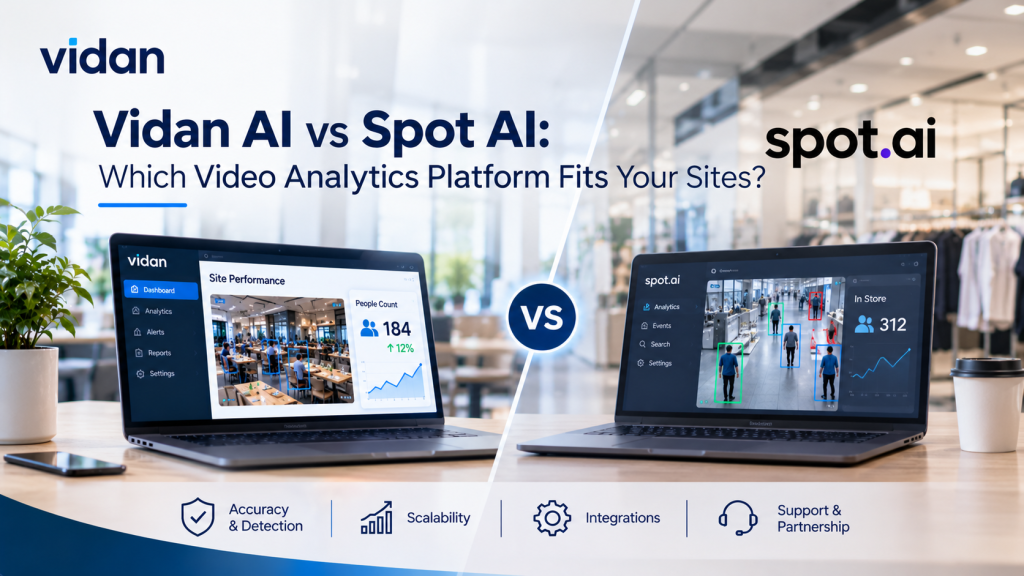
Choose Vidan AI when your business needs video analytics built around specific objects, actions, risks, and operating conditions. Its configurable detection model suits organizations with requirements that standard, preconfigured tools may not cover. Spot AI is worth evaluating when your priority is a broad platform with named AI agents, documented camera protocols, and a self-installation model.
The right choice depends on what your cameras need to detect and what your teams need to do with that information. For businesses with specialized monitoring requirements, Vidan AI vs Spot AI is not simply a comparison of features. It is a decision between a configurable analytics approach and an agent-led platform. This video analytics platform comparison covers how each approach works, where each fits, what to verify before you buy, and a scorecard you can reuse for any vendor.
At a Glance: Vidan AI vs Spot AI
| Evaluation Area | Vidan AI | Spot AI |
| Platform Approach | Configurable video analytics built around defined business requirements | Video AI platform with prebuilt AI agents and custom detection capabilities |
| Detection Focus | Customer-defined objects, actions, and operational conditions | Pretrained agents for security, safety, and operations, plus custom detections |
| Industry Applications | Automotive, retail, food and beverage, logistics, restaurants, textile & manufacturing, QSR construction, healthcare, traffic, and smart cities | Retail, manufacturing, construction, car washes, healthcare, education, and government |
| Alerts | Real-time alerts for detected events | Alerts and agent-led responses, including documented deterrence features |
| Camera Compatibility | Supports ONVIF or RTSP-compatible IP cameras through its Intelligent Video Recorder. IP-capable cameras or a network-enabled NVR/DVR with an accessible RTSP stream URL are required. | Any ONVIF or RTSP IP camera through its Intelligent Video Recorder |
| Integrations | API integration with existing systems | Open APIs for business systems, plus an MCP endpoint for AI assistants |
| Deployment Options | On-premises, cloud, and hybrid architectures | Edge-first recorder architecture with cloud management |
| Pricing | Quoted on request | Per-feed subscription with no mandatory hardware purchase, per Spot AI’s documentation |
| Customer Evidence | Published case study with Trans-Global Solutions (freight cap monitoring) | Multiple named customer case studies |
| Best Fit | Organizations with specialized detection requirements and tailored workflows | Organizations seeking a broad set of ready-made video AI agents |
What Separates Vidan AI from Spot AI?
The biggest difference is how each platform approaches video analytics.
Vidan AI starts with the events a business needs to monitor. Teams can define objects, actions, and conditions that matter to their operations. The platform then uses video analytics to detect those events and send alerts.
Spot AI takes an agent-led approach. Its platform offers named AI agents for security, safety, and operations. It also provides custom detection capabilities through its Iris product.
Both approaches address the limitations of passive CCTV. The distinction lies in how buyers want to define and manage their monitoring requirements.
Vidan AI: Start with the Operational Requirement
Many businesses have monitoring needs that do not fit neatly into standard security categories.
A logistics operator may need to check whether freight caps remain secured. A manufacturer may need to monitor tool usage or restricted production zones. A construction company may need alerts when equipment moves outside approved hours.
Vidan AI is built around these specific requirements.
Its customizable object and action detection lets teams define what cameras should monitor. Published examples include:
- Unauthorized vehicle entry.
- Critical tools and equipment.
- Missing personal protective equipment.
- Running in restricted areas.
- Opening secure doors.
- Prolonged inactivity in high-risk zones.
- Unusual vehicle activity and crowd movement.
This makes Vidan a strong option when the business needs detection rules shaped around its own sites, procedures, and risks. Our AI video analytics software turns live camera feeds into real-time alerts for the events you define.
Spot AI: Start with a Set of AI Agents
Spot AI packages video intelligence through named AI agents. Its published offerings include AI Security Guard, AI Operations Assistant, and AI Safety Manager.
These agents address common monitoring needs.
The AI Security Guard focuses on security events and deterrence. The AI Operations Assistant supports operational monitoring and SOP adherence. The AI Safety Manager identifies workplace hazards and safety concerns.
Spot also offers AI-powered video search and its Iris tool for custom detection. This approach can suit organizations that want to start with a defined set of capabilities. Teams can evaluate the available agents against their security, safety, and operational requirements.
The distinction is not that one platform offers custom detection and the other does not. Both describe custom capabilities. The difference is how the products package their core monitoring experience.
Why Vidan AI Is a Strong Choice for Specialized Video Analytics
A video analytics platform should be evaluated against the events a business needs to catch. A long feature list means little if the system cannot identify the specific activity that creates risk. Vidan AI puts configurable detection at the center of its approach.
Detection Rules Built Around Your Sites
A standard detection library may cover familiar events. Your business may need to monitor something more specific.
Consider a distribution yard with several vehicle entry points. The security team may need to identify unauthorized vehicles entering a restricted area. A manufacturing facility may need to flag workers using tools incorrectly. A restaurant group may need to monitor hygiene procedures across multiple kitchens.
These requirements depend on the location, camera angle, activity, and operating rules.
Vidan AI lets businesses define the objects and actions they want to monitor. Its team can then scope the detection requirements around the intended use case. This is useful when a business needs monitoring that reflects its own operating procedures rather than relying only on a generic detection list.
Industry-Specific Monitoring
A warehouse, restaurant, hospital, and construction site do not face the same risks. Vidan AI’s industry-specific approach addresses different monitoring needs across business environments.
| Industry | Potential Monitoring Requirements |
| Retail | Suspicious activity, product movement, customer flow, and store security |
| Logistics | Freight yard activity, unauthorized vehicle entry, cargo and equipment monitoring, and multi-site visibility |
| Manufacturing | Equipment activity, PPE compliance, tool usage, and production floor safety |
| Construction | After-hours access, equipment movement, missing PPE, and restricted zones |
| Healthcare | Facility monitoring, patient safety, and access to restricted areas |
| Food and beverage | Kitchen activity, hygiene practices, staff movement, and theft risks |
| Smart cities | Traffic violations, crowd movement, vehicle anomalies, and public safety |
The value comes from defining what matters at each location. A monitoring rule for a construction site may not suit a retail store. Vidan’s configurable approach gives businesses room to account for those differences.
Real-Time Alerts Instead of Footage Review
Traditional CCTV records events for later review. Someone still needs to watch the footage or search through recordings after an incident. Vidan AI analyzes video feeds and flags configured events as they occur. Teams receive alerts that help them investigate and respond. For a deeper comparison, read our guide to video analytics vs traditional CCTV.
For example, a warehouse manager may receive an alert when a vehicle enters a restricted loading zone. A security team can review the relevant footage instead of searching hours of recordings.
This changes how teams use their camera infrastructure. Video becomes a source of event notifications, not only a record of past activity.
Deployment Choices for Different Environments
Businesses have different infrastructure, security, and data requirements. Vidan AI states that it supports on-premises, cloud, and hybrid deployment architectures. Its AI video surveillance software page also describes integration with existing systems through APIs and support for legacy cameras.
This gives buyers different deployment models to evaluate.
- On-premises: Consider this option when video processing and infrastructure need to remain within a company’s premises.
- Cloud: Consider this option when teams need centralized access and remote monitoring.
- Hybrid: Consider this option when some processing or data needs to remain local while other functions operate through cloud infrastructure.
The final architecture should be confirmed during technical discovery. Ask where video is processed, where recordings are stored, how long footage is retained, and which data leaves the site.
Delivery and Local Support
Detection quality is only part of the picture. Vidan AI describes its approach as mapping the right video intelligence setup to your risks, budget, and timeline, with one team supporting rollout, tuning, and ongoing support. It lists contact numbers for both the United States and the United Arab Emirates, with locations in Houston and the UAE.
If your sites are in the UAE or the wider GCC, ask each vendor where implementation and support are based, which time zones they cover, and whether on-site visits are included.
What Does Spot AI Offer?
Spot AI has a broader agent-led product presentation. Buyers evaluating it should understand its architecture, available agents, and documented customer outcomes.
AI Agents for Common Operational Needs
Spot AI publishes several named agents.
- AI Security Guard: Detects security events and supports deterrence through features such as talk-down audio, lights, and sirens.
- AI Operations Assistant: Helps teams review operational activity and SOP adherence.
- AI Safety Manager: Monitors workplace safety events and hazards.
- Iris: Supports conversational custom detection and video queries.
Camera and Recorder Architecture
Spot AI documents support for ONVIF and RTSP IP cameras. Its Intelligent Video Recorder provides edge processing and connects to its cloud platform.
Vidan’s public product pages describe support for existing and legacy camera infrastructure. Buyers should still request a written compatibility assessment covering camera models, protocols, video quality, network requirements, and any additional hardware.
Customer Case Studies
Spot AI publishes named customer examples across several industries, including Don Franklin Auto, All Star Elite, and the YMCA of Greater Richmond. These examples give buyers customer references to investigate.
Vidan AI has published case studies with Trans-Global Solutions (freight cap monitoring). Focuses on a specialized requirement rather than a broad collection of security and retail examples.
The number of published case studies is not a complete measure of product capability. Buyers should ask each vendor for references that match their own industry, site conditions, and detection requirements.
Vidan AI vs Spot AI: Which Platform Fits Your Requirements?
The Spot AI vs Vidan AI decision becomes clearer when you compare each platform against the work your cameras need to perform.
Choose Vidan AI for Configurable, Specialized Detection
Vidan AI is the stronger candidate when your requirements begin with a specific operational event.
Consider Vidan when:
- Your team needs to detect objects or actions specific to your business.
- Your monitoring requirements vary across locations.
- Your industry has specialized safety or security procedures.
- You need alerts tied to operational conditions.
- You want to evaluate on-premises, cloud, or hybrid deployment.
- You prefer a solution scoped around your business requirements.
- You want one team supporting rollout, tuning, and ongoing support.
Choose Spot AI for a Broad Agent-Led Platform
Spot AI may suit organizations that want a ready-made set of AI agents for common security, safety, and operational needs.
Consider Spot when:
- Your requirements map closely to its published agents.
- Your IT team needs documented ONVIF or RTSP compatibility.
- You want to assess an edge recorder and cloud dashboard architecture.
- Your organization values a self-installation approach.
- You want to review multiple named customer case studies.
A Practical Framework for Evaluating Both Platforms
Use the following framework to compare Vidan AI and Spot AI against your operational requirements. It also works for comparing other Spot AI competitors and any video analytics vendor on your shortlist.
| Evaluation factor | What to ask | Why it matters |
| Detection fit | Can the platform identify every event on your detection list? | Confirms whether it handles your actual use cases |
| Camera compatibility | Which protocols, camera models, and resolutions are supported, including our oldest cameras? | Avoids surprise hardware costs and gaps in coverage |
| Detection accuracy | How is accuracy measured, and what counts as a missed event? | Makes performance measurable |
| False alerts | How are false positives tracked and reduced? | Helps prevent alert fatigue |
| Deployment | Which architecture fits your infrastructure? | Determines technical and security requirements |
| Data handling | Where is video processed, stored, and retained? | Supports IT and privacy reviews |
| Integrations | Can alerts connect to your existing systems? | Helps teams act on events within existing workflows |
| Multi-site management | Can teams manage permissions and monitoring across locations? | Supports consistent oversight |
| Support | Who configures, tunes, and maintains detections? | Establishes responsibilities after launch |
| Commercial model | What are the software, hardware, setup, and support costs? | Gives finance teams a full cost picture |
Score the Platforms Against Your Actual Requirements
A useful evaluation should give more weight to the requirements that affect daily operations.
For example, a company focused on specialized detection may assign more weight to detection fit than to the number of prebuilt agents. A business with hundreds of existing cameras may give camera compatibility a higher score.
Use a weighted scorecard:
| Criterion | Suggested weight |
| Detection fit | 25% |
| Camera compatibility | 15% |
| Alert accuracy and false positives | 15% |
| Deployment and architecture | 15% |
| Integrations and response workflow | 10% |
| Security and data handling | 10% |
| Support and total cost | 10% |
Score each vendor from one to five. Multiply the score by the criterion’s weight. Use the same test footage and acceptance criteria for both platforms. This gives your team a comparison based on operational fit rather than marketing claims.
What Vidan AI’s Published Case Studies Show
Trans-Global Solutions: Freight Cap Monitoring
Vidan AI’s published case study with Trans-Global Solutions provides a practical example of configurable video analytics in use.
Trans-Global Solutions provides transportation and logistics services on high-value cargo routes. Its monitoring requirement involved the caps used to load and seal liquid cargo on freight trains.
An unsecured cap can create a spill risk. Manual inspection across freight operations can leave gaps between checks. Trans-Global Solutions deployed Vidan AI as a custom video surveillance and analytics system that monitors cargo caps and sends instant alerts when a cap is found unsecured.
The case study reports:
- 10,000+ freight caps monitored
- Up to 99% detection accuracy
- 200% ROI in months
The case study also describes human oversight: operators can flag missed instances, which helps the system improve over time while keeping operators in control. These results are company-reported.
The deployment shows how Vidan AI handles a specialized freight monitoring requirement beyond standard security detection.
Read the Trans-Global Solutions Vidan AI case study to review the deployment.
What Should Buyers Verify Before Choosing Either Platform?
A vendor comparison should lead to a technical evaluation. Public product pages cannot answer every question about your camera estate or operating environment.
Ask both vendors for the following:
Camera Compatibility Documentation
Request a list of supported protocols, camera models, resolutions, frame rates, and video formats. Include your oldest cameras in the assessment.
Do not rely on a general statement about existing camera support. Confirm compatibility with your actual equipment.
A Live Detection Test
Provide sample footage from your sites. Ask the vendor to configure the events your team needs to monitor.
Measure detection accuracy, missed events, false alerts, and alert delivery time. Test different lighting conditions and camera angles.
Deployment Architecture
Request a technical diagram showing where video is processed and stored. Confirm whether the proposed setup requires additional hardware.
Ask how the system handles network interruptions and what happens when a camera or processing device goes offline.
Data Security and Retention
Review encryption, access controls, audit logs, retention settings, and data deletion procedures.
Ask for the relevant certification documents and their current scope. Confirm which services and infrastructure are covered. Vidan AI lists SOC 2 Type II and ISO 27001 on its website; request the current certificates and confirm their scope, as you would with any vendor.
Implementation and Support
Ask who configures the detections, who reviews performance, and who handles changes after deployment.
Request a written rollout plan with milestones, responsibilities, training, and support terms.
Total Cost
Compare the complete cost, not just the subscription.
Include setup, hardware, integration, model configuration, support, storage, and future site additions. Ask how pricing changes as the number of cameras or locations grows.
Final Verdict
Spot AI suits businesses that want ready-made AI agents and a self-installed platform. Vidan AI is a strong fit when your cameras need to detect events specific to your operation, backed by published case studies in freight monitoring and traffic enforcement.
Choose Vidan AI when your cameras need to detect more than standard security events. Its configurable analytics support tailored monitoring across logistics, retail, manufacturing, construction, and other industries.
Ready to define what your cameras should detect? Book a Vidan AI demo.