
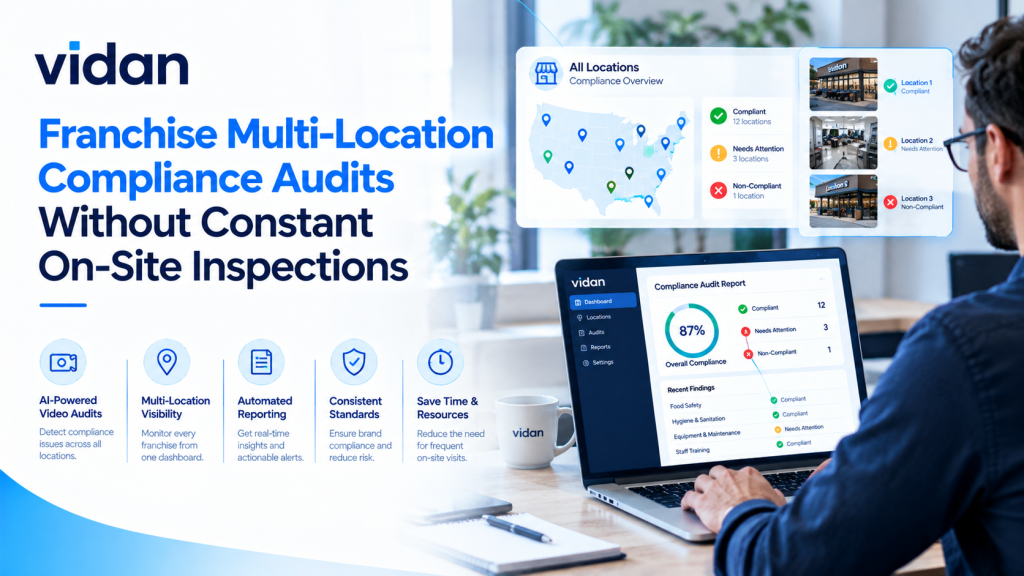
Quick answer: Yes, most franchise standards can be audited remotely. AI compares camera footage to your SOPs. It flags exceptions with video proof. Field visits then shift from routine checks to targeted follow-ups.
A two-hour site visit covers well under one percent of a location’s operating hours. Yet that visit still anchors every franchise multi-location compliance audit at many brands. The rest goes unchecked until a customer, an inspector, or a review site finds the problem first.
Vidan AI built a different model. AI video analytics reads the cameras you already own and checks them against your written standards. Field teams then travel only where the evidence points.
Key Takeaways
- Site visits sample a sliver of operating time. Video covers every open hour.
- Rules must be specific and visible on camera. “Clean store” is vague. “Fry station wiped before close” works.
- AI flags exceptions. People still judge context and coach franchisees.
- Start with five pilot sites and three rules. Expand once scores stabilize.
- Disclose monitoring in franchise agreements and follow local privacy law.
Why Do On-Site Inspections Fall Short at Franchise Scale?
They sample, they cost travel time, and they follow schedules people can anticipate. Three numbers show why the gap keeps widening.
The Network Keeps Growing
845,000 U.S. franchise establishments are projected for 2026, according to the International Franchise Association’s 2026 Franchising Economic Outlook. No field team can visit that many doors often.
Every new unit widens the gap between standards on paper and standards in practice. Franchise operational compliance depends on what happens between visits.
The Stakes Are Not Abstract
48 million Americans get sick from foodborne disease each year, per the CDC’s foodborne illness estimates. That is roughly 1 in 6 people.
Hygiene steps are brand standards. One lapse at one unit can damage every unit under the banner.
Multi-Site Visibility Is A Solved Problem Elsewhere
Operators in other industries hit the same wall. Our guide to logistics security camera solutions for warehouse safety shows how multi-site remote access closes that gap.
🍔 QSR Franchise Compliance
Your Brand Standards Don’t Clock Out. Neither Should Your Audit.
Vidan AI watches counters, prep lines, and drive-thrus at every unit. Missed SOP steps reach your team with video proof attached.
How Does a Franchise Multi-Location Compliance Audit Run Without Constant Visits?
It runs as a loop, not a checklist. We call it the 4C Audit Loop.
| Step | What happens | Who owns it |
| 1. Codify | Turn each SOP into a rule a camera can see | Brand compliance team |
| 2. Capture | Existing cameras feed events to the analytics engine | Vidan AI platform |
| 3. Compare | Events are scored against each rule, per location | Platform plus reviewer |
| 4. Correct | Exceptions reach the franchisee with video proof | Franchisee and field manager |
Why the loop beats a checklist
A checklist ends when the visit ends. The loop never stops running. Each score also tells you which rule is unclear. Weak rules get rewritten. Strict rules stay.
What Can AI Check on Camera, and What Still Needs a Person?
A franchise multi-location compliance audit works best when each rule maps to something a camera can see. SOP compliance monitoring then becomes a yes-or-no question per event.
Checks Video Handles Well
- Protective gear or uniforms worn in required zones
- Opening and closing steps completed on time
- Counter or station staffed during peak hours
- Restricted areas entered after hours
- Visible cleanliness cues in dining and prep areas
Checks That Still Need A Person
- Taste, product quality, and temperature probe readings
- Licenses, pest control logs, and paperwork
- Coaching conversations with franchisees
- Context calls, such as a one-off emergency
Accuracy depends on camera angle, lighting, and how clearly each rule is written. Safety rules follow the same logic. Our guide to monitoring multiple construction sites remotely shows how.
What Does a Remote Audit Scorecard Look Like?
Here is an illustrative scenario. A 40-unit quick service brand tracks three rules per location for 30 days. These figures are examples, not client data.
| Location | Closing steps completed | Stations sanitized | Status |
| Unit 07 | 29 of 30 nights | 30 of 30 | Pass |
| Unit 18 | 22 of 30 nights | 27 of 30 | Coaching call |
| Unit 31 | 15 of 30 nights | 19 of 30 | Field visit |
Only Unit 31 earns a trip. Unit 18 gets a call. Unit 07 needs nothing. This franchise audit tracking view replaces a binder of visit notes.
How to read it:
- Green means no action this cycle.
- Amber means a coaching call within the week.
- Red means a visit and a corrective action with a due date.
Strong franchise compliance monitoring should read like a to-do list. A report nobody opens is not monitoring.
🍽️ Food Safety Visibility
Food Safety Doesn’t Wait for the Next Inspection
How Should You Roll Out Remote Audits Across Franchisees?
Move in four phases. Keep each one small.
- Weeks 1 to 2, choose the pilot. Start the first franchise multi-location compliance audit at five pilot sites. Pick three rules with clear visual proof.
- Weeks 3 to 6, baseline the scores. Run the rules silently. Review exceptions weekly and fix unclear rules.
- Weeks 7 to 10, share the results. Remote store monitoring works best when franchisees see their own scores. Add alerts and corrective action owners.
- Ongoing, expand by risk. Add sites and rules in waves. Low-scoring units get the most attention.
Restaurant brands can compare vendors in our guide to the best remote video monitoring solutions for restaurants.
Franchisee Buy-In And Privacy
- Put monitoring terms in the franchise agreement.
- Post clear notices at each location.
- Keep cameras out of restrooms and break areas.
- Review local video and audio laws with counsel before launch.
This is general guidance, not legal advice.
How Does Vidan AI Handle Franchise Audits?
What we do
Our approach to AI franchise compliance starts with your SOPs, not a template. You define the objects and actions that matter. We tune detection rules by location and camera angle.
How it works
Vidan AI connects to existing and legacy cameras. It runs on-premises, in the cloud, or in a hybrid setup. One centralized dashboard covers every site.
What you get
Real-time alerts for missed steps. Every event logged with video evidence. Clips you can share with franchisees through secure links.
Built around your standards
Off-the-shelf rule packs rarely match a brand’s exact procedures. Our team builds and retrains models around your standards. Your audit then reflects how your brand actually operates.
Your SOPs Are Unique. Your Detection Models Should Be Too.
Work with Vidan AI’s machine learning engineers to build, deploy, and retrain models around your own standards.
Which Myths Slow Down Remote Franchise Audits?
Myth: Multi-location franchise audits need a visit every quarter.
Reality: Risk should set the cadence. Stable units earn fewer visits.
Myth: We must replace our cameras.
Reality: Existing IP cameras usually work. A site survey confirms coverage.
Myth: Franchisees will resist monitoring.
Reality: Shared scores and fewer surprise visits give them a reason to agree.
Myth: AI replaces field auditors.
Reality: AI finds exceptions. Auditors judge context and coach.
In Conclusion
A single visit shows one afternoon. A well-built franchise multi-location compliance audit shows every shift, at every unit, with proof.
Start small. Pick five sites, three rules, and one dashboard. Let the exceptions decide where your team travels.
Vidan AI connects to the cameras you already own and turns your SOPs into automatic checks. Ready to audit more and drive less? Talk to the Vidan AI team, and we will map your first three rules together.