
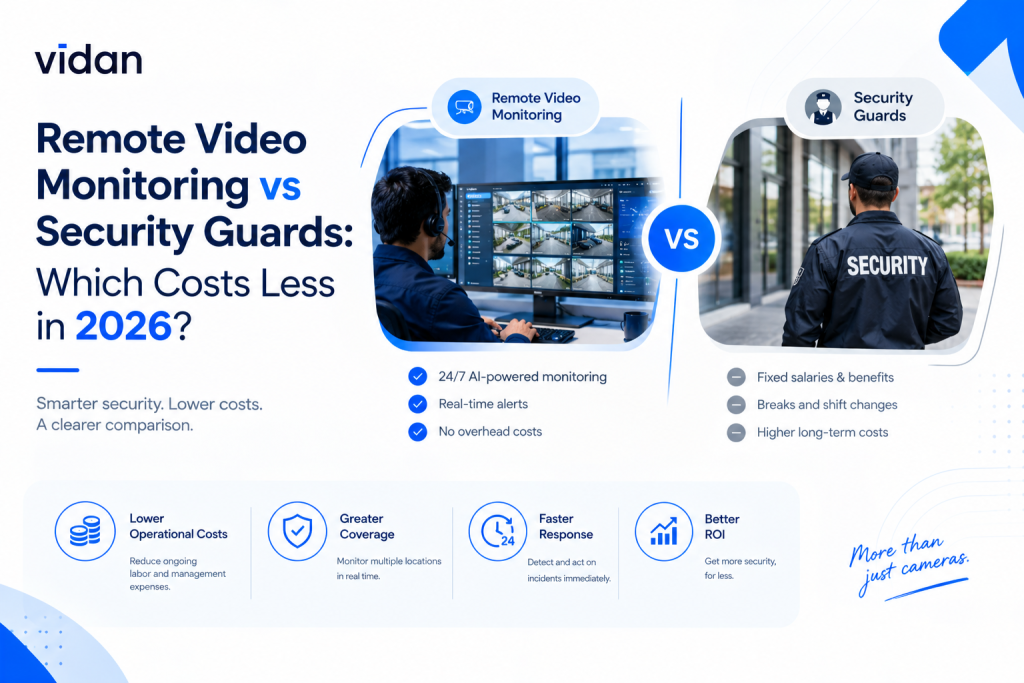
For most commercial properties, comparing remote monitoring against guard coverage is not a close race on price. Monitoring plans typically run $300 to $3,000 a month. A single guard post costs $200,000 or more a year for round-the-clock coverage. The gap holds even after you add cameras, installation, and cloud storage.
This guide breaks down remote video monitoring vs. security guards, using real 2026 pricing, so you can pick the model that actually fits your budget and risk level.
Key Takeaways
- A 24-hour guard post now averages $200,000 or more per year, according to industry pricing guides.
- Commercial remote video monitoring plans typically run $300 to $3,000 per month, based on camera count and coverage hours.
- Guard turnover in the contract security industry runs at 100 to 200 percent annually, driving hidden retraining costs.
- AI-powered detection can cut alert-to-response time from minutes to under 15 seconds.
- The right choice depends on your site risk, footprint, and whether you need a physical presence, not price alone.
What Does a Security Guard Cost in 2026?
Wage vs. Billed Rate
The Bureau of Labor Statistics puts the median U.S. security guard wage at roughly $18.46 an hour, based on its most recent 2026 reporting. The median pay for U.S. security guards is about $38,370 per year or $18.46 per hour, according to federal labor data. That’s the wage a guard takes home, not what your business actually pays once an agency adds its markup.
Billed hourly rates run higher once overhead, insurance, and agency margin are factored in:
- Unarmed guards: $22 to $35 an hour
- Armed guards: $32 to $50 an hour. Unarmed security guards typically bill between $22 and $35 an hour, while armed guards run $32 to $50 an hour, according to industry pricing benchmarks.
What that adds up to annually
Round-the-clock guard coverage for a single post commonly exceeds $200,000 a year. The average cost of hiring a traditional security guard in 2026 has climbed to $25-45 per hour depending on location and experience level, translating to over $200,000 annually for round-the-clock coverage. That figure covers one post only. Multiply it by every gate, dock, or lobby you’re staffing to get a real annual number.
The coverage gap guards can’t avoid
A guard watches one location at a time. Coverage gaps show up during patrols, breaks, and shift changes, when a property has no active set of eyes on it at all. On-site guards can only monitor one location at a time and may miss critical incidents during routine patrols or shift changes.
What Does Remote Video Monitoring Cost in 2026?
Pricing here works differently than guard billing. You’re paying for camera coverage and monitoring hours, not a person’s time on site.
Monthly Cost By Coverage Tier
| Coverage Level | Monthly Cost | What It Covers |
| Basic monitoring (4 to 8 cameras) | $300 to $800 | Low activity sites, overnight coverage |
| Standard coverage (8 to 16 cameras) | $800 to $1500 | Mid-size commercial properties |
| Enterprise solutions (16+ cameras) | $1500 to $3000+ | Large facilities, multiple zones |
Pricing pulled from a 2026 commercial security cost analysis.Basic monitoring (4-8 cameras): $300-800 per month · Standard coverage (8-16 cameras): $800-1,500 per month · Enterprise solutions (16+ cameras): $1,500-3,000+ per month
Per Camera Pricing
- Standard monitoring: $50 to $150 per camera, per month
- AI-enhanced monitoring with human verification: $100 to $200 per camera, per month. Standard remote video monitoring costs $50 to $150 per camera per month for most commercial applications
One-Time Setup Cost
Understanding true remote video surveillance cost means factoring in installation, which is a one-time expense rather than a recurring one. Initial installation and equipment typically run $3,000 to $15,000 depending on property size.
Remote Video Monitoring vs Security Guards: The Direct Comparison
This is the core of the remote video monitoring vs security guards decision, laid out side by side.
| Factor | Security Guards | Remote Video Monitoring |
| Typical Cost | $22 to $50/hour billed, $200,000+/year for 24/7 coverage | $300 to $3,000/month for full site coverage |
| Coverage | One location at a time, gaps during shift changes | Multiple zones and cameras simultaneously |
| Response consistency | Varies by alertness, fatigue, training | AI flags activity the moment it happens |
| Scability | Adding coverage means adding headcount | Adding coverage means adding cameras |
| Physical Presence | Yes, useful for visitor checks and escorts | No, but virtual guard speakers can talk down intruders |
| Best Fit | Reception, access control, hands-on tasks | Perimeters, parking lots, after-hours coverage |
The pattern across most 2026 pricing research is consistent. Guard coverage scales with headcount and hours, while monitoring scales with camera count, and camera count is a lot cheaper to expand than a security payroll.
Where Security Guards Still Win
Cost isn’t the only variable, and a fair comparison has to say where guards earn their line item.
Guards handle tasks that need a physical human decision on the spot. Checking a visitor’s ID, de-escalating a confrontation in person, or physically walking someone off a property are jobs a camera can flag but can’t finish alone. The role of security guards involves protecting people and property, highlighting the situations where their physical presence is essential.
Sites with constant, high-stakes foot traffic, like hospital entrances or executive events, often keep at least some guard presence regardless of monitoring technology on site.
How Vidan AI Approaches This Differently
Most comparisons stop at price. Vidan AI starts somewhere else: detection accuracy first, cost savings second.
How the system actually works, step by step
- Camera captures activity across the property.
- On-device AI filters out routine motion, like blowing leaves or passing cars.
- A real event gets flagged and verified within seconds.
- Only verified events reach a human or trigger a response protocol.
That verification step is what separates a genuine AI security guard alternative from a basic camera system that just records footage nobody reviews until after a loss already happened. It’s also why response times can beat a guard on patrol. The system watches every camera at once instead of walking a route.
For sites seeking real-time detection rather than post-incident footage review, “Why Real-Time Threat Detection Is Becoming the New Standard in Physical Security“ explains why this transition is significant for insurance, liability, and actual loss prevention outcomes.
A Practical Example
Take a mid-size distribution warehouse with a loading dock, a parking lot, and two entrances.
Guard-staffed option:
- One overnight guard post
- Roughly $80,000 to $100,000 a year once wages, overtime, and turnover costs are factored in
- Covers one route, walked on a schedule
Remote monitoring option:
- 12-camera setup covering the same footprint
- $800 to $1,500 a month, roughly $9,600 to $18,000 a year
- Plus a one-time installation cost
- Covers every camera simultaneously, no route to walk
That gap is exactly why so many facilities are comparing AI video monitoring vs security guards before their next contract renewal, rather than automatically re-upping with the same guard agency.
Why Construction Sites Are a Prime Case for Remote Monitoring
Construction sites carry a specific set of risks that make them one of the clearest wins for camera based monitoring over a guard post.
Construction site theft averages $15,000 to $50,000 per incident in 2026, according to industry loss data.Construction site theft averages $15,000-$50,000 per incident in 2026
What makes a job site different from a typical commercial property:
- Sites often have no permanent structure, so entry points change as the project moves through phases.
- Equipment and materials sit exposed overnight and on weekends, when the crew is gone.
- Guard turnover is especially high on temporary sites, since the assignment itself is short term.
- Multiple contractors and subcontractors come and go, making it harder for a guard to know who belongs on site.
Where camera coverage closes the gap:
- Cameras can be deployed quickly and relocated as the site progresses through phases.
- Coverage runs continuously overnight, exactly when theft risk is highest and guard attention is hardest to maintain.
- Verified alerts reach a response team the moment someone enters after hours, instead of a guard discovering a loss on the next walk through.
For a project with a defined timeline and a shrinking budget for site security, remote monitoring scales down as easily as it scales up. That’s a much harder thing to do with a guard contract mid project.
🏗️ Construction Site Security
Protect Equipment and Materials After Crews Go Home
Job sites lose thousands to theft during off hours. Vidan AI watches the perimeter overnight and sends verified alerts before equipment leaves the property.
Making the Switch: What to Evaluate First
Before comparing quotes, get clear on what you’re actually solving for.
- Map every entry point and blind spot on the property first.
- Decide which hours actually need coverage versus which are already low risk.
- Ask any provider for their false alarm rate, not just their price per camera.
- Compare security guard cost vs AI monitoring using your real hours needed, not a national average.
- Request a live demo of alert verification speed before signing anything.
Businesses evaluating remote security monitoring vs guards usually get the clearest answer once they map their actual coverage hours against real quotes, not published averages.
Conclusion
The numbers don’t leave much ambiguity. Guard coverage bills by the hour and keeps climbing with wage laws and turnover. Camera-based coverage bills by the site and gets cheaper as hardware improves. Neither model wins every situation, but for most commercial properties, comparing remote video monitoring vs security guards in 2026, the monitoring side of the ledger is where the real savings live.
Vidan AI builds that monitoring layer with real-time detection at the core, not just recorded footage nobody checks until after a loss. If your current guard contract is up for renewal, get a property assessment before you sign anything. Book a demo