
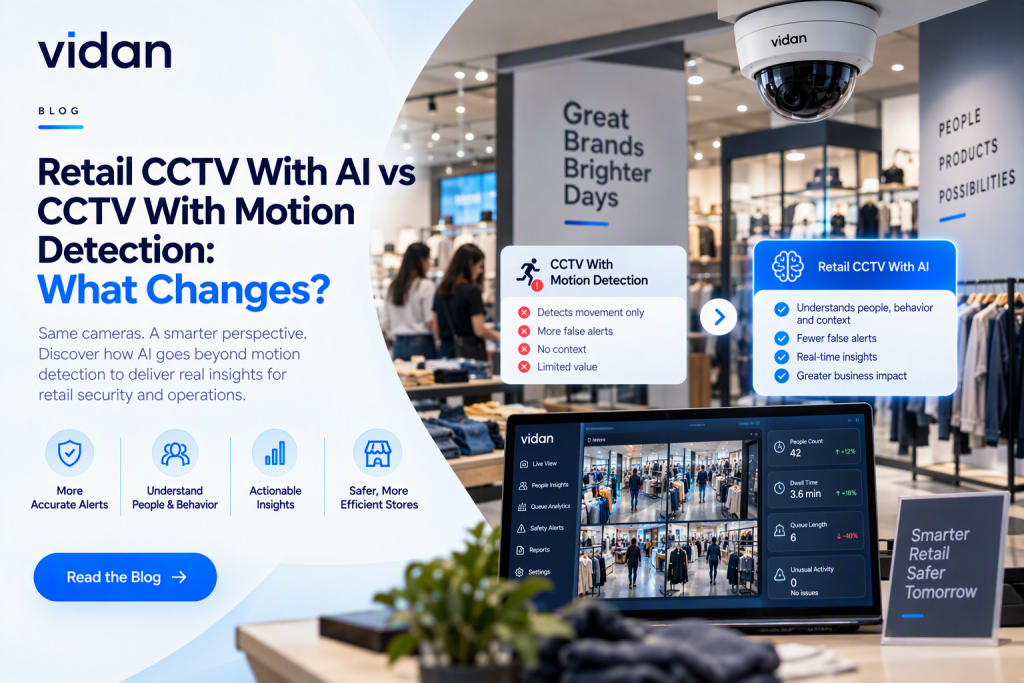
Motion detection asks one question. Did something move?
That was enough once. A busy retail floor needs a better question. AI-integrated CCTV for retail business asks who moved, what they are doing, and whether it matters.
Quick answer: Motion detection reacts to pixel changes. AI reads the scene. It separates people from shadows, spots risky behavior, and alerts your team with context. For retail, that means fewer false alerts and faster action on real theft.
Key Terms to Know
- Motion detection: A camera feature that triggers when pixels change between frames.
- Object classification: AI labeling what is on screen, such as a person, cart, or vehicle.
- Behavior analytics: Software that flags actions like loitering, repeat visits, or group movement.
- False positive: An alert caused by something harmless, like a shadow or reflection.
- Alert fatigue: Staff ignoring alerts after too many false ones.
- Dwell time: How long a person stays inside one zone.
- Shrink: Inventory lost to theft, fraud, or error.
- Edge processing: Running AI on or near the camera for faster results.
How Is AI CCTV Different From Motion Detection?
What does motion detection actually do?
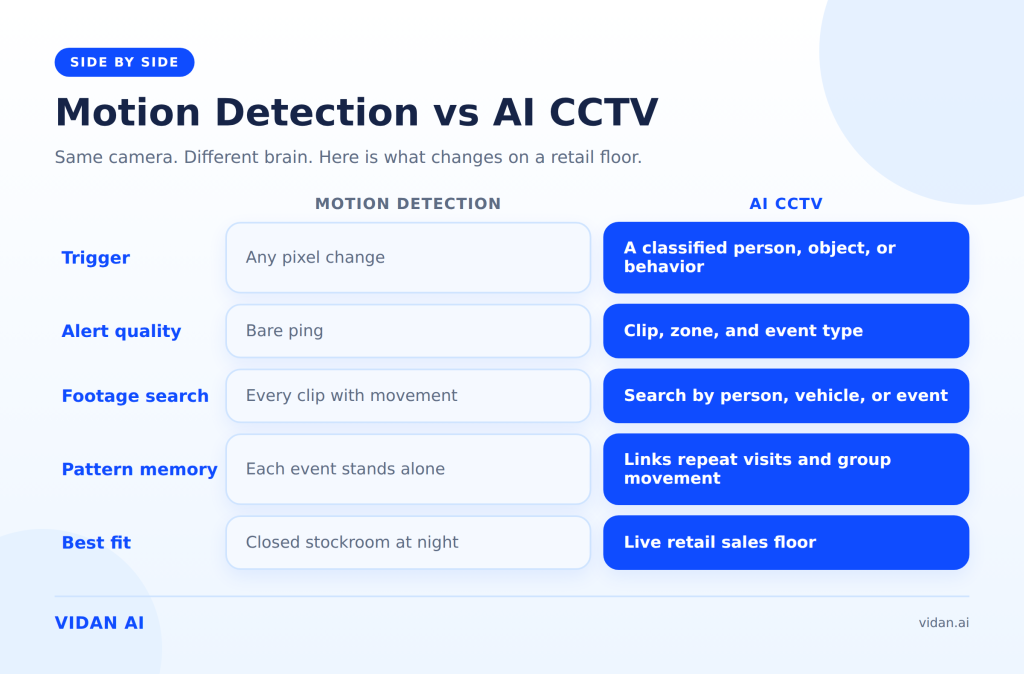
Motion detection is a camera feature that triggers when pixels change between frames. Traditional CCTV motion detection has no idea what it is looking at.
A moth, a mop, and a thief all look the same to it.
What does AI add to the same camera?
AI video analytics uses trained models to classify objects and read behavior. The AI CCTV vs. motion detection gap is about context, not picture quality.
Same lens. Different brain.
How Does AI-Integrated CCTV for Retail Business Work?
It works like a five-step filter that runs on every frame.
The Noise Filter
- Motion. The camera sees change. This part is the same as before.
- Object. AI labels the change as a person, cart, vehicle, animal, or shadow.
- Behavior. Models check dwell time, path, repeat visits, and group movement.
- Priority. The system scores the event against your rules and zones.
- Alert. Only events that pass reach your team, with a clip and a reason.
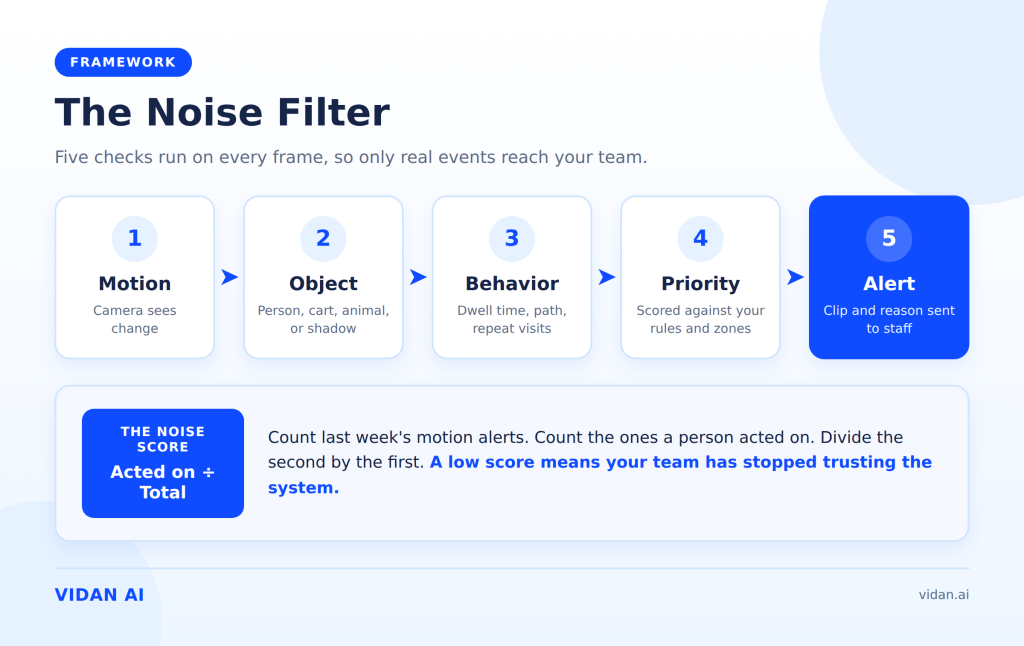
Try the Noise Score. Count last week’s motion alerts. Count how many a person acted on. Divide the second number by the first. A low score means your team has stopped trusting the system.
Why Do Motion Alerts Fail in Busy Stores?
More than 90%
The share of false alarms AI tools remove, according to Brian Baker of Calipsa, writing in Security Info Watch. This is a vendor figure. Results vary by site.
Four common false triggers in a store:
- Glass door glare and window reflections
- Lighting shifts near entrances
- Hanging signs moving with airflow
- Staff restocking during open hours
The AI object detection vs. motion detection difference shows up fastest here.
Every false alert trains staff to ignore the next one. That is alert fatigue. The one real incident then arrives hidden in a crowd of false ones.
Is Smart Motion Detection Good Enough for a Store?
Quick answer: It helps at night. It falls short on a busy floor.
Where It Helps
Intelligent motion detection adds filters such as zones, schedules, and minimum object size. It costs little. It works on many cameras.
Where It Stops
Filters still react to pixels, not behavior. They cannot link a repeat visitor across days. They cannot tie three people into one group.
Verdict
Fine for a closed store overnight. Weak where behavior matters most.
Teams that outgrow filters move to AI-integrated CCTV for retail business and keep their existing cameras in the loop.
Don’t Wait for the Cart to Reach the Door
Vidan AI links repeat visits, loitering, and group movement, so your team steps in before the cart reaches the door.
What Retail Theft Does AI Catch That Motion Detection Misses?
AI CCTV for retail loss prevention works best when it tracks patterns, not single frames.
12.4% drop in shoplifting incidents in 2025
50% / 40% / 37% repeat offenders, ORC incidents, and walkout or pushout theft, all reported at higher rates
Source: NRF Impact of Theft & Violence 2026 report
Fewer simple thefts. More planned ones.
NRF also found that 63% of retailers report fewer than half of theft incidents to police. Clear, searchable video makes the reports worth filing.
Scenario 1: The Repeat Visitor
- Motion detection sees: a person walking in.
- AI sees: the same visitor circling a high-loss aisle again.
- Your team gets: a flag before the next visit ends.
Scenario 2: The Coordinated Group
- Motion detection sees: five separate pings.
- AI sees: one event with split movement.
- Your team gets: one alert that shows the full picture.
Scenario 3: The Fast Exit
- Motion detection sees: movement at the door, like every shopper.
- AI sees: a full cart heading out quickly.
- Your team gets: a prompt to check the exit.
Scenario 4: The Stockroom After Hours
- Motion detection sees: a banner moving in a draft.
- AI sees: a person inside a restricted zone.
- Your team gets: a verified alert, not a guess.
Read how stores handle this with retail loss prevention software that never blinks.
What Changes When Alerts Arrive in Real Time?
Real-time video analytics for retail shrinks the gap between the event and the action.
Detection
- Before: someone scrubs footage after the fact.
- After: the system flags it as it happens.
Alert
- Before: a generic ping.
- After: a ping with a clip, a zone, and an event type.
Response
- Before: a manager checks a screen, if one is free.
- After: the nearest associate walks over.
Evidence
- Before: hours of raw clips.
- After: tagged, searchable events.
A visible response can deter an attempt before it becomes a loss. That is the real shift. You stop documenting incidents and start interrupting them.
One more result: your AI-integrated CCTV for retail business setup keeps its history. Each event is tagged, so audits and reviews take minutes, not shifts.
Which Store Zones Should Get AI First?
Quick answer: Start where loss and alert noise are both highest. For most stores, that means the exit or the stockroom.
The Five Zone Priorities
Priority 1: Exits And Entrances
- Why: Every loss passes through here.
- What AI watches: Fast exits, repeat visitors, and groups arriving together.
- Alert example: A loaded cart leaving at speed.
Priority 2: Stockrooms And Receiving
- Why: Access should be limited to staff.
- What AI watches: People in restricted zones and entries after closing.
- Alert example: A person inside the stockroom after close.
Priority 3: High Value Aisles
- Why: Loss risk sits in a small number of shelves.
- What AI watches: Dwell time, lingering, and repeat passes.
- Alert example: The same person passing one shelf three times.
Priority 4: Checkout And Self-Checkout Lanes
- Why: Busy lanes hide odd behavior.
- What AI watches: Unusual lingering and group movement near lanes.
- Alert example: A group clustering at a lane while one person drifts away.
Priority 5: Parking Lot And Loading Dock
- Why: Activity continues after the doors lock.
- What AI watches: People and vehicles during off hours.
- Alert example: A vehicle and a person at the dock overnight.
How To Pick Your First Zone
Score each zone from 1 to 5 on three questions:
- How much loss does this zone see?
- How many false alerts does it produce today?
- How clear is the camera view?
Start with the zone that has the highest total. A clear view and a noisy history give the fastest proof.
📦 Stockroom Security
After Hours, Only Staff Belong Back There.
➜
🧍 Person detected
➜
🔔 Alert sent with clip
Vidan AI watches restricted zones and tells your team the moment someone enters, with a clip ready to review.
How Does Vidan AI Bring This to a Retail Store?
Vidan AI adds a detection layer on top of your camera feeds. AI-powered CCTV for retail stores should not mean more screens to watch. It should mean fewer, better alerts.
VIDAN AI AT A GLANCE
- What it watches: Entrances, aisles, counters, stockrooms, and exits
- What it flags: Loitering, repeat visits, coordinated movement, and suspicious activity
- What your team gets: Real-time alerts, event clips, and searchable footage
- Where it fits: Single stores and multi-site retail groups
- How it starts: A site review with a Vidan specialist
Our view: The camera is rarely the problem. Alert quality is. Fix the noise first, and the coverage question gets simpler. Explore Vidan AI’s retail solutions for store-specific use cases.
What Does AI CCTV Cost Compared With Motion Detection?
Quick answer: Motion detection looks cheaper on the invoice. Noisy alerts cost more in labor. Compare total cost, not license price.
What Drives The Price of AI
Five factors shape a quote:
- Number of cameras analyzed
- Number of stores and zones
- Detection types enabled, such as loitering or repeat visits
- Deployment setup, whether cloud, edge, or mixed
- Monitoring and support level
Vidan AI quotes by site and scope. Contact the team for numbers that match your stores.
The Hidden Cost Of Noise
Use this formula to price your current alerts.
Cost of noise = Alerts per week × Minutes per alert × Hourly labor cost
Example only: 200 alerts × 3 minutes × $20 per hour is about $200 per week. Most of it buys nothing.
What AI Does Not Remove
AI does not erase security cost. It moves spend. Less time goes to reviewing noise. More goes to acting on real events.
Three Questions For Your Business Case
- How many of last week’s alerts did someone act on?
- What does one theft incident cost your store?
- How many incidents did your pilot zone see before AI?
How Do You Upgrade From Motion Alerts Without Starting Over?
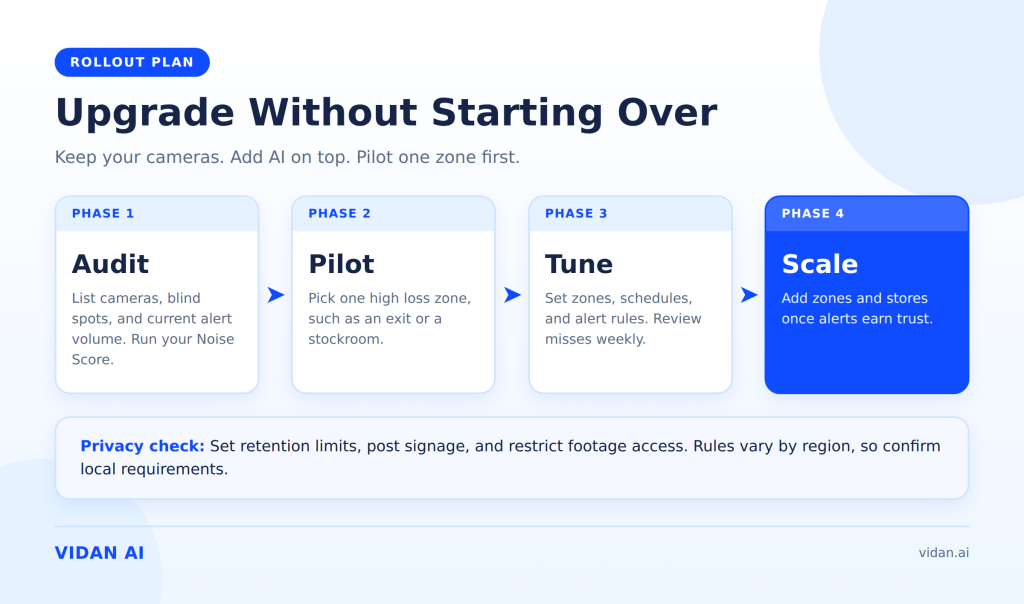
Quick answer: Keep your cameras, add AI on top, and pilot one zone first.
Phase 1: Audit → List cameras, blind spots, and current alert volume. Run your Noise Score.
Phase 2: Pilot → Pick one high-loss zone, such as an exit or a stockroom.
Phase 3: Tune → Set zones, schedules, and alert rules. Review misses weekly.
Phase 4: Scale → Add zones and stores once alerts earn trust.
Choose your pilot from these seven use cases beyond shoplifting.
Is Your Current System Holding You Back?
Tick what applies:
- Staff mute or ignore motion alerts.
- You find footage by scrubbing timelines.
- Incidents surface after the shift ends.
- Each store runs its own alert rules.
- You cannot spot repeat visitors or group movement.
- Alerts arrive with no clip and no reason.
Tick three or more, and retail video analytics is worth a pilot.
Want to cover more than theft? Learn how to monitor people, queues, and restricted areas with video analytics.
Conclusion
Motion detection tells you something moved. That is a low bar for a store full of people, products, and risk. AI-integrated CCTV for retail business raises the bar. It filters the noise, reads behavior, and alerts your team while there is still time to act.
Vidan AI turns the cameras you already own into a team that never looks away. Ready to test it on your floor? Book a walkthrough with Vidan AI and start with one zone.
Your cameras are already watching. Let Vidan AI make them useful.