
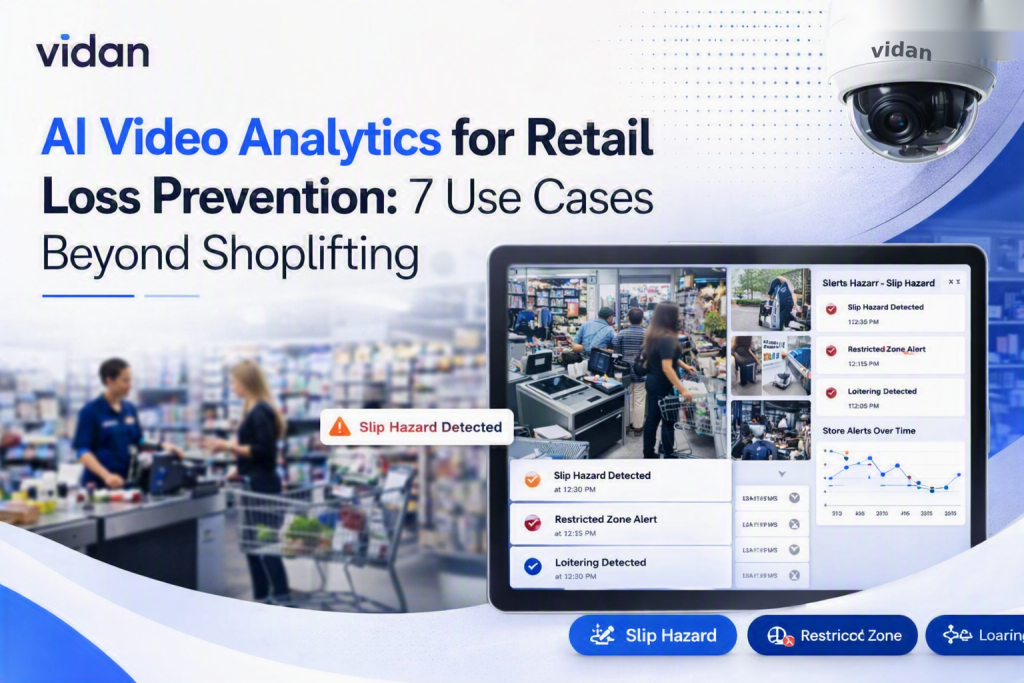
Shoplifting gets the headlines. It is not the biggest hole in your shrink number.
Roughly two-thirds of retail shrink comes from internal theft, paperwork errors, and process failures, not a stranger walking out the door with a jacket under their coat, according to NRF shrink data. AI video analytics for retail loss prevention has grown up around that reality. It is no longer one camera watching one exit. It is a layer of intelligence that reads behavior, movement, and transaction data across the entire store.
This guide breaks down seven use cases most retailers never connect to their camera system and how Vidan AI turns raw video into a single intelligence layer instead of another silo of footage nobody watches.
Key Terms to Know
- Shrink: The gap between recorded inventory and what is physically on the shelf, caused by theft, damage, error, or fraud.
- Sweethearting: A cashier deliberately undercharging or not scanning items for a friend, family member, or accomplice.
- Scan Avoidance: It is merchandise that leaves a self-checkout lane without being scanned, whether by accident or intent.
- Organized Retail Crime (ORC): Organized retail crime, where coordinated groups steal merchandise for resale rather than personal use.
- Bracketing and Wardrobing: Buying multiple sizes or versions of an item, using or keeping one, and returning the rest as if unused.
What Is AI Video Analytics for Retail Loss Prevention
AI video analytics for retail loss prevention means software that watches live and recorded video, then flags behavior patterns tied to loss. That includes theft, but it also includes fraud, process gaps, and operational waste that never shows up on a police report.
Traditional CCTV records footage for someone to review after a loss already happened. Analytics software reads the footage in real time and sends an alert before the loss is finalized, or feeds a pattern report that shows where losses keep repeating. Retailers researching camera coverage on their own can start with AI Security Cameras in USA for Retail Loss Prevention and Theft Detection, which covers hardware and placement in more depth.
Here are seven places that intelligence layer earns its cost beyond catching shoplifters.
1. Internal Theft by Employees
Employees have access, time, and knowledge of blind spots. That combination makes internal theft harder to catch than shoplifting and far more expensive across a year.
Video analytics tied to POS data can flag:
- Register openings with no matching sale
- Repeated voids or discounts from a single employee
- Back room or stockroom access outside scheduled hours
- Items scanned at self-checkout but not matching cart weight
Retailers unsure whether their current setup covers this gap can check the signs listed in 8 Signs Your Business Needs Better Retail Asset Protection Technology.
2. Sweethearting at the Register
Sweethearting is quiet. A cashier scans one item and bags three, or hits a manual price override for a friend in line. No alarm goes off. No item leaves without being scanned.
| Warning Sign | What Analytics Flag |
| Long pause with no scan sound | Item movement without a matching barcode read |
| Frequent manual price entry | Override pattern tied to one cashier ID |
| Bagging before scanning | Hand and item tracking mismatch at the counter |
| Same customer, same cashier, repeat visits | Cross-reference of loyalty ID and employee shift |
This is where AI loss prevention earns its budget. A pattern that would take a human reviewer weeks to notice across hundreds of hours of footage gets flagged the same day.
3. Return and Refund Fraud
Returns are not free. Retailers absorb restocking, shipping, and resale losses every time an item comes back, and fraud makes that worse.
Bracketing and wardrobing, buying items to wear once and return, cost retailers heavily. Ninety-three percent of retailers say retail fraud and other exploitative behavior is a significant issue for their business. Retail shrinkage prevention technology now links point-of-sale return data with video of the original purchase, so staff can confirm the item, tags, and packaging actually match before issuing a refund.
Steps a video-linked returns process usually follows:
-
- Customer requests a return at the counter
- System pulls the original purchase video and receipt
- Staff compares item condition against the recorded purchase
- Refund is approved or flagged for manager review
Video Intelligence Platform
See Every Store Signal in One Dashboard
Vidan AI turns your existing cameras into a single video intelligence layer covering security, people counting, heatmaps, and shelf availability.
4. Vendor and Delivery Dock Fraud
Loss does not start at the front door. It can start at the back one, during receiving, when delivery counts do not match what actually comes off the truck.
AI theft detection retail systems increasingly cover loading docks, tracking pallet counts, seal breaks, and dwell time against delivery manifests. Retailers running multi-site distribution alongside store-level loss prevention often need both angles covered under one system rather than two separate vendors.
5. Queue Length and Checkout Friction
Long lines do more than annoy customers. They push shoppers toward self-checkout stations, which carry a higher scan avoidance rate, and they create crowding that makes it easier for a theft to go unnoticed.
Retail security analytics now track queue length in real time and can trigger a staff alert when wait time crosses a set threshold. Shorter lines mean fewer rushed self-checkout scans and fewer distracted staff at the front of the store.
Quick facts on why this matters:
- Self-checkout areas see higher rates of unintentional and intentional scan avoidance than staffed lanes
- Crowded queues reduce staff visibility across the sales floor
- Queue data pairs naturally with people counting already running on the same cameras
6. On Shelf Availability Tied to Shrink
An item that shows as in stock but is not physically on the shelf looks like a lost sale. Sometimes it is actually a loss, misplaced, damaged, or stolen before it ever reached the register.
AI video analytics retail loss prevention platforms that also monitor shelf conditions can flag the difference between a popular item selling fast and a gap that keeps reappearing in the same spot, which usually points to a process or shrink issue rather than demand.
7. Loitering and Organized Retail Crime Patterns
Organized retail crime rarely starts with the theft itself. It starts with reconnaissance, someone walking the same aisle repeatedly, checking for camera coverage, or waiting near an exit.
Transnational organized retail crime groups were involved in thefts at 67% of surveyed retailers, according to NRF, and these groups often scout a location before acting. Behavior pattern recognition is detailed in “How AI-Powered Loitering Detection Helps Reduce Retail Shrinkage.” It can identify repeated visits, abnormal dwell times near high-value items, and coordinated movement between two or more individuals.
See the Patterns Before the Loss Happens
Vidan AI flags loitering, repeat visits, and coordinated movement tied to organized retail crime.
Where Vidan AI Fits Into This
Most retail camera vendors sell one product. A camera that watches a door. Vidan AI was built around a different premise entirely.
What makes the approach different:
Vidan AI treats every camera in a store as a data source, not just a recording device. The same video feed that flags a sweethearting pattern at register three also feeds the heatmap showing where customers actually spend their time. One video intelligence layer replaces a stack of disconnected point solutions.
Where retailers use it:
From single storefronts to distributed retail chains, the platform connects loss prevention, operations, and asset protection data into a single dashboard. Loss prevention managers see exception alerts. Operations teams see traffic and conversion signals. Both come from the same footage, analyzed once.
Why it matters for shrink specifically:
AI retail security cameras paired with Vidan AI’s analytics layer do not just record an incident for later review. They compare what a camera sees against POS transactions, delivery records, and return logs continuously. Hence, exceptions surface the moment they happen rather than during a quarterly audit nobody has time to run properly.
Conclusion
AI video analytics retail loss prevention closes every one of those gaps with one connected system instead of seven disconnected reports nobody has time to cross-reference. Retailers who wait for the next quarterly shrink number to justify the investment are already behind the retailers who moved on this last year.
Vidan AI builds video intelligence for retailers who want their cameras working as hard as their loss prevention team does. Talk to Vidan AI about mapping this across your stores before the next inventory count tells you what you already suspected.