
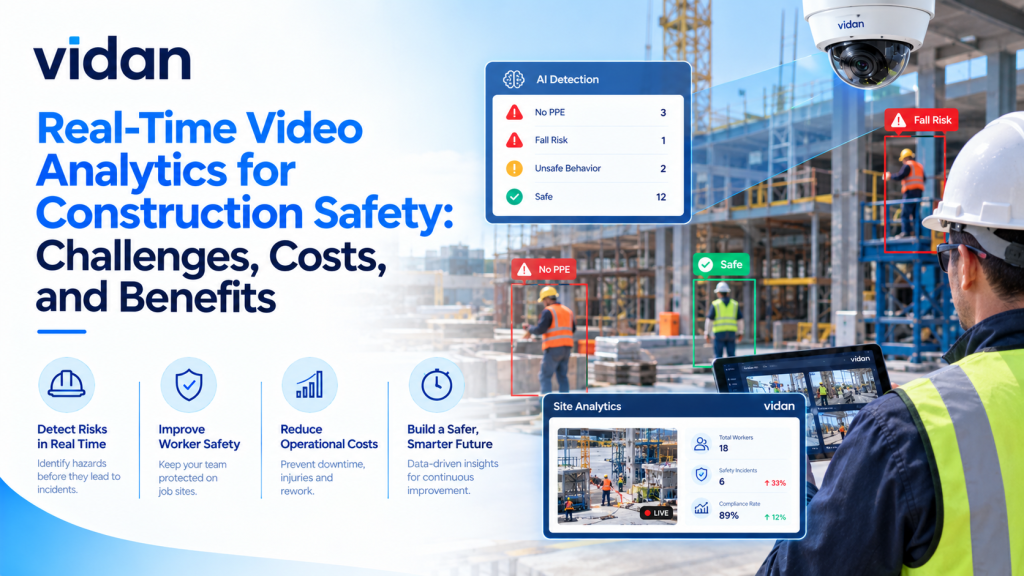
Construction sites record thousands of hours of video and review almost none of it. Real-time video analytics for construction safety reads that footage as it happens. It flags a missing harness or a breached exclusion zone while a supervisor can still step in.
The stakes are not abstract. Construction made up about 1 in 5 U.S. workplace deaths in 2023, according to the Bureau of Labor Statistics. This guide covers how the technology works, what slows adoption, what it costs, and what you gain.
Quick Answer: Is AI video analytics worth it for construction safety?
Yes, for most active sites. AI reads live camera feeds and detects missing PPE, zone breaches, and unsafe behavior. It sends an alert to a supervisor within seconds. The main hurdles are camera placement, false alerts, and worker trust. Costs depend on camera count, compute, and software licensing. The payoff is fewer incidents, faster response, and a video record for audits.
Key Takeaways
- AI turns passive cameras into an active safety layer that watches every zone at once.
- Falls, struck-by, electrocution, and caught-in hazards cause most construction deaths. Video AI targets all four.
- Camera placement and alert tuning decide success more than software features.
- Cost is driven by camera count, edge compute, licensing, and tuning time.
- Pilot one high-risk zone first, then scale across sites.
How Does Real-Time Video Analytics for Construction Safety Work?
Real-time video analytics is software that analyzes live video frames and triggers an action within seconds. On a construction site, that action is usually an alert to a human.
Step 1: Cameras Capture The Site
Fixed, mobile, and PTZ cameras stream video from every work area. Many existing cameras can be reused.
Step 2: AI Models Read Each Frame
Computer vision models identify workers, vehicles, helmets, vests, and equipment. They do this on every camera at once.
Step 3: Rules Decide What Counts As A Hazard
You set zones, schedules, and tolerance windows. A worker near an open edge without a harness breaks a rule.
Step 4: Alerts Reach The Right Person
A short alert with a video clip goes to the supervisor responsible for that zone. They act, and the event is logged.
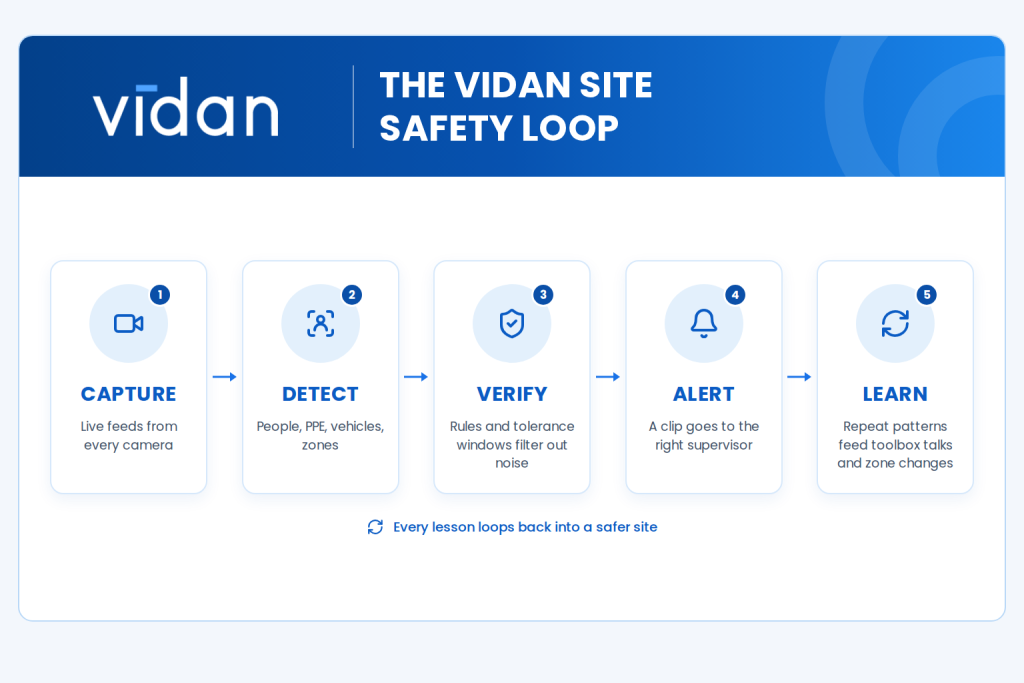
Most vendors stop at alerting. The Learn step is where safety improves week over week.
Which Hazards Can AI Catch Before They Cause Harm?
| Hazard | What the AI sees | Who gets alerted |
| Falls from height | Worker near an edge without a harness | Site supervisor |
| Struck-by | Pedestrian inside a vehicle path | Operator and foreman |
| Electrocution risk | Crew or crane inside a power line buffer | Safety manager |
| Caught-in or between | Worker in a trench or beside moving machinery | Foreman |
| Missing PPE | No helmet or vest in a required area | Zone lead |
This table maps closely to the “Fatal Four.” BLS data shows those hazards caused 56% of construction deaths in 2023. Falls alone caused 39%.
- PPE violation detection checks helmets, vests, and harnesses frame by frame. It flags the gap, not the person’s history.
- Restricted zone monitoring draws virtual boundaries around crane swing paths, open edges, and excavations. Anyone entering without clearance triggers a rule.
- Real-time safety alerts reach a supervisor’s phone, a site radio, or an on-site speaker. Speed matters because the hazard is still active.
Broader construction site hazard detection also covers vehicle and pedestrian conflicts. Gate traffic is a common blind spot. Processing on site keeps those alerts fast. Our guide on edge AI for real-time construction alerts explains why.
Your Site Never Sleeps. Your Safety Coverage Shouldn’t Either.
Vidan AI watches every zone, flags missing PPE and zone breaches, and alerts your team before a near miss becomes an incident.
What Makes Deployment Hard on a Live Construction Site?
Teams that succeed with real-time video analytics for construction safety treat setup as a site survey, not an install. Here are the five problems we see most, and the fix for each.
Blind Spots And Shifting Views
- Challenge: Buildings rise, and layouts change weekly. Fixed cameras lose coverage.
- What works: Re-survey coverage on a schedule and add relocatable cameras.
Dust, Glare, Rain And Night
- Challenge: Poor visibility lowers detection quality.
- What works: Pick camera models for harsh conditions and test at dusk and at night.
False Alerts
- Challenge: Too many pings teach supervisors to ignore them.
- What works: Use tolerance windows and tune each zone. A worker removing a helmet on break should not trigger anything.
Worker Privacy And Trust
- Challenge: Crews may read cameras as surveillance of people.
- What works: Tell crews what is analyzed, limit clip retention, and frame the goal as safety. Our approach to coaching crews with video evidence keeps it constructive.
Weak Connectivity
- Challenge: Temporary sites often have unreliable networks.
- What works: Run detection on site and sync only events and clips.
What Does It Cost to Run AI Safety Monitoring?
Budget for real-time video analytics for construction safety as an ongoing operating cost. Pricing varies by vendor, so compare drivers instead of headline numbers.
| Cost driver | What moves the price | How to control it |
| Cameras | Reuse existing or buy new | Audit current cameras first |
| Compute | Edge devices or cloud processing | Process on site to cut bandwidth |
| Software licensing | Per camera, per site, or per use case | Start with two or three use cases |
| Setup and tuning | Number of zones and rules | Pilot one area first |
| Training | Supervisor and crew time | Run short toolbox talks |
| Storage | Retention period and clip length | Keep event clips, not full streams |
Four questions to ask every vendor
- Can you use my existing cameras?
- What is the false alert rate after tuning?
- Where is video processed and stored?
- What happens to cost when I add a second site?
Now compare quotes to the cost of failure. In 2024, BLS recorded 1,032 deaths among construction and extraction workers. That was out of 5,070 total U.S. workplace deaths, as summarized by the Delaware Division of Small Business.
What Do Teams Gain From Seeing Hazards Live?
| Without live analytics | With live analytics |
| Footage reviewed only after an incident | Hazards flagged as they happen |
| Supervisors cover one zone at a time | Every camera watched at once |
| Near misses go unreported | Near misses logged with clips |
| Audit evidence is manual | Evidence is timestamped automatically |
- AI construction safety monitoring gives one supervisor eyes on every zone. That matters most on large or multi-level sites.
- Construction accident prevention improves because repeat patterns become visible. If the same gate sees three vehicle conflicts, you fix the gate.
- Construction safety compliance monitoring builds a timestamped record for inspections and insurers. It supports your safety program but does not replace it.
Falls remain the biggest target. NIOSH reports that construction workers suffered 95% of all fatal falls from elevation in 2024.
How Does Vidan AI Approach Construction Site Safety?
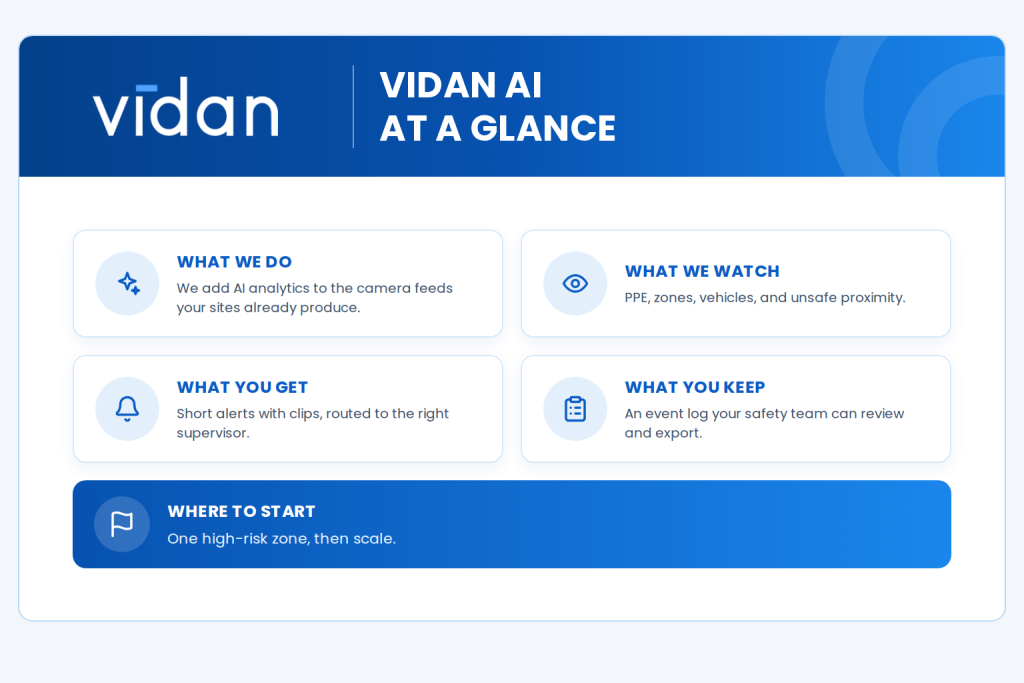
Our AI video surveillance for construction is built around one idea. Cameras should warn people while action is still possible. Alerts are tuned per zone, so supervisors see signal instead of noise.
How Do You Launch in 30 Days?
Week 1: Survey. Walk the site and list your top three hazards. Mark camera coverage gaps.
Week 2: Configure. Draw zones, set PPE rules, and choose who receives each alert.
Week 3: Tune. Review every alert. Adjust tolerance windows until supervisors trust the feed.
Week 4: Brief and expand. Share results with crews. Decide which zone or site comes next.
Running several sites? Our guide to building escalation policies across sites helps standardize this.
Success scorecard
- Alerts per shift
- Time to acknowledge
- False alert rate
- Repeat violations by zone
- Near misses logged
The Bottom Line
Your cameras already see the hazard. The question is whether anyone sees it in time. Real-time video analytics for construction safety closes that gap with a second set of eyes on every zone.
The challenges are real, but they are solvable. Good camera placement, tuned alerts, and honest communication with crews handle most of them. A single-zone pilot keeps cost and risk low.
Vidan AI helps construction teams turn existing cameras into an active safety layer. Start with your highest-risk area and see what the first week reveals.