
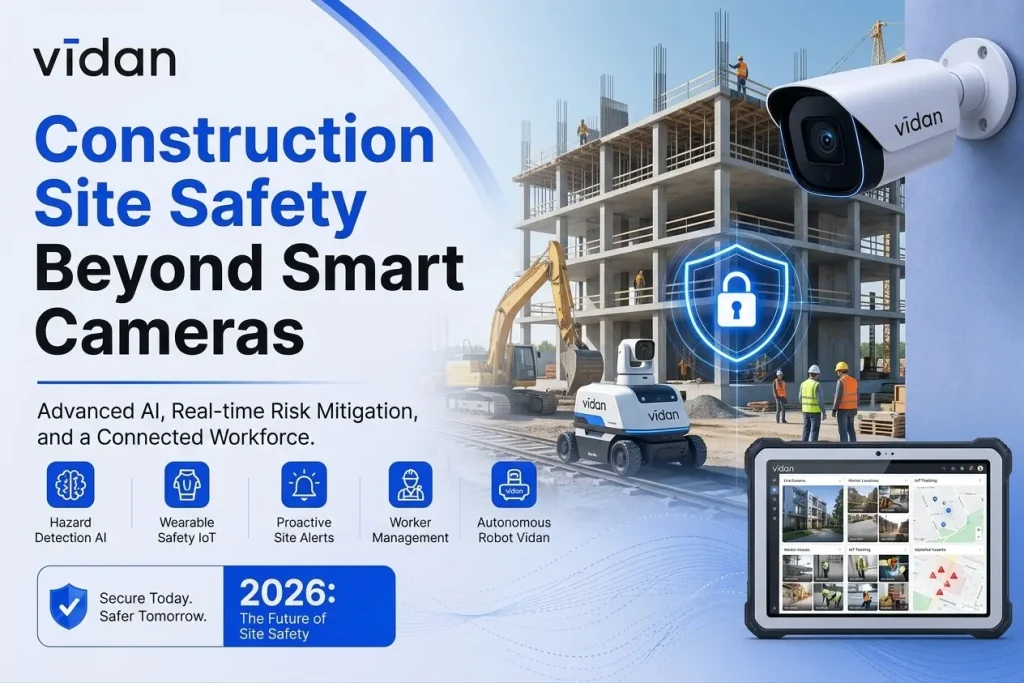
Construction sites lose workers to preventable accidents every single day, and most safety systems only react after something goes wrong. That is the real problem with traditional cameras. They record. They do not think. AI agents in construction risk prevention flip this entire model by predicting danger before it happens, not just documenting it afterward.
This shift matters because construction remains one of the most hazardous industries on the planet, and the old playbook of mounting a camera and hoping someone watches the footage simply is not working anymore.
Key Takeaways
- Why smart cameras alone cannot prevent construction accidents
- How AI agents actually think, learn, and act on job sites
- The real difference between passive surveillance and active risk prevention
- Practical ways AI agents for construction improve daily operations
- How Vidan AI builds intelligent safety systems for real-world sites
- Ten quick answers to common questions about AI-powered safety
The Camera Myth That Is Costing Construction Companies
Most site managers still believe a camera network equals a safety system. It does not. A camera captures pixels. It has no understanding of what those pixels mean.
Cameras Watch. Agents Understand.
A traditional camera cannot tell the difference between a worker resting and a worker who has collapsed. It cannot recognize that a crane is swinging too close to an occupied zone. It simply films everything and waits for a human to notice.
This is exactly why AI agents in construction risk prevention exist. They are built to interpret scenes, not just record them. An agent can identify a missing hard hat, flag an unsecured scaffold, or detect a worker entering a restricted zone, all within seconds.
Three Things Cameras Cannot Do
Here is a short list showing where passive cameras fall short compared to intelligent agents.
- They cannot predict behavior patterns that lead to accidents
- They cannot alert supervisors in real time without a human watching
- They cannot connect data across multiple site zones automatically
What Makes an AI Agent Different From a Smart Camera
The word smart gets thrown around a lot in construction tech marketing. Let us clear up the confusion.
The Brain Behind the Lens
A smart camera usually means better resolution or basic motion detection. An AI agent goes far beyond that. It combines computer vision, decision-making logic, and continuous learning into one system that acts almost like a digital safety officer walking the site nonstop.
Think of it this way. A camera has eyes. An agent has eyes, judgment, and the ability to respond.
How the Technology Works
- The system captures live video from multiple site angles
- Computer vision models identify people, equipment, and hazards
- The agent cross-references safety protocols against what it sees
- Alerts get sent instantly to supervisors or safety officers
- Patterns get logged to improve future risk predictions
This layered process is what separates genuine construction site safety technology from a simple recording device bolted to a pole.
Why Prevention Beats Detection Every Single Time
Detecting an accident after it happens helps with insurance claims. It does nothing for the injured worker. Prevention is the only outcome that actually matters.
The Cost of Reactive Safety
Reactive systems tell you what already went wrong. By the time footage gets reviewed, the incident has occurred, the worker is hurt, and the project timeline is disrupted. Insurance premiums climb. Trust erodes.
The Value of Predictive Safety
AI agents in construction risk prevention work differently because they focus on stopping the incident before it starts. They notice a worker walking too close to an open trench. They catch a forklift operator missing a required checkpoint. They flag heat stress risk based on posture and movement patterns before a worker collapses.
This predictive approach is not science fiction anymore. It is already running on active job sites, and companies that adopt it early are seeing measurable drops in recordable incidents.
Real World Applications Across the Job Site
AI agents are not limited to one task. They apply across nearly every corner of a construction operation.
Perimeter and Access Control
Unauthorized entry is one of the leading causes of site liability. Agents can identify unrecognized individuals, flag tailgating at gates, and alert security teams instantly.
Equipment and Machinery Monitoring
Heavy machinery causes some of the most severe injuries in construction. Intelligent agents track proximity between workers and equipment, warning operators before a collision risk becomes real.
Personal Protective Equipment Compliance
Missing hard hats, vests, or harnesses are flagged automatically. No manual walkthroughs required. No relying on memory or spot checks.
Environmental and Structural Risk Detection
Weather changes, unstable scaffolding, and shifting ground conditions can all be monitored continuously, giving teams time to react before conditions become dangerous.
For companies exploring broader surveillance needs beyond agents, construction video surveillance remains a foundational layer that pairs well with intelligent monitoring systems.
Where AI Agents Fit Into the Bigger Security Picture
Construction safety does not exist in isolation. It connects to a much larger conversation about how AI is reshaping physical security across every industry.
Beyond the Job Site
Facilities like data centers face similar challenges around unauthorized access and equipment protection. If you want a deeper look at how intelligent systems handle high-stakes environments, Data Center Construction Security Challenges and How AI Solves Them breaks this down in detail.
The Vidan AI Approach to Smarter Construction Safety
Vidan AI was built around one core belief. Safety technology should think, not just watch.
What Sets Vidan AI Apart
Vidan AI designs intelligent security systems that go beyond footage storage. The platform is engineered to interpret site activity, flag genuine risks, and reduce false alarms that waste supervisor time.
Built for the Realities of Active Sites
Construction sites are chaotic by nature. Dust, changing light, moving equipment, and constantly shifting layouts make consistent monitoring difficult for standard systems. Vidan AI accounts for these variables, adapting its detection models to real site conditions rather than ideal lab settings.
A System That Learns Your Site
Every project is different. Vidan AI continuously refines its understanding of a specific site layout, worker patterns, and risk zones, becoming more accurate the longer it runs. This is the foundation of genuine AI agents for construction rather than a one-size-fits-all camera package.
How AI Video Analytics Extends Beyond Construction
The same intelligence powering construction risk prevention applies to other high-risk environments too. AI Video Analytics helps organizations detect unusual behavior, unauthorized access, and safety violations across industries far beyond the job site.
Supporting Technology Worth Knowing About
Not every safety tool needs to be an active agent. Some technologies work quietly in the background, supporting overall site documentation and progress tracking.
Time Lapse Documentation
Long-term project tracking benefits from consistent visual records. Why You Need Time Lapse Cameras on Construction Sites explains how this simpler technology complements active safety monitoring by capturing progress and providing evidence when disputes arise.
Companies still comparing camera resolution specs are asking the wrong question. The right question is whether the system can think, decide, and act without waiting for a human to review footage hours or days later. This is precisely where AI agents in construction risk prevention prove their worth, turning raw video into real-time protection for every worker on site.
The ROI Case for Construction Leaders
Safety technology decisions often come down to budget. Here is why the investment makes financial sense.
- Insurance and Liability Savings: Fewer incidents mean lower premiums over time. Documented proactive safety measures also strengthen a company’s position during liability disputes.
- Reduced Downtime: Accidents halt projects. Investigations, equipment damage, and morale issues all slow progress. Preventing incidents keeps schedules intact.
- Labor Retention: Workers stay longer at companies that visibly invest in their safety. Word travels fast in construction circles, and reputation affects hiring.
Common Mistakes Companies Make When Choosing Safety Tech
Avoid these pitfalls before signing any contract.
- Choosing based on camera resolution instead of intelligence capability
- Ignoring how well the system adapts to changing site conditions
- Overlooking integration with existing safety protocols
- Failing to ask whether alerts happen in real time or after the fact
The Future of Construction Site Protection
Construction Site Safety will continue evolving as agents become more capable of understanding context, not just objects. Expect deeper integration with wearables, environmental sensors, and predictive analytics that anticipate risk days before it becomes visible on camera.
Companies that adopt intelligent agents now are not just improving safety scores. They are building a foundation for the next decade of construction technology.
Final Thoughts
Construction safety has outgrown passive cameras. The industry needs systems that think, predict, and protect workers before harm occurs, not systems that simply document tragedy after the fact. AI agents in construction risk prevention represent that shift, turning ordinary surveillance into an active line of defense for every crew member on site.
If your current setup only records footage, it is already behind. Vidan AI builds the intelligent systems that modern construction sites actually need, systems that notice danger before your team does. Reach out today.