
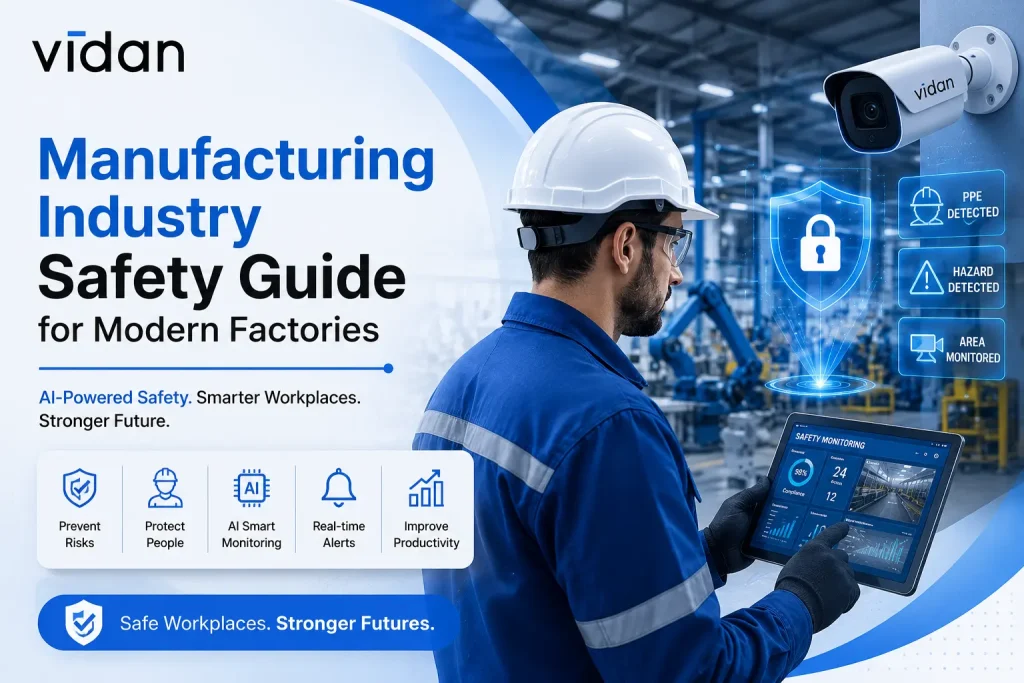
Manufacturing industry safety today is not just a checklist of hard hats and fire extinguishers. It is a living system that blends human judgment with intelligent technology to prevent incidents before they happen.
Modern factories run on speed, automation, and tight margins. But none of that matters if a worker gets injured or a compliance audit fails. This guide breaks down exactly what manufacturing safety means in 2026, why it keeps failing in traditional setups, and how AI in manufacturing industry operations is quietly rewriting the rulebook.
Key Takeaways
- What Manufacturing Industry Safety actually means in a modern factory setting
- The biggest safety risks factories face today and why old methods miss them
- How AI Video Analytics changes detection speed and accuracy
- Real-world examples of safety failures and what could have prevented them
- A practical framework for building a safety program from scratch
- Where Vidan AI fits into the modern factory safety stack
- Compliance standards every factory manager should know
- Answers to the most common questions safety officers actually search for
Why Factories Still Struggle With Safety in 2026
The numbers tell an uncomfortable story. The U.S. Bureau of Labor Statistics reported that manufacturing recorded over 350,000 nonfatal injuries and illnesses in a recent reporting year. Many of these incidents were preventable.
Most factories still rely on manual inspections, paper checklists, and reactive reporting. A supervisor walks the floor twice a shift. A camera records footage that nobody reviews until after an incident. By the time a problem is caught, the damage is already done.
The Three Root Causes Behind Most Incidents
- Delayed Detection: Hazards exist for minutes or hours before anyone notices.
- Inconsistent Enforcement: PPE and safety zone rules get skipped when supervision is thin.
- Fragmented Data: Safety records live in spreadsheets, disconnected from real-time floor activity.
Manufacturing Industry Safety breaks down exactly at these three points. Fixing them requires more than better training. It requires better visibility.
What Modern Manufacturing Industry Safety Actually Requires
A strong safety program today rests on four pillars. Think of these as the foundation every factory needs, regardless of size or sector.
Pillar One: Physical Hazard Control
This includes machine guarding, proper lighting, clear walkways, and controlled access to dangerous zones. It is the oldest and most familiar layer of safety.
Pillar Two: Human Behavior Management
Training programs, PPE enforcement, and fatigue monitoring fall here. Even the best equipment fails if workers are not trained or are too tired to follow protocol.
Pillar Three: Real-Time Monitoring
This is where most factories fall short. Static cameras that only record footage add little value. Facilities need systems that actively watch for risk as it happens.
Pillar Four: Compliance and Documentation
OSHA and ISO 45001 both require detailed records. Manual logging is slow and error-prone. Automated systems capture this data continuously and accurately.
Here is a quick comparison of traditional versus modern safety approaches.
- Traditional Approach: Manual floor walks, paper logs, reactive response after incidents, camera footage reviewed only after something goes wrong.
- Modern Approach: Continuous automated monitoring, digital compliance trails, proactive alerts before incidents escalate, footage analyzed in real time.
How AI Video Analytics Is Changing the Safety Equation
AI Video Analytics does something traditional CCTV never could. It interprets what it sees. Instead of just recording, the system identifies unsafe behavior, restricted-zone breaches, and equipment anomalies as they occur.
Consider a worker who steps into a forklift path without noticing the vehicle approaching. A traditional camera captures the moment for later review. An AI-powered system flags the collision risk instantly and can trigger an alert before contact occurs.
Where AI Video Analytics Adds the Most Value
- Detecting PPE violations such as missing hard hats or gloves
- Identifying unauthorized access to restricted or hazardous zones
- Spotting slips, trips, and falls as they happen
- Monitoring machine proximity and worker positioning
- Flagging unusual crowd density near exits or loading docks
Manufacturing Industry Safety improves dramatically when detection happens in seconds instead of hours. According to a 2024 McKinsey report, manufacturers using AI-powered monitoring saw measurable reductions in workplace incidents within the first year of deployment.
Read More: Learn how AI is reshaping manufacturing compliance
Building a Manufacturing Safety Program From the Ground Up
If you are starting fresh or rebuilding an outdated program, follow this practical framework.
Step One: Conduct a Full Risk Assessment
Walk every zone of the facility. Identify high-risk areas including loading docks, machine floors, chemical storage, and high-traffic corridors.
Step Two: Define Clear Safety Zones
Mark restricted areas digitally and physically. Pair physical signage with camera coverage that can detect unauthorized entry automatically.
Step Three: Deploy Real-Time Monitoring
This is the step most factories skip or underinvest in. A monitoring system should not just record. It should interpret and alert.
Step Four: Train Staff on the Technology
Workers need to understand why cameras are watching for safety, not surveillance for punishment. Framing matters for adoption.
Step Five: Review and Refine Continuously
Safety is not a one-time project. Monthly reviews of incident data, near misses, and system alerts keep the program sharp.
Industry-Specific Safety Challenges Worth Knowing
Not every factory faces the same risks. Here is a quick breakdown by sector.
Automotive manufacturing deals heavily with robotic arm proximity risks and requires strict zone separation between human workers and automated machinery.
Textile manufacturing faces fire risk from dust and fabric materials, along with machine entanglement hazards. Textile manufacturing video surveillance has become essential for early fire and hazard detection in this sector.
Food and beverage manufacturing requires strict hygiene monitoring alongside standard safety protocols, since contamination risks carry both safety and compliance consequences.
Heavy equipment manufacturing deals with the highest rates of crush and impact injuries due to large machinery and material handling equipment.
Compliance Standards Every Factory Manager Should Know
Staying compliant is not optional, and the standards keep evolving. Below is a quick reference table in plain text form.
- OSHA General Industry Standards: Covers machine guarding, PPE, hazard communication, and recordkeeping requirements for U.S. based facilities.
- ISO 45001: The international standard for occupational health and safety management systems, widely adopted across global manufacturers.
- NFPA 70E: Focuses specifically on electrical safety in the workplace, relevant for facilities with heavy machinery and power systems.
- Local Fire and Building Codes: Vary by region but typically dictate emergency exit requirements, fire suppression systems, and occupancy limits.
Manufacturing Industry Safety compliance now increasingly depends on digital audit trails. Regulators are beginning to expect timestamped video and sensor data as part of incident investigations, not just paper logs.
Access Control: The Overlooked Layer of Manufacturing Safety
Physical access control is often treated as a security function separate from safety. That separation is a mistake. Unauthorized entry into hazardous zones is one of the leading causes of preventable injuries.
Modern facilities are shifting toward layered access models that combine badge systems, biometric verification, and video confirmation.
A well-designed access control system does two things at once. It keeps unauthorized people out of dangerous zones, and it creates a verifiable record of who was where and at what time.
Read More: Centralized and Decentralized Access Control in the Age of Zero Trust Security
Response Time: The Metric That Actually Matters
Detection alone does not save lives or reduce damage. What happens after detection determines the outcome. This is where most legacy security setups fail the hardest. A camera that records an incident but takes fifteen minutes to reach a human reviewer is not much better than no camera at all.
Faster response means smaller injuries, less downtime, and lower liability exposure. It is arguably the single most important metric in modern factory safety.
The Business Case for Safety Investment
Safety spending is often viewed as a cost center. That framing is outdated. Facilities that invest in proactive safety technology consistently see measurable returns.
Fewer incidents mean lower workers’ compensation claims. Fewer shutdowns mean higher production output. Stronger compliance records mean lower insurance premiums and reduced legal exposure.
Also Read: Remote Video Monitoring ROI: How Vidan AI Transforms Security Into a Strategic Asset
Where Vidan AI Fits Into the Modern Factory
Vidan AI was built for exactly the problems this guide has described. Instead of passive cameras that simply record, our platform actively watches, interprets, and alerts.
Here is what that looks like on a real factory floor.
Our AI Video Analytics engine continuously scans camera feeds for PPE violations, restricted zone breaches, and unsafe worker positioning near machinery. When something is flagged, an alert reaches your safety team within seconds, not hours.
Manufacturing leaders working with Vidan AI have reported faster incident response, cleaner compliance documentation, and fewer repeat safety violations across shifts. This is what AI in manufacturing industry safety looks like when it is built for the factory floor, not adapted from generic office security software.
Final Word
Safety programs fail not because people do not care, but because visibility is too slow and too fragmented. Manufacturing Industry Safety cannot run on paper logs and cameras nobody watches in real time anymore.
If your current setup still relies on someone reviewing footage after an incident already happened, you are already behind. Vidan AI exists to close that gap before it costs you a worker, a shipment, or a regulatory citation.