
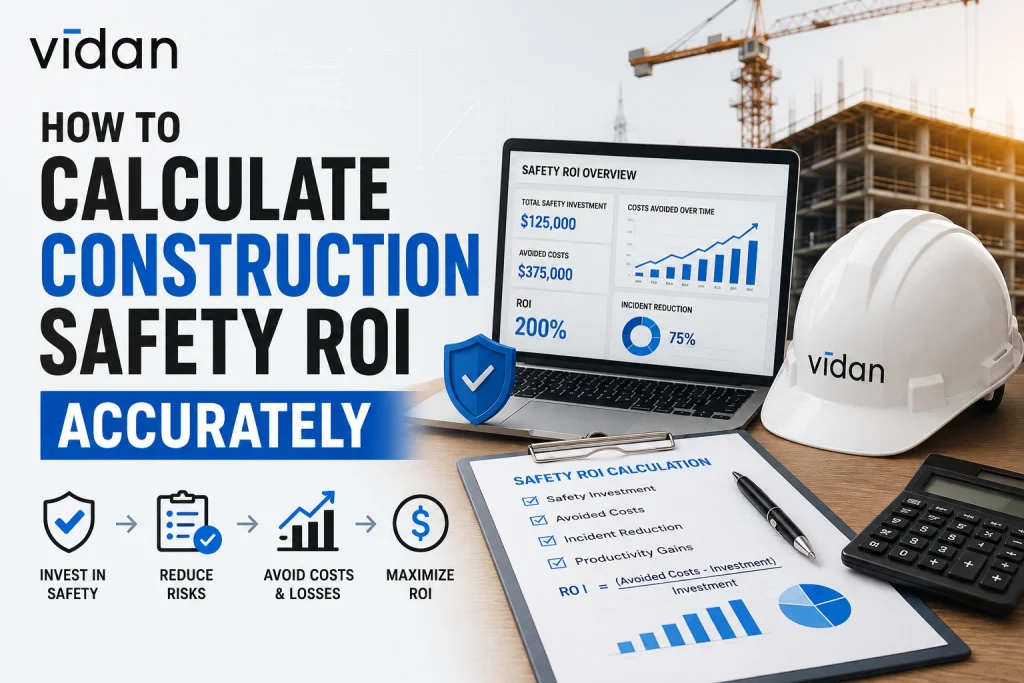
Every dollar spent on construction site safety either pays you back or quietly disappears. Most contractors cannot tell you which one is happening. That is the real problem this blog solves.
Construction safety ROI is the single number that tells you whether your safety spending is protecting your bottom line or just checking a compliance box. If you cannot calculate it, you cannot defend your safety budget, and you cannot prove your program works.
This blog gives you a practical framework to calculate, track, and improve your Construction Safety ROI, with real numbers, a usable formula, and a look at how AI monitoring is changing what safety investment actually returns.
Key Terms to Know
- Construction Safety ROI: The financial return generated by safety spending, measured against costs avoided.
- AI Monitoring: Continuous, camera-based analysis of a site using computer vision to detect risks in real time.
- Rework Costs: Expenses incurred when previously completed work must be redone due to an incident, error, or violation.
- PPE Detection: An AI capability that identifies whether workers are wearing required protective equipment.
- Leading Indicator: A safety metric, like PPE compliance rate, that predicts future incidents rather than reporting past ones.
What is Construction Safety ROI
Construction Safety ROI is a financial metric. It compares what you spend on safety against what that spending saves you in avoided incidents, avoided delays, and avoided rework.
A high Construction Safety ROI does not mean you spent less. It means every dollar you spent worked harder. A low ROI does not always mean you overspent either. Sometimes it means your safety tools are not generating usable data, which is exactly where AI monitoring changes the math.
Why Traditional Safety Tracking Misses the Full Picture
Traditional site safety relies on manual walkthroughs, paper checklists, and incident reports filed after something already went wrong. This approach has three blind spots.
- It only catches what a human physically sees during a walkthrough.
- It reports incidents after the fact, not near misses before they happen.
- It rarely connects safety data to financial outcomes, such as rework costs or schedule delays.
AI monitoring closes all three gaps by continuously monitoring the site and turning what it sees into data you can measure against cost.
The Construction Safety ROI Formula
Here is the formula in its simplest form.
Construction Safety ROI = (Value of Incidents Avoided minus Cost of Safety Program) divided by Cost of Safety Program, multiplied by 100
To use this formula, you need three numbers.
- Cost of Safety Program: This includes PPE, safety staff, training hours, signage, and any technology like AI monitoring or camera systems.
- Value of Incidents Avoided: This includes injury-related costs you did not pay, OSHA fines you avoided, and rework costs you never had to absorb.
- Net Gain: This is simply the value avoided minus what you spent to avoid it.
A Worked Example
A mid-sized commercial contractor spends 85,000 dollars a year on a safety program that includes AI video monitoring and PPE detection across two active sites.
Over that year, the system flags 340 PPE violations before they led to injury, catches 12 near-miss events involving equipment proximity, and helps avoid an estimated 3 OSHA citations based on historical citation rates for similar violations.
Using average injury cost data and typical OSHA fine ranges, the contractor estimates 410,000 dollars in avoided costs. Construction Safety ROI equals 410,000 minus 85,000, divided by 85,000, multiplied by 100. That comes out to roughly 382 percent.
That number is what gets a safety budget approved by a CFO who does not care about compliance language. They care about return.
Where the Real Money Leaks: Rework Costs
Rework is one of the most underestimated costs in construction, and it is directly tied to safety incidents more often than most project managers realize.
When an incident happens, whether it is a fall, a struck-by event, or equipment damage, work often has to stop, get inspected, and sometimes get redone entirely. Industry research consistently shows rework can account for a significant share of total project cost, and safety-related incidents are a recurring trigger for it.
Rework avoided is one of the clearest, most defensible line items in a Construction Safety ROI calculation because it has a direct dollar value tied to labor, materials, and schedule delay.
How Rework Costs Add Up
Here is a simple breakdown of what rework really costs beyond the obvious materials bill.
- Labor cost: Crews get paid again to redo work they already completed once.
- Material cost: Damaged or improperly installed materials often cannot be reused.
- Schedule cost: Delays push back dependent tasks, which can cascade across the entire project timeline.
- Equipment cost: Machinery sitting idle during rework periods still costs money even when it is not being used.
- Reputation cost: Repeated rework on a project can affect client trust and future bids.
When AI monitoring catches an unsafe condition before it causes an incident, every one of these costs simply does not happen. That avoided cost belongs directly in your ROI calculation.
PPE Detection: The Safety Investment That Pays for Itself Fastest
PPE detection is one of the fastest ways to see measurable ROI because the cost of noncompliance is so well documented, and the cost of the technology itself is relatively low compared to the incidents it prevents.
AI-powered surveillance cameras can automatically detect whether workers are wearing hard hats, high-visibility vests, gloves, or harnesses in real time, across an entire site, without needing a supervisor to physically walk every zone.
This matters because PPE violations are one of the most commonly cited safety failures on construction sites, and they are also one of the easiest for AI to catch consistently.
What PPE Detection Actually Prevents
- Missed hard hat violations in areas with overhead work
- Workers entering high-risk zones without proper harnesses
- Repeated violations that go unnoticed during manual spot checks
- Delayed response to unsafe behavior that a human reviewer would only see after the fact
When PPE detection is running continuously, violations get flagged the moment they happen instead of during a scheduled walkthrough that might happen hours later.
Direct Costs vs Hidden Costs in Safety ROI
Most Construction Safety ROI calculations only account for direct costs. That is a mistake because hidden costs are often larger.
| Cost Type | Direct Costs | Hidden Costs |
| Injury | Medical bills, workers comp | Lost productivity, morale impact |
| OSHA Violation | Fine amount | Increased inspection frequency |
| Rework | Labor and materials | Schedule delay, client trust |
| Equipment Damage | Repair or replacement | Idle crew time waiting on equipment |
| Incident Investigation | Admin time | Insurance premium increases |
A calculator that only includes direct costs will always undervalue your safety program. Hidden costs are where the real ROI story lives, and they are also the costs AI monitoring is best positioned to reduce because it prevents the triggering event entirely.
How AI Monitoring Changes the ROI Equation
Traditional safety staffing has a hard limit. A safety officer can only be in one place at a time, and their observations end the moment they leave a zone. AI monitoring removes that limit. It watches every zone continuously, flags violations the instant they occur, and creates a timestamped record that can be reviewed, audited, or used to train crews on repeated risk patterns.
This shifts safety spending from a reactive cost to a measurable investment, because every flagged event has a dollar value tied to the incident it likely prevented.
The Vidan Safety ROI Framework
Here is a simple framework Vidan AI uses internally when helping clients think through their own Construction Safety ROI.
- Baseline Your Current Costs: Pull twelve months of incident data, rework costs, and OSHA fines if any occurred.
- Baseline Your Current Safety Spend: Include staffing, PPE, training, and any existing monitoring tools.
- Layer in AI Monitoring Data: Once AI monitoring is active, track flagged violations and near misses monthly.
- Assign Avoided Cost Value: Use industry average injury and fine costs to estimate what each flagged event likely prevented.
- Recalculate ROI Quarterly: Safety ROI is not static. It should be reviewed every quarter as your data set grows.
This framework turns Construction Safety ROI from a one-time calculation into an ongoing performance metric, similar to how you would track cost per square foot or labor productivity.
Read More: How Artificial Intelligence Security Systems Improve Security Response Times
What the Data Says About Safety Investment
According to OSHA, employers pay roughly 1 billion dollars per week in direct workers’ compensation costs for disabling, nonfatal workplace injuries. Construction consistently ranks among the industries with the highest injury and fatality rates tracked by the Bureau of Labor Statistics.
Separately, industry safety research has repeatedly found that companies investing proactively in safety programs see measurable reductions in incident rates and associated costs over time, reinforcing that safety spending functions as risk reduction with a quantifiable return rather than a pure compliance expense.
These numbers matter because they give your ROI calculator a credible baseline instead of relying only on your own site history, which may not include enough incidents to be statistically meaningful on its own.
How Vidan AI Approaches Safety ROI Differently
Most safety technology vendors sell hardware and stop there. Vidan AI approaches Construction Safety ROI as a continuous measurement problem, not a one-time install.
Our platform integrates PPE detection, real-time zone monitoring, and automated incident flagging into one dashboard, eliminating the need for manual cross-referencing of footage and reports. Each PPE violation, near miss, and restricted zone breach is automatically logged with a timestamp, providing precise data for ROI calculations.
This also means your safety ROI story is defensible when a client, insurer, or executive team asks for proof. You are not guessing at what your safety spend prevented. You have a record.
Read More: Monitoring Construction Site Storage Remotely with Vidan AI
Building Your Own Construction Safety ROI Calculator
You do not need custom software to start. A simple spreadsheet with five columns gets you most of the way there.
- Month
- Total safety spend for that month
- Estimated value of incidents avoided
- Net gain
- ROI percentage
Update it monthly using flagged violations, near misses, and any avoided rework you can attribute to early detection. Over two or three quarters, patterns emerge that are far more convincing than a single point in time calculation.
If your monitoring system already logs violations automatically, this process takes minutes instead of hours. That is the practical difference AI monitoring makes, not just in safety outcomes but in how easily you can prove them.
Where This Gets More Complex: Multi-Site Portfolios
If you manage multiple active sites, calculating Construction Safety ROI gets more complicated because risk levels vary by project type, phase, and location.
A high-rise project mid-construction carries different fall risk than a site still in excavation. A data center build has different access control and equipment risk than a retail fit-out.
Rather than averaging ROI across all sites, calculate it per site and per project phase when possible. This shows you exactly where your safety investment is working hardest and where it needs to be reallocated.
Common Mistakes That Skew Safety ROI Calculations
Avoid these mistakes when building your own calculator.
Mistake one: Only counting direct costs
Hidden costs like productivity loss and insurance premium increases matter just as much.
Mistake two: Treating ROI as a one-time calculation
Safety ROI should be recalculated quarterly as your data set grows.
Mistake three: Ignoring near misses
Near misses are leading indicators and should be assigned an estimated avoided cost, not ignored because no injury occurred.
Mistake four: Comparing unlike sites
A high-risk site will naturally show different ROI than a low-risk one. Compare similar project types when benchmarking.
Wrapping It Up
Construction Safety ROI is not a soft metric. It is a calculation that stands up in a budget meeting, an insurance renewal, or a client conversation about why your site runs safer than the one down the street.
The formula is simple. The data collection is where most contractors fall short, and that is exactly the gap AI monitoring and PPE detection are built to close.
If you are ready to see what your own sites would show, talk to Vidan AI about a live demo and find out what your safety investment is really returning.