
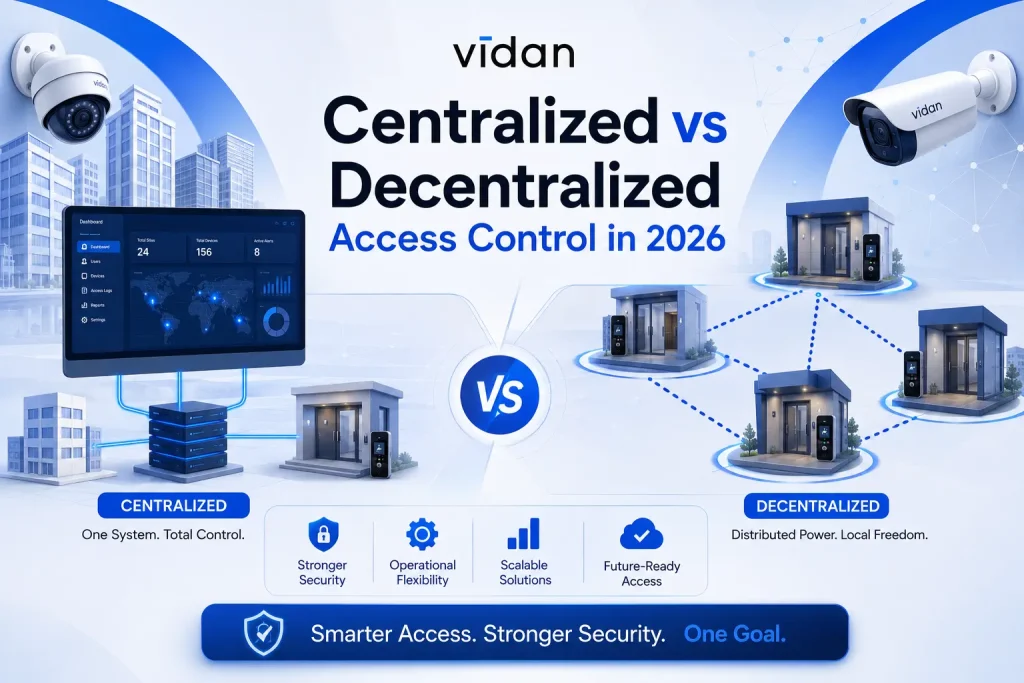
Every door, badge, and login is now a potential breach point. That single sentence explains why centralized and decentralized access control is one of the most searched security topics of 2026. Zero Trust security assumes no user, device, or location is automatically safe. That assumption changes how facilities decide who gets in, who gets out, and who watches the watchers.
Centralized access control manages every entry point from one system, giving security teams unified visibility and faster response. Decentralized access control spreads decision-making across multiple local systems, which adds redundancy but weakens oversight. Under Zero Trust, most enterprises now use a hybrid model that combines centralized oversight with decentralized enforcement at the edge.
Vidan AI builds physical security systems for organizations that cannot afford to guess. This blog breaks down both models, shows where Zero Trust fits, and explains what modern commercial access control actually requires in 2026.
Key Terms to Know
- Zero Trust security. A framework requiring continuous verification instead of automatic trust based on network location.
- Centralized access control. A model where one system manages authentication for all connected doors and devices.
- Decentralized access control. A model where individual sites or devices make independent access decisions.
- Access control list (ACL). A defined set of permissions determining who can access specific areas or systems.
- Security management system. A unified platform combining access control, video surveillance, and alarm monitoring.
- Security systems integration. The process of connecting separate security tools so they share data and trigger coordinated responses.
- Multi-factor authentication (MFA). A verification method requiring two or more credentials before granting access.
Access Control Isn’t Just About Doors Anymore
Physical access control used to mean a badge reader and a locked door. That definition is outdated. Modern facilities protect data centers, warehouses, hospitals, schools, and hybrid offices. Each location has different risk levels and different compliance needs.
Zero Trust changes the core question security teams ask. The old question was “Does this person have a badge?” The new question is “should this person have access right now, at this location, under these conditions?” That shift is why centralized and decentralized access control conversations have exploded across security forums, LinkedIn groups, and vendor blogs this year.
Security leaders are no longer choosing between centralized and decentralized models based on cost alone. They are choosing based on risk exposure, regulatory pressure, and how fast their teams need to respond to threats.
What Centralized Access Control Actually Means
Centralized access control places all authentication and authorization decisions inside one core system. Every door, gate, and terminal reports back to a single control point, whether on premises or cloud-based.
How It Works in Practice
A hospital with twelve buildings can manage every badge, every door schedule, and every access log from one dashboard. Security staff sees real-time entry data across the entire campus. If a badge is compromised, access can be revoked instantly across every connected door.
This model gives organizations strong audit trails. Compliance teams love centralized systems because reporting takes minutes instead of days.
Where Centralized Systems Struggle
Centralized systems rely on network connectivity. If the central server fails, authentication may stop unless redundancy and local caching are in place. They can also be harder to scale across multiple regions with different compliance requirements.
What Decentralized Access Control Means
Decentralized access control distributes authentication decisions across multiple independent systems. Each location, building, or device makes its own access decisions locally, often without needing constant contact with a central server.
Why Some Organizations Prefer This Model
Retail chains with hundreds of locations often choose decentralized models. Each store manages its own access rules based on local staffing and operating hours. If one store loses internet connectivity, the doors still function normally. This model reduces single points of failure. A breach at one site does not automatically expose every other location’s access data.
Where Decentralized Systems Struggle
Visibility becomes harder. Security teams cannot see a unified view of access activity across every site without pulling data manually from each location. This creates delays during incident response and makes company-wide audits more time-consuming. Decentralized systems also increase the risk of inconsistent security policies. One location might enforce stricter rules than another, creating gaps attackers can exploit.
Zero Trust Changes the Rules for Both Models
Zero Trust security is not a product. It is a framework built on one core principle. Never trust automatically; always verify.
Under Zero Trust, access decisions are continuous, not one-time events. A badge swipe is only the first check. Systems increasingly combine access control with behavioral verification, video confirmation, and contextual data like time of day and location history.
This is exactly why centralized and decentralized access control models are being rebuilt around Zero Trust principles instead of legacy assumptions. A badge alone no longer proves identity. Verification needs to be layered, continuous, and connected to real-time monitoring.
Read More: Why Real-Time Threat Detection Is Becoming the New Standard in Physical Security
The Hybrid Model Emerging in 2026
Most enterprise security teams are not choosing purely centralized or purely decentralized systems anymore. They are building hybrid architectures.
- Centralized oversight handles policy creation, audit logging, and company-wide visibility.
- Decentralized enforcement handles local decision-making at the edge, keeping doors functional even during connectivity issues.
This hybrid approach reflects Zero Trust thinking directly. Centralized visibility supports continuous verification. Decentralized resilience prevents total system failure.
Building a Security Management System That Actually Holds Up
A strong security management system connects access control, video surveillance, and alarm monitoring into one operational picture. Disconnected systems create blind spots, and blind spots create incidents that go unnoticed until it’s too late.
Three Pillars of a Modern Security Management System
- Unified Data: Access logs, camera footage, and alarm triggers should live in one platform, not three separate tools.
- Real-time Correlation: If a badge is used at a side entrance at 2 AM, the system should automatically pull nearby camera footage for verification.
- Actionable Alerts: Security teams need alerts that tell them what happened and where, not just that something happened.
Facilities that connect access control with AI video surveillance catch far more anomalies than those relying on access logs alone. A badge swipe tells you who entered. The video tells you what actually happened.
Why Standalone Access Control Isn’t Enough Anymore
A badge can be stolen. A badge can be shared. A badge cannot confirm that the person walking through the door is who the system thinks it is.
This is where verification layers matter. Combining centralized access control with visual confirmation closes the gap between “authorized” and “actually authorized.” Organizations that skip this step often discover the gap only after an incident.
Security Systems Integration Is the Real Differentiator in 2026
Security systems integration is what separates a modern facility from one running outdated infrastructure. Integration means access control, cameras, alarms, and analytics all communicate with each other automatically.
A Practical Example
A logistics yard has multiple gates, loading docks, and perimeter fencing. Without integration, a security guard checks access logs on one screen and camera footage on another. Response time depends entirely on how fast a human can cross-reference two systems manually.
With integration, an unauthorized access attempt automatically triggers a camera to zoom in, sends a real-time alert to security staff, and logs the event with visual proof attached.
Read More: How Artificial Intelligence Security Systems Improve Security Response Times
Integration Checklist for Facility Managers
- Confirm access control software supports open API connections.
- Verify cameras can trigger automated alerts based on access events.
- Test how the system performs during network outages.
- Review how audit logs combine access and video data.
- Ask vendors how updates and patches are deployed across integrated systems.
Commercial Access Control Needs Vary by Industry
Commercial access control is not a one-size-fits-all category. A school, a warehouse, and a corporate office all face different risks and require different configurations.
Retail and Commercial Spaces
Retail locations deal with high foot traffic and frequent staff turnover. Decentralized access with strong local controls often works best, paired with visual verification to reduce internal theft and unauthorized access.
Warehouses and Logistics Yards
These facilities need strict perimeter control combined with real-time monitoring across large physical areas. Mobile security cameras are a flexible solution for remote monitoring of yards where fixed infrastructure isn’t practical or cost-effective.
Schools and Campuses
Educational facilities require centralized oversight for compliance and rapid lockdown capability, combined with decentralized enforcement at individual building entrances.
Corporate Offices
Hybrid work has changed office access patterns permanently. Centralized systems now need to handle inconsistent schedules, visitor management, and multiple building access levels simultaneously.
Common Access Control Mistakes That Undermine Zero Trust
Many organizations claim to follow Zero Trust principles while running access control systems that contradict them.
- Treating badge access as sufficient identity verification without any visual confirmation layer.
- Failing to update access permissions when employees change roles or leave the organization.
- Running access control and video surveillance as completely separate systems with no shared data.
- Ignoring how loitering near entry points signals potential unauthorized access attempts before they happen.
- Assuming decentralized systems are automatically more secure simply because they are distributed.
How Vidan AI Approaches Access Control Differently
Vidan AI doesn’t sell access control as a standalone product disconnected from real-world verification. Here’s how Vidan AI supports both centralized and decentralized environments.
- For centralized deployments, Vidan AI connects directly into existing access control platforms, layering AI-powered video verification on top of every badge event. Security teams get a single dashboard showing access logs paired with real-time footage, not two disconnected tools.
- For decentralized environments, Vidan AI’s edge-enabled cameras continue functioning even during connectivity gaps, ensuring local sites maintain monitoring without depending entirely on a central server.
Vidan AI’s approach reflects exactly what Zero Trust requires. Continuous verification, layered checks, and no blind trust in a single credential.
In Conclusion
Choosing between centralized and decentralized access control depends on your security needs, compliance requirements, and operational structure. Many organizations now use a hybrid approach, combining centralized management with local decision-making. Under Zero Trust, every access request should be verified, not just approved with a badge swipe.
Vidan AI adds AI-powered video verification to access control, giving security teams visual confirmation of every entry. If your current system relies only on credentials, it’s time to build a stronger access strategy. Book a demo