
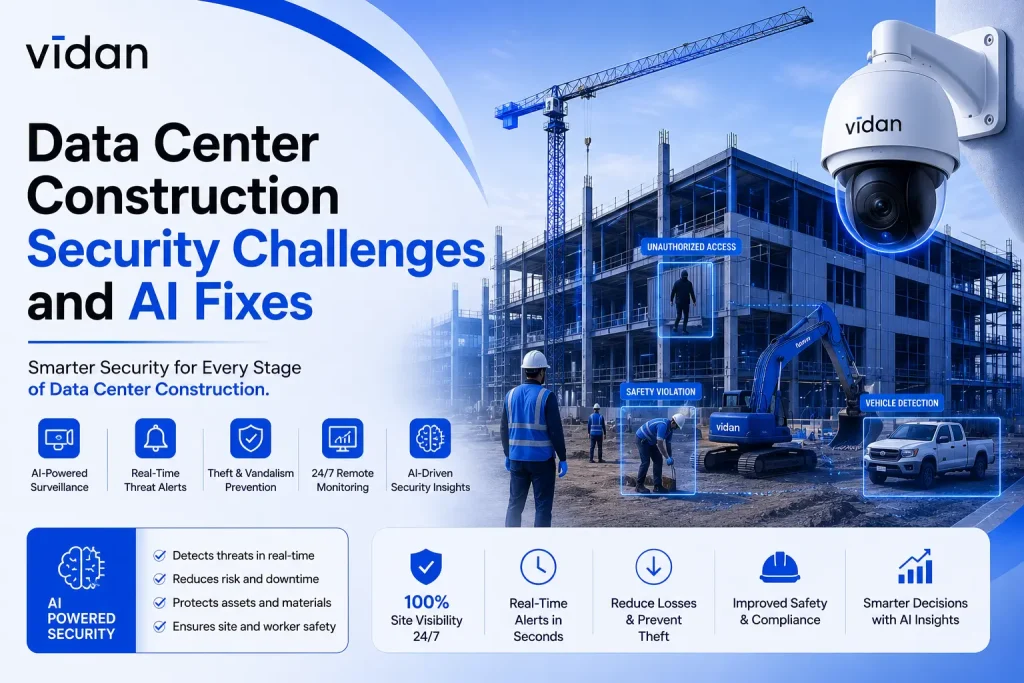
Data center construction sites face theft, unauthorized access, insider risk, and blind spots that standard guards and fences cannot fully cover. AI-powered surveillance closes these gaps by watching every angle, flagging threats instantly, and giving builders proof of what happened and when.
A single stolen generator can delay a data center build by weeks. A single unlogged visitor can compromise a facility before it even opens. That is the blunt reality of data center construction security today, and it is why builders are done relying on chain link fences and hope.
Data centers are not ordinary buildings. They house the servers that run banks, hospitals, and entire cloud platforms. Securing them starts long before the first server rack arrives. It starts on day one of construction.
This blog breaks down exactly where construction security fails, what it costs, and how AI closes the gap.
Key Takeaways
Here is what this guide covers, scannable in under a minute.
- Why do data center builds face higher security stakes than typical construction projects
- The most common security failures during construction, from theft to insider threats
- How AI infrastructure for security actually works on an active job site
- A practical framework for building a stronger security strategy
- Where Vidan AI fits into protecting data center construction from ground breaking to handover
- Real statistics on construction theft and site vulnerabilities
- Answers to the questions builders and security teams ask most
Why Data Center Builds Carry Higher Security Stakes
Not all job sites are equal. A retail store build and a data center build face very different risks.
Protect Every High-Value Asset
Data center projects involve expensive equipment early. Generators, cooling systems, and electrical components often arrive before walls are up. That makes early-stage sites a target.
The End Use Raises the Bar
Once operational, a data center holds sensitive infrastructure for major companies. Any security gap during construction can become a permanent weakness once the facility goes live. Builders are essentially securing tomorrow’s critical infrastructure today.
The Site Footprint Is Large and Hard to Watch
These projects often span dozens of acres with multiple entry points. Guards cannot physically watch every corner around the clock. This is where most construction site security plans start to break down.
The Real Security Challenges Facing Data Center Job Sites
This is the section every project manager searches for. Here are the problems showing up on data center builds right now.
Equipment and Material Theft
Copper wiring, generators, and tools are common theft targets. Industry estimates from groups like the National Equipment Register have long put annual construction equipment theft losses in the United States at close to one billion dollars a year. Data center sites, with their high-value electrical components, are especially attractive targets.
Unauthorized Site Access
Large sites with multiple gates make it easy for unauthorized people to walk in unnoticed. A missed entry point can mean a stranger on site for hours before anyone notices.
Insider and Subcontractor Risk
Not every threat comes from outside the fence. Subcontractors, delivery drivers, and temporary workers all have legitimate reasons to be on site. That access can be misused. Tracking who is where and when becomes difficult with paper logs or manual checkpoints.
Night and Off Hours Vulnerability
Most theft and vandalism happen after crews leave for the day. A dark, empty site with limited lighting and no active monitoring is an easy target for anyone watching the schedule.
Weather and Visibility Gaps
Fog, rain, and low light reduce what human guards and standard cameras can actually see. A data center construction security plan that only works in daylight is not complete.
Slow Incident Response
Even when something is caught on camera, footage reviewed the next morning does not stop a theft in progress. By the time someone notices, the equipment and the thief are both gone.
What a Security Breach Actually Costs a Data Center Project
Security failures are not just inconvenient. They carry real financial weight.
Direct Financial Loss
Stolen generators, transformers, and copper wiring can cost tens of thousands of dollars per incident. Replacement parts for specialized data center equipment often carry long lead times too.
Project Delays
A single theft can pause work for days or weeks while replacement equipment is sourced. On a data center build, delays ripple into missed launch dates for clients waiting on server capacity.
Insurance and Liability Impact
Frequent incidents can raise insurance premiums for future projects. Some insurers now ask for documented security measures before offering competitive rates.
Reputational Risk
Contractors known for security lapses can lose bids on future high value projects. Data center clients specifically look for builders with a strong security track record.
How AI Solves These Construction Security Problems
Here is a step-by-step look at how AI changes the equation on an active build.
Step One: Constant Visual Coverage: AI cameras monitor the entire perimeter around the clock, including nights and low-visibility conditions, without needing a person watching every screen.
Step Two: Instant Object and Behavior Recognition: The system can tell the difference between a delivery truck, a worker, and an unauthorized vehicle, then flag anything unusual in seconds.
Step Three: Real-Time Alerts: Security teams get notified the moment a breach or suspicious activity happens, not hours later during a footage review.
Step Four: Automatic Escalation: Alerts can trigger alarms, notify site managers, or alert law enforcement depending on the severity, cutting out delays caused by manual monitoring.
Step Five: Searchable Video History: Every incident is logged and easy to pull up later, which matters for insurance claims and investigations.
The Technology Stack Behind Modern Construction Site Security
AI infrastructure is not one single tool. It is a combination of hardware and software working together.
- Fixed AI cameras cover entry points, laydown yards, and high value equipment zones around the clock.
- Mobile camera trailers relocate easily as the site layout changes during different construction phases.
- Thermal imaging detects movement in total darkness or heavy fog, when standard cameras struggle.
- License plate recognition logs every vehicle entering or leaving, creating an automatic access record.
- Drone monitoring covers large open areas quickly, useful for perimeter checks across sprawling data center sites.
- Cloud based storage keeps footage accessible remotely, so stakeholders can review activity from anywhere.
Combining several of these tools creates layered coverage that a single camera type cannot match on its own.
Building a Smarter Security Strategy for Data Center Sites
A strong security strategy blends technology, process, and people. Here is how traditional methods compare to an AI-supported approach.
Perimeter Monitoring
- The traditional method relies on guard patrols and static cameras.
- An AI-supported method uses continuous automated monitoring with instant alerts.
Access Tracking
- The traditional method uses sign-in sheets and manual gate checks.
- The AI-supported method uses automated logs tied to camera verification.
Night Coverage
- The traditional method depends on reduced staffing and limited lighting.
- The AI-supported method maintains full visibility with low-light and thermal-capable cameras.
Incident Response
- The traditional method reviews footage after the fact.
- An AI-supported method sends real-time alerts as events happen.
Reporting
- The traditional method involves manual notes and delayed summaries.
- An AI-supported method provides searchable, timestamped video records.
This comparison shows why more data center developers are shifting budgets toward smarter systems rather than simply adding more guards.
A Practical Framework for Securing a Data Center Build
- Here is a simple framework Vidan AI recommends for any construction team planning a data center project.
- Site Assessment: Map out entry points, blind spots, and high-value storage areas before placing a single camera.
- Layered Coverage: Combine fixed cameras, mobile units, and time-lapse tools so no zone is left unmonitored.
- Real-Time Response Protocol: Define who gets alerted, how fast, and what action follows each type of alert.
- Documentation and Audit Trail: Keep footage and logs organized for insurance, compliance, and post-project reviews.
- Continuous Review: Reassess coverage as the site changes, since a foundation phase and a fit-out phase have very different risks.
Teams managing multiple laydown yards often pair this framework with the approach outlined in Monitoring Construction Site Storage Remotely with Vidan AI, which focuses specifically on protecting stored materials and equipment.
Practical Example: A Data Center Site in Its First 90 Days
Picture a mid-size data center built in its early phase. Generators and transformers have already arrived, but the building shell is not complete.
Without AI monitoring, the site relies on two guards rotating shifts and a handful of static cameras. Blind spots exist near the equipment laydown area. Within the first month, a section of copper wiring goes missing overnight.
With AI monitoring in place instead, cameras cover the full perimeter and the laydown yard specifically. An unfamiliar vehicle approaches after hours. The system flags it immediately, alerts the site manager’s phone, and the footage is saved automatically. Security responds before anything is taken.
This is the practical difference between hoping nothing happens and knowing the moment something does.
Where Vidan AI Fits Into Data Center Construction Security
Vidan AI was built for exactly this kind of high-stakes job site. Here is what that looks like in practice.
Our cameras run continuous AI-powered analysis, not just recording. That means the system actively looks for theft, intrusion, and unusual activity instead of simply storing footage for someone to review later.
Coverage extends across large, changing sites. As a data center build grows, camera placement can adapt without ripping out existing infrastructure.
Alerts reach the right person fast. Site managers, security teams, and stakeholders get notified in real time, not the next morning.
Every event is documented. That documentation supports insurance claims, safety audits, and post-incident reviews without digging through hours of raw footage.
End-to-End AI Monitoring for Construction Sites
Security is not only about stopping theft. It is about visibility across the entire build.
Progress Tracking Doubles as Security
Cameras that document daily progress also capture anything unusual happening on site. This dual purpose is part of Why You Need Time Lapse Cameras on Construction Sites, which has become a common addition to data center projects specifically.
Safety and Security Overlap
Unauthorized access is not just a theft risk. It is a safety risk. Someone wandering into an active construction zone without training can get hurt, and that becomes a liability issue too.
Compliance Gets Easier
Many data center clients require documented proof of site security as part of contract terms. A searchable video record makes that requirement simple to satisfy.
The Bottom Line
Data center construction security is not optional anymore. It is a baseline requirement for any project of this scale. The builders who treat it that way are the ones who avoid costly delays, theft losses, and compliance headaches.
Vidan AI exists to make that baseline achievable. Our systems watch every angle, respond in real time, and give your team the visibility a data center build demands. If your current setup still relies on guards checking a handful of screens, it is time for an upgrade that matches the stakes of what you are building.
Talk to the Vidan AI team today and see how AI-powered surveillance can protect your data center build from the ground up.