
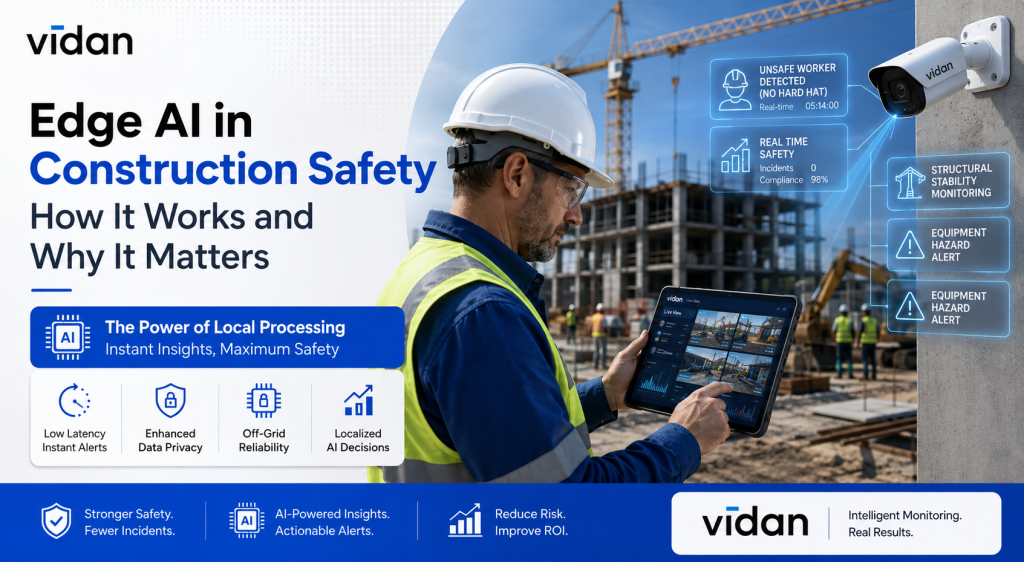
A construction site does not wait for a stable internet connection before a worker steps under a suspended load. Safety decisions happen in milliseconds, not in the time it takes data to travel to a distant server and back. That gap is exactly why Edge AI in Construction Safety is changing how job sites detect danger before it becomes an incident.
Industry analysts from Markets and Markets project that the edge AI hardware market will grow to USD 58.90 billion by 2030.
This is not another camera upgrade. It is a shift in where intelligence lives, moving from a distant cloud to the site itself.
Key Takeaways
- Edge AI in Construction Safety analyzes footage on site, cutting alert times from minutes to seconds.
- Edge computing in construction removes reliance on constant internet access.
- Cloud AI still plays a role for storage, reporting, and long-term analytics.
- Poor connectivity on remote sites makes offline processing a practical necessity, not a luxury.
- Vidan AI builds edge-first systems designed for the unpredictable conditions of active construction sites.
What Is Edge AI in Construction Safety?
Edge AI in Construction Safety refers to artificial intelligence models running directly on cameras, gateways, or local servers placed on a job site. Instead of streaming raw video to a distant data center for analysis, the AI processes the footage where it is captured.
This local processing means a camera can recognize a worker without a harness near an open edge and send an alert within seconds. There is no waiting on an upload, no dependence on a distant server queue, and no risk of losing the moment because a connection dropped.
A Simple Way to Picture It
Think of edge AI as a security guard standing on site, watching directly and reacting immediately. Cloud AI is more like a guard watching through a video feed from another building, reacting only after the footage arrives.
Both roles matter. But only one of them can act the instant something happens.
How Edge Computing in Construction Works
Edge computing in construction is the infrastructure layer that makes real-time safety detection possible. It typically involves three components working together on site.
- Local processing hardware
Cameras or dedicated edge devices contain enough computing power to run AI models directly. This hardware analyzes video frames as they are captured, without sending raw footage elsewhere first.
- On-device AI models
Lightweight, optimized versions of detection models run locally. These models are trained to recognize hazards such as missing PPE, unauthorized entry, proximity to heavy equipment, or workers in fall risk zones.
- Local alerting and storage
When a hazard is detected, the alert triggers immediately from the site itself. Footage and event logs can be stored locally, then synced to the cloud once connectivity allows.
Also Read: Data Center Construction Security Challenges and How AI Solves Them
Why This Setup Matters for Safety Specifically
A hazard on a construction site can develop and resolve within seconds. A crane swinging a load, a vehicle reversing near a blind spot, or a worker stepping past a barricade all happen fast.
Local processing means the system does not need to wait. It sees the event and reacts to it in real time, on site, without a round trip to a distant server.
Edge vs Cloud: Why Cloud-Only Systems Fall Short on Site
Cloud AI and cloud-only systems are not inherently bad. They offer strong storage capacity, easier software updates, and centralized dashboards across multiple sites. The problem is not the cloud itself. The problem is depending on it exclusively for time-sensitive safety alerts.
Here is a straightforward comparison of how each approach behaves under real job site conditions.
Detection Speed
- Edge-based systems respond in near real time since processing happens locally.
- Cloud-only systems depend on upload speed, which varies with signal strength.
Connectivity Requirement
- Edge systems can function during outages because processing does not require internet access.
- Cloud-only systems stop analyzing footage the moment connectivity drops.
Bandwidth Usage
- Edge systems send only alerts and summaries, using minimal bandwidth.
- Cloud-only systems require constant video streaming, consuming significant bandwidth.
Cost Over Time
- Edge systems reduce data transfer costs since most processing stays local.
- Cloud-only systems often carry higher recurring data costs at scale.
Best Use Case
- Edge systems excel at instant hazard detection and immediate alerts.
- Cloud systems excel at long-term analytics, reporting, and multi-site dashboards.
The strongest safety platforms combine both. Edge handles the moment. Cloud handles the bigger picture.
Also Read: Construction Safety ROI Calculator: Measure the Value of Every Safety Investment
Why Connectivity Problems Break Cloud-Only Safety Systems
Connectivity on a construction site is rarely consistent. Steel structures block signals. Excavation sites sit far from cell towers. Temporary power setups do not always support stable network hardware.
A cloud-dependent camera in these conditions has a real weakness. If the connection drops, the system stops analyzing footage in real time. It might still record locally for later upload, but the immediate detection and alerting capability is gone exactly when it may be needed most.
This is where offline processing becomes a practical requirement rather than a nice feature. An edge-based system keeps detecting hazards even during a total connectivity blackout, because the AI model and the decision-making both live on site.
What Offline Processing Protects Against
Consider a night shift on a remote highway project. Cell coverage is weak. A worker crosses into an active equipment zone without noticing the operator’s blind spot.
With offline processing, the on-site system still detects the intrusion and triggers a local alarm or alert, even with zero internet access. With a cloud-only setup, that same event might go completely unnoticed until footage uploads hours later, if it uploads at all.
That gap is not theoretical. It is the daily reality on remote and rural project sites across the country.
Real World Wins: What Edge AI Actually Prevents on a Job Site
Understanding the technology matters less than understanding what it stops before it happens. Here are specific scenarios where Edge AI in Construction Safety makes a measurable difference.
Unauthorized Site Access
Construction sites hold expensive equipment and materials, making them frequent targets for theft and trespassing. Edge-based detection identifies unauthorized entry after hours and triggers an immediate alert to site security.
Read More: What You Need to Know About Trespassing and Its Consequences
Missing Personal Protective Equipment
The system can flag a worker without a hard hat, vest, or harness in a designated high-risk zone, prompting a supervisor to intervene before an injury occurs.
Proximity To Heavy Machinery
Struck-by incidents remain one of the leading causes of construction fatalities. Edge detection can identify a worker standing too close to an active excavator or crane and alert both the worker and the operator instantly.
Fall Risk Zones
Open edges, unguarded floor openings, and incomplete scaffolding are flagged the moment a worker enters those zones without proper fall protection.
After-Hours Perimeter Breaches
Sites left unattended overnight remain vulnerable. Local detection continues working even without stable connectivity, closing a gap that cloud-only systems cannot reliably cover.
Where Edge AI Fits Inside a Layered Security Strategy
No single tool should carry the full weight of site safety. Edge AI in Construction Safety works best as one layer inside a broader strategy.
Layer One: Perimeter Detection
This layer covers site boundaries, gates, and fencing. Edge cameras here focus on unauthorized entry, after-hours breaches, and vehicle activity near access points.
Layer Two: Active Work Zone Monitoring
This layer sits closer to the actual work. It tracks PPE compliance, proximity to machinery, and fall risk areas like open floor edges or incomplete guardrails.
Layer Three: Response and Escalation
Detection alone does not stop an incident. This layer defines what happens after an alert triggers, including who gets notified, how fast, and through what channel.
A system that only handles layer one is a perimeter tool. A complete safety platform needs all three layers working together.
The Vidan AI Approach: Built for Sites
Vidan AI designs its safety systems around the actual conditions of a working job site, not the ideal conditions of a demo room with perfect Wi Fi.
Here is what that looks like in practice.
- Edge-first Architecture: Detection models run directly on site hardware, so alerts do not depend on a stable internet connection.
- Hybrid Cloud Support: Once connectivity is available, event data syncs to the cloud for reporting, trend analysis, and multi-site dashboards.
- Purpose-built Detection Models: Models are trained specifically for construction environments, including PPE compliance, restricted zone breaches, and equipment proximity.
- Scalable Deployment: Systems expand easily as a site grows, from a single trailer setup to a full multi-phase project.
Also Read: Why AI Agents in Construction Risk Prevention Are More Than Just Smart Cameras
Common Myths About Edge AI in Construction Safety
A few misconceptions come up often when teams evaluate this technology for the first time.
Myth: Edge AI means no cloud involvement at all.
Fact: Most systems use a hybrid model, processing locally while still syncing data to the cloud once connectivity allows.
Myth: Edge hardware is too expensive for smaller projects.
Fact: Deployment scales down easily, and reduced bandwidth costs often offset the initial hardware investment over time.
Myth: Edge AI cameras require constant manual monitoring.
Fact: The system flags hazards automatically, reducing the need for someone to watch every feed continuously.
Myth: All AI safety cameras already work offline.
Fact: Many marketed systems still depend on cloud processing for detection, despite branding themselves as smart or AI-powered.
Rolling Out Edge AI Without Disrupting Active Operations
Adding a new safety system mid-project can feel disruptive. A phased rollout avoids that problem.
- Site Assessment: A technician evaluates blind spots, power access, and connectivity gaps before placing any hardware.
- Pilot Deployment: Cameras go live in one high-risk zone first, allowing the team to confirm detection accuracy before expanding further.
- Full-site Coverage: Once the pilot performs well, coverage extends across the remaining zones, including perimeter, work areas, and equipment lanes.
- Ongoing Calibration: Detection models get fine-tuned over the following weeks as the system adjusts to the specific site layout.
This staged approach keeps daily operations running while safety coverage builds up in the background.
What to Look for in an Edge AI Safety Partner
Not every system marketed as edge-based actually processes data locally. Here is a short checklist worth running through before choosing a provider.
- Ask whether detection still works during a full internet outage.
- Ask how much local processing power the hardware actually contains.
- Ask how quickly alerts trigger from the moment an event occurs.
- Ask whether the system was trained specifically for construction environments.
- Ask how footage and event data sync once connectivity returns.
A provider that cannot answer these clearly is likely offering a cloud-dependent system with an edge label attached.
Conclusion
Construction safety has always been about prevention, not just documentation. Edge AI in Construction Safety shifts detection from something that happens after the fact to something that happens in the moment, right when it can still change the outcome. If your current safety setup goes quiet the moment signal drops, that is not a minor gap. That is the exact moment protection matters most.
Vidan AI builds detection systems engineered for real job sites, with real connectivity problems, not demo conditions. See how edge-first monitoring performs on an active site. Talk to Vidan AI today and find out what your cameras are missing right now.