
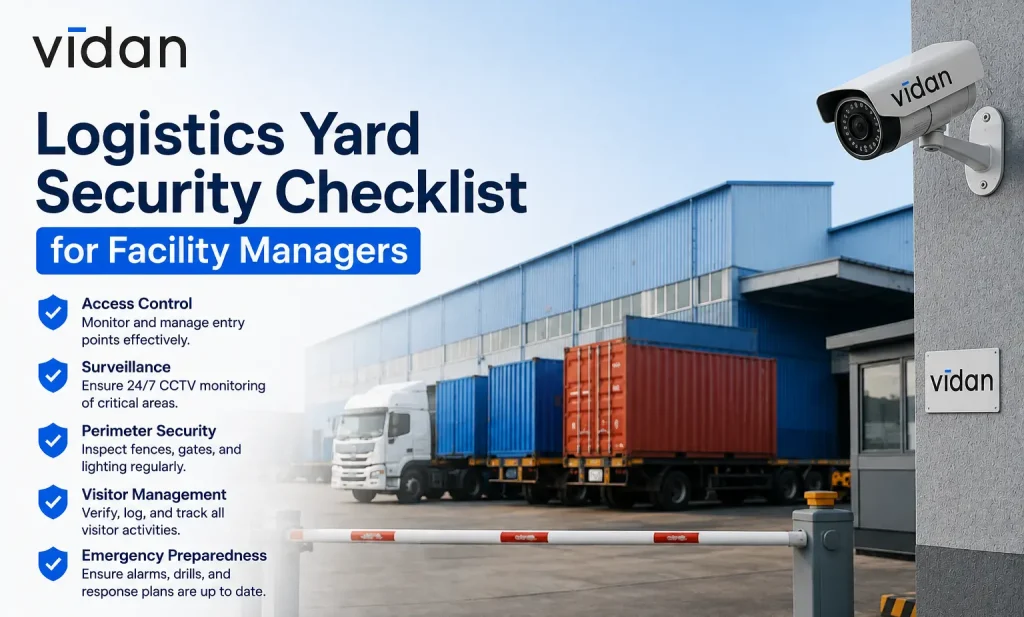
A single unlocked gate can cost a logistics operation more than a full year of security spending. That is not a scare tactic. It is the math behind most cargo theft cases reported across trucking yards and distribution hubs every year. Facility managers already know the pressure. Trailers sit overnight. Drivers rotate. Gates open and close hundreds of times a day. One gap in coverage is all it takes.
This blog breaks down exactly what a modern logistics yard security plan needs, why old methods are falling behind, and how facility managers can close the gaps before they become losses.
Key Takeaways
Before diving in, here is what this guide covers.
- Why traditional yard security methods leave blind spots
- A full breakdown of patrol security vs remote monitoring
- A complete, checklist-by-checklist look at yard security essentials
- How AI-powered detection is changing yard protection
- Why real-time intervention matters more than recorded footage
- How Vidan AI approaches logistics yard protection differently
- A practical roadmap to strengthen your yard’s security posture
Why Logistics Yard Security Cannot Be an Afterthought
Yards are not warehouses. They are open, active, and constantly changing. Trucks arrive at odd hours. Trailers get parked temporarily. Staff rotate between shifts. This constant motion makes logistics yard security far harder to manage than indoor facility protection.
Blind Spots That Cost Millions
Most yard theft does not happen through dramatic break-ins. It happens through quiet gaps.
Common blind spots include:
- Unmonitored fence lines during night shifts
- Trailers parked outside camera range
- Gate areas without live supervision
- Poor lighting near loading docks
- Staff entry points without identity verification
Each gap looks small on its own. Together, they create a yard that is easy to exploit.
The Real Price of a Breach
A stolen trailer is not just lost cargo. It disrupts delivery schedules, damages client trust, and increases insurance premiums. Facility managers often underestimate how one incident can ripple across an entire quarter of operations.
Patrol Security vs Remote Monitoring: Which One Actually Works
This is the question every facility manager eventually faces. Should you rely on guards walking the yard, or on a monitoring system watching it live?
How Traditional Patrols Fall Short
Human guards get tired. They cover one section at a time. A yard spanning several acres cannot be watched fully by a person walking a route every thirty minutes. Between rounds, anything can happen.
Where Remote Monitoring Wins
Remote monitoring changes the equation. Cameras never blink. Trained operators can view multiple zones from a single screen. This is where remote video monitoring becomes clear for facility managers comparing costs against outcomes.
Here is a simple comparison.
| Factor | Patrol Security | Remote Monitoring |
| Coverage | Limited to one area at a time | Full yard visibility at once |
| Response Speed | Delayed until next round | Immediately upon detection |
| Cost Over Time | Rises with more guards | Scales without added headcount |
| Night Coverage | Reduce visibility | Enhanced with night vision tech |
Patrol security vs remote monitoring is not about choosing sides. It is about understanding which method actually prevents loss instead of just recording it.
The Complete Facility Manager Checklist
Perimeter and Fencing
- Inspect fence lines monthly for damage or gaps
- Confirm gate locks function correctly every shift
- Add motion sensors along less visible fence sections
Lighting and Visibility
- Replace dim or flickering lights immediately
- Add lighting near blind corners and trailer rows
- Pair lighting upgrades with cameras that support low-light footage.
Camera Coverage
Cameras are only useful if they cover the right zones.
- Entry and exit gates
- Loading docks
- Trailer parking rows
- Fence perimeters
- Employee access points
Facility managers often research the effectiveness of logistics security camera solutions for warehouse security before selecting a vendor, as not all camera systems perform equally well in outdoor, high-traffic yards.
Access Control
Access points need more than a lock.
Recommended controls include:
- Badge-based entry systems
- Visitor logs for drivers and vendors
- Time-stamped gate activity records
Documentation and Audits
Keep records of every incident, no matter how small. Patterns often reveal themselves only after several months of data.
Staffing and Training Gaps Most Facilities Miss
Technology matters, but people still run the yard day to day. Weak training undoes even the best equipment.
Guard Turnover and Its Hidden Cost
Security staff turnover in logistics yards runs higher than in most industries. New guards need time to learn blind spots, shift patterns, and driver routines. During that learning curve, gaps widen.
Training Checklist for Yard Staff
Facility managers should confirm that every guard and gate attendant understands the following.
- Correct procedure for verifying driver identity
- Steps for logging trailer arrivals and departures
- Escalation protocol when something looks wrong
- How to use camera alerts on mobile devices
- Communication chain during an active incident
Why Cross Training Helps
Guards who understand both physical patrol duties and monitoring software respond faster. A team member who only knows one system becomes a bottleneck during a shift change.
Common Mistakes Facility Managers Make
Even experienced teams fall into predictable traps. Avoiding these saves both money and stress.
- Treating cameras as a deterrent alone without active monitoring behind them.
- Skipping regular fence and lighting audits until something breaks.
- Relying on a single guard for a yard that needs continuous coverage.
- Ignoring data from past incidents instead of using it to adjust protocols.
- Choosing cheaper camera systems that lack low-light performance or smart alerts.
Each mistake seems minor alone. Combined, they create the exact blind spots theft depends on.
The Cost of Doing Nothing vs Upgrading
Facility managers often hesitate on upgrades due to budget concerns. The real comparison looks different once losses are factored in.
Doing nothing means absorbing the cost of stolen cargo, damaged trailers, insurance claim increases, and delayed shipments after every incident.
Upgrading systems means a fixed, predictable investment that reduces incident frequency and shortens response time when something does happen.
Most facility managers find that one prevented theft covers a significant portion of a yearly monitoring upgrade. Over time, the math consistently favors prevention.
AI-Powered Detection Changes the Math
Traditional cameras record. They do not think. AI-powered detection changes that completely. It analyzes movement, identifies unusual activity, and flags threats without waiting for a human to notice.
From Passive Recording to Active Awareness
A camera that simply records footage is reactive. Once footage is reviewed after an incident, the damage is already done. AI shifts this timeline. Systems built with AI-powered detection identify a person climbing a fence or a vehicle idling near restricted zones as it happens.
This shift matters because logistics yard security depends on speed, not just visibility. Seeing an incident an hour later does not stop it.
Why Facility Managers Are Making the Shift
Labor costs continue rising. Guard shortages remain common across the security industry. AI systems fill this gap without needing more staff. This is why video AI agents are a key development in video intelligence technology, especially for facility teams looking to enhance yard protection.
Real-Time Intervention: The Missing Piece in Most Yards
Detection alone is not protection. A system can spot a threat, but if nothing happens next, the value is limited.
What Real-Time Intervention Looks Like
Real-time intervention means the system takes action the moment a threat is confirmed. This can include live audio warnings, instant alerts to security teams, or automatic lockdowns of certain access points.
Why This Matters for Logistics Yards
A trailer theft often takes less than three minutes. Waiting for a guard to notice and respond is too slow. Real-time intervention closes that gap by acting during the incident, not after it.
This highlights how artificial intelligence security systems enhance response times, as prompt reactions can often mean the difference between averting an incident and incurring a significant loss.
Integrating Yard Security With Broader Facility Operations
Security should not sit isolated from daily operations. The best results come from connecting it to existing workflows.
Linking Security Data With Yard Management Software
When alerts feed directly into yard management systems, dispatchers see security events alongside trailer schedules. This reduces confusion during busy shifts.
Coordinating With Warehouse and Dock Teams
Security teams and dock staff often work in silos. Sharing real-time alerts between both groups closes response gaps during shift transitions.
Reporting That Actually Gets Used
Monthly security reports should be simple enough for operations managers to act on, not just security specialists. Clear summaries drive faster decisions.
How Vidan AI Approaches Logistics Yard Protection
Most security systems are built to record. Vidan AI is built to respond.
Here is what makes the approach different.
Live Threat Recognition
Vidan AI identifies unusual movement, unauthorized entry, and suspicious patterns as they unfold, not after the fact.
Instant Alert Delivery
Security teams receive alerts within seconds, allowing faster decision making during active incidents.
Scalable Yard Coverage
Whether a yard spans two acres or twenty, Vidan AI adjusts coverage without requiring additional staff.
Built for Facility Managers, Not Just Security Teams
The platform is designed around real operational needs, including shift changes, vendor access, and multi-site oversight.
Vidan AI does not just watch the yard. It works to protect it, actively and continuously.
Building Your Yard Security Roadmap
A checklist is only useful if it leads to action. Here is a simple path forward.
- Audit your current setup against the checklist above.
- Identify which gaps involve missed detection versus missed response.
- Evaluate whether your current system supports AI-powered detection or only passive recording.
- Prioritize upgrades that improve real-time intervention, not just camera count.
- Review results quarterly and adjust based on incident data.
Final Thoughts
Yard security is not about having more cameras. It is about having the right system watching the right way. Facility managers who upgrade from passive recording to intelligent, responsive coverage see fewer incidents and faster resolutions. A strong logistics yard security plan combines smart coverage, faster detection, and immediate action, not just footage sitting in storage.
If your current setup only records what already happened, it is time for a system that actually stops it from happening. Vidan AI helps facility managers move from reactive monitoring to active protection, one yard at a time. Talk to the Vidan AI team today and see how a smarter security layer can change the way your facility operates overnight.