
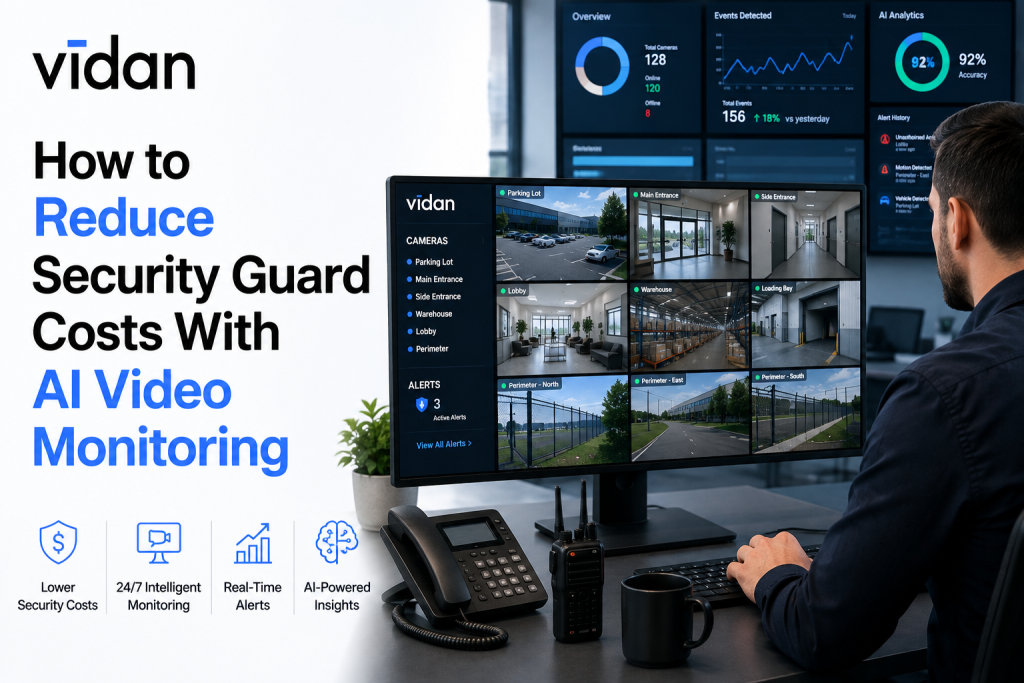
Guard shifts don’t scale. Cameras do. That single fact is quietly reshaping physical security budgets across every industry in 2026.
Security guard costs climb every year while coverage gaps stay exactly where they were. A guard can watch one entrance at a time. A single monitoring platform can watch fifty. This math is why more facilities are shifting spend from headcount to intelligent video systems, and why this shift is happening faster than most security budgets can adjust to.
This guide breaks down exactly what drives guard expenses, how AI video monitoring cuts them, and what the real numbers look like when you compare both models side by side.
Key Takeaways
- AI video monitoring can lower security guard costs by reducing headcount needs without reducing coverage.
- Real-time intervention through live monitoring stops incidents before they escalate, not after.
- Cost, Coverage, and ROI all improve simultaneously when facilities pair AI analytics with remote guarding.
- Most sites don’t need to eliminate guards. They need a smarter ratio between technology and personnel.
- Comparing Cost and Coverage side by side shows AI systems scale wider for a fraction of the price.
- Vidan AI builds this exact model for construction, retail, warehouse, and multifamily properties.
Quick Summary
Traditional guard staffing costs rise with every added shift, holiday, and location. AI video monitoring replaces or supplements guards with cameras, analytics, and remote operators who can see multiple sites at once. Facilities typically see the sharpest savings on overnight and perimeter coverage, where guard costs run highest, but incident rates run lowest. Pairing a smaller onsite team with AI monitoring often cuts total security spend by a significant margin while improving response speed. That combination of lower cost and faster response is the entire value proposition.
Why Security Guard Costs Keep Climbing
This isn’t a pricing problem. It’s a structural one.
The Hourly Math Doesn’t Bend
A single unarmed guard post typically runs anywhere from twenty to thirty-five dollars an hour depending on region, licensing, and shift type. Multiply that across three shifts, seven days a week, and one post alone can cost a facility well over a hundred thousand dollars annually. Add a second or third post for a larger property and the number multiplies fast.
Turnover Quietly Drains Budgets
The private security industry has one of the highest turnover rates of any service sector, often cited above one hundred percent annually. Every departure means recruiting, background checks, training, and a gap in coverage while a replacement gets up to speed.
Overnight Shifts Cost More And Cover Less
Guards working overnight command shift differentials, yet overnight is when human alertness naturally dips. Facilities pay a premium for the hours when a guard is statistically least likely to catch something on the first pass.
Coverage Doesn’t Scale With Headcount
A guard walking a property covers ground linearly. A ten-acre site needs multiple patrol loops to check every corner, and there’s always a blind window between rounds. This is where security guard costs stop matching the actual protection a facility receives.
What AI Video Monitoring Actually Replaces (And What It Doesn’t)
This is the part people get wrong most often.
It’s Not About Removing Every Guard
AI video monitoring isn’t designed to eliminate human security. It’s designed to remove the parts of the job that don’t require a physical body: constant visual scanning, static post coverage, and routine perimeter checks.
What Stays Human
Guest escalation, physical response, and situations requiring judgment still benefit from a trained person. Many facilities keep a lean onsite presence while shifting overnight and perimeter duties to AI monitoring.
What Shifts To Technology
Continuous scanning across dozens of camera feeds, instant motion and object detection, and automated alerts are tasks software handles better than a tired guard at three in the morning. AI video surveillance picks up patterns a single set of eyes will eventually miss during a long shift.
A Simple Way To Picture The Split
Think of it as a layered model instead of a replacement model.
- Cameras and analytics watch everything, all the time, without fatigue.
- Remote operators verify flagged events in seconds.
- A smaller onsite or dispatched team responds only when action is actually needed.
That structure is how facilities cut costs without cutting protection.
Cost, Coverage, and ROI: The Numbers That Matter
Here’s where the decision usually gets made.
| Factor | Traditional Guard | AI Video Monitoring |
| Coverage per resource | One post, one location | Dozens of cameras, multiple sites |
| Overnight premium | Higher shift pay | No shift differential |
| Turnover impact | Frequent retraining | Minimal, system-based |
| Response consistency | Varies by individual | Consistent, rule-based |
| Scalabiliy | Linear, costly to expand | Add cameras, not headcount |
Where ROI Actually Comes From
Cost, Coverage, and ROI improve together for three main reasons. First, fewer guard hours are needed for routine watching. Second, incidents get caught earlier, which reduces theft, vandalism, and liability losses. Third, one monitoring center can serve several properties, spreading the cost across a portfolio instead of one site.
A Realistic Example
A logistics yard running two guard posts around the clock might spend well over two hundred thousand dollars a year on labor alone. Replacing overnight and perimeter coverage with AI monitoring, while keeping a smaller day shift presence, commonly brings that number down by a substantial percentage, often somewhere between thirty and fifty percent depending on site size and risk level.
Real-Time Intervention: The Feature That Changes Everything
Recording an incident and stopping one are two very different outcomes.
The Old Model: Evidence After The Fact
Traditional cameras without live monitoring mostly serve one purpose. They give you footage to review after something already happened. That’s useful for investigations. It does nothing to prevent loss.
The New Model: Action During The Event
Real-time intervention means a monitoring center sees the trespasser the moment they step onto the property, not the next morning during footage review. Trained operators can trigger an audio warning through onsite speakers, notify onsite staff, or contact law enforcement while the person is still there.
Why Speed Changes Outcomes
Most opportunistic intrusions and theft attempts end the moment the person realizes they’re being watched and addressed live. A voice coming through a speaker in real time is a far stronger deterrent than a camera they assume is just recording. How artificial intelligence security systems improve security response times comes down almost entirely to this live verification and response loop.
What This Looks Like In Practice
A person climbs a fence after hours. The system detects the motion instantly. An operator reviews the feed within seconds. A live audio warning plays. In most cases, the individual leaves immediately, and no guard ever needs to respond physically.
Comparing Cost and Coverage Across Industries
Different facility types get different value from this shift.
Construction Sites
Construction sites face constant equipment theft risk, especially overnight when no staff is present. Comparing Cost and Coverage here usually favors AI monitoring heavily, since hiring overnight guards for a temporary site is expensive and coverage still leaves blind spots between patrol rounds.
Stop Equipment Theft Before It Happens
Protect construction sites with AI-powered perimeter monitoring, live video verification, and real-time intervention that works day and night.
Construction Security Speak with Our Team
Warehouses And Distribution Centers
Large footprints make traditional guard patrols slow and inconsistent. AI video analytics can provide continuous camera coverage across large warehouse and distribution areas, helping security teams monitor activity, identify unusual events, and respond faster without relying solely on physical patrols.
Read More: Warehouse Security Guards vs. AI Video Analytics: Which Provides Better Protection?
Retail Properties
Shrinkage and after-hours break-ins are the primary concerns in retail properties. AI monitoring catches suspicious behavior at entry points before merchandise ever leaves the building.
Multifamily And Residential Communities
Trespassing, unauthorized access, and parking violations dominate resident complaints in apartments and residential communities. Consistent monitoring reduces these incidents without requiring a guard stationed at every entrance.
Schools And Campuses
Perimeter monitoring after hours protects a large school property when staff and students aren’t present, without the cost of a full overnight guard rotation.
The Hybrid Model Most Facilities Land On
Very few sites go from full guard staffing to fully unmanned overnight. Here’s what the middle ground typically looks like.
- Keep a reduced onsite presence during peak hours when human interaction with staff or visitors matters most.
- Shift overnight and perimeter coverage entirely to AI monitoring with real-time intervention capability.
- Route verified incidents to either onsite staff or law enforcement, depending on severity.
- Review monthly incident data to adjust camera placement and staffing further.
This phased approach avoids a jarring transition while still capturing most of the cost reduction from day one.
Why 2026 Is the Turning Point for This Shift
Timing matters more than people think.
Guard Wages Are Rising Faster Than Inflation In Many Markets
Licensing requirements and minimum wage increases across several states have pushed guard contract rates up year over year, squeezing security budgets that were already tight.
AI Analytics Accuracy Has Improved Sharply
False positive rates have dropped considerably compared to just a few years ago, making live monitoring far more reliable and less prone to alert fatigue.
Remote Operations Centers Have Matured
Why organizations are investing in AI security guard technology in 2026 largely comes down to this maturity. Monitoring providers now run around-the-clock centers capable of managing hundreds of properties simultaneously, something that simply wasn’t scalable a decade ago.
Insurance Carriers Are Taking Notice
Some insurers now offer reduced premiums for properties with verified AI monitoring and documented intervention protocols, adding another line to the ROI calculation.
How Vidan AI Approaches This Differently
Vidan AI builds security monitoring around one simple idea: coverage should not depend on how many people are physically on-site.
AI Video Analytics + Human Response
The platform combines:
- AI video analytics for continuous monitoring
- Trained operators to verify flagged events
- Real-time response across different property types
- Coverage for construction sites, warehouses, retail locations, and multifamily communities
Detection Is Only the First Step
When an event is detected, operators can:
- Verify the alert
- Issue live audio warnings
- Dispatch the appropriate response
- Document the incident for liability purposes
Monitoring Built Around Each Property
Every site has different security risks. Vidan AI adjusts monitoring based on:
- Property type
- Site layout
- Camera placement
- Activity patterns
- Risk areas
- Response protocols
A construction site with seasonal equipment needs a different approach than a busy retail location.
Lower Security Guard Costs
By combining AI monitoring with human intervention, facilities can reduce reliance on constant physical patrols while maintaining active security coverage.
The goal is not simply to use fewer guards. It is to make every security dollar work toward reducing actual risk.
A Simple Framework For Deciding What Your Site Needs
Use this four-question framework before making any staffing changes.
Question one. What hours carry the highest risk at your property? Overnight and after-hours coverage is usually the first place to shift toward AI monitoring.
Question two. How large is the area a single guard would need to cover? Larger footprints favor camera-based coverage over foot patrols.
Question three. How often does an incident require physical human response versus verification and deterrence? If most incidents resolve through a warning, live monitoring may be sufficient.
Question four. What’s your current cost per square foot of coverage? Compare that number against a monitoring quote before assuming guards are cheaper.
Answering these four questions honestly usually makes the right staffing mix obvious.
The Bottom Line
Security guard costs aren’t going down on their own, and hoping wages stabilize isn’t a strategy. The facilities getting ahead of this are the ones treating video monitoring as core infrastructure, not an add-on. Pairing a smaller trained team with AI analytics and real-time intervention consistently delivers stronger coverage at a lower price point than staffing alone ever could. The properties that make this shift early aren’t just saving money. They’re closing coverage gaps that guards were never able to close in the first place fully.
If your current security budget feels like it’s growing faster than your actual protection, that gap is exactly what AI monitoring is built to close. Vidan AI can walk your property through a real cost and coverage comparison. Talk to our team and see what your facility could save this year.