
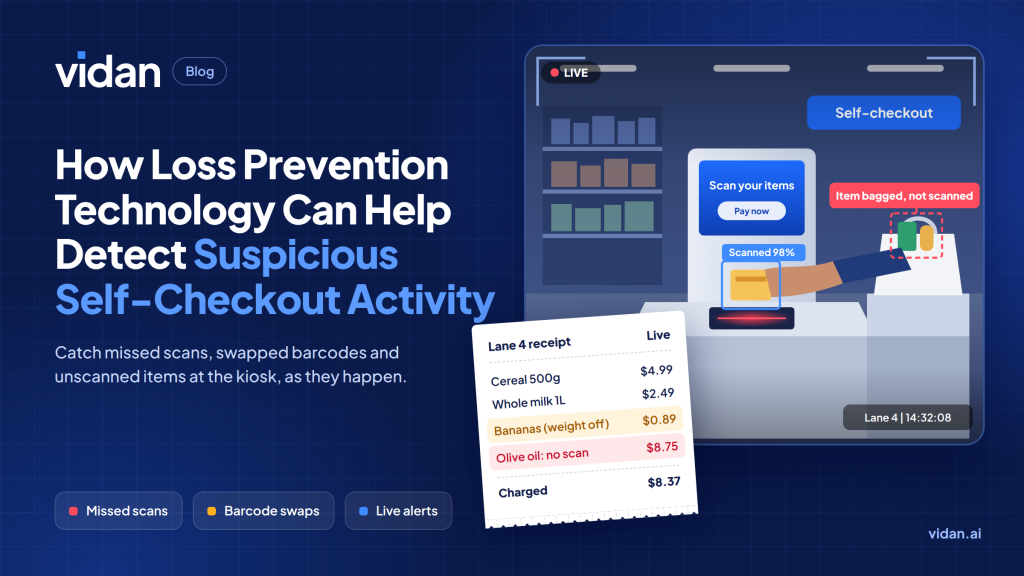
Self checkout runs on trust. Trust is not a control. Loss prevention technology closes that gap. It compares what shoppers handle with what the register records. Then it flags any mismatch while the shopper is still at the lane.
Here is the tricky part. Some of that loss is honest error. The rest is deliberate. Both look identical on a receipt. This guide shows what suspicious lane behavior looks like and how video AI catches it.
Quick answer: AI video analytics watches each lane through your existing cameras. It compares what a shopper handles with what the register records. When the two disagree, staff receive a short clip and a reason.
Key Terms to Know
- Shrink: Inventory lost to theft, error, or fraud and usually measured as a share of sales.
- Partial shrink: A shopper pays for some items but not all of them.
- Ticket switching: Covering a pricey barcode with a cheaper one.
- Produce code swap: Entering a cheap produce code for a costly item.
- Computer vision: Software that reads video to recognize objects and actions.
- Event detection: Software that labels specific moments, such as a bagged item with no scan.
- Alert fatigue: Staff ignore warnings because too many are false or low value.
What Is Loss Prevention Technology for Self Checkout?
It is a mix of cameras, video software, and alerts that spot theft and scan errors as they happen.
It works in three layers:
- Capture: Cameras above each lane record the shopper, the scanner, and the bagging area.
- Interpret: Computer vision reads actions such as lifting, scanning, and bagging.
- Respond: Staff get an alert with a clip and a likely reason.
Older tools react after the sale. Receipt checks, exit alarms, and exception reports all arrive late. Video AI works during the visit.
Your Lanes Are on Camera. Make Them Work.
Vidan AI watches for unscanned items, odd checkout behavior, and repeat patterns. Your team gets an alert while the shopper is still in the store.
Why Do Self-Checkout Lanes Lose More Than Staffed Lanes?
Shoppers handle every item themselves, and nobody verifies the match.
22%
Average rise in shrink during the first year after a store adds self-checkout. Source: ECR Retail Loss, Self Checkout Loss Report 2026
33%
How much higher losses ran at stores with self-checkout than at comparable stores without it. Source: ECR Retail Loss, 2026
1% to 4.8%
Share of transactions hit by missed scans, the most common cause of loss. Source: ECR Retail Loss, 2026
54%
Share of retail transactions now completed at self-service lanes. Source: ESM Magazine on the ECR study
Where does the loss come from?
Some gaps come from missed item scanning. A bulky item never reads, and the shopper moves on. Others are intentional. Most stores face both at once. ECR also found that ordinary mistakes drive much of the loss. That is why self-checkout loss prevention needs more than a camera on the ceiling.
At Vidan AI, we treat every mismatch as a service moment first and a theft case second.
Which Behaviors Look Suspicious at a Self-Checkout Lane?
Suspicious self-checkout activity rarely looks dramatic. It shows up as small gaps between what hands do and what the screen shows.
The most common pattern is skipping scanning at self-checkout. An item moves past the scanner without a read.
| Behavior | What video AI sees | Likely flag |
| Item never scanned | Product goes from cart to bag with no scan event | Unscanned item |
| Item mismatch | Scanned product does not match the object on camera | Mismatch |
| Produce code swap | Produce type does not match the entered code | Produce mismatch |
| Cart left loaded | Items stay in or under the cart during payment | Unscanned cart items |
| Walk out without paying | Shopper leaves with a bag and no payment event | Exit without payment |
| Repeat or group pattern | Same people return to lanes or shift items between them | Coordinated activity |
Staff can create gaps too. This guide on external theft vs internal theft in retail explains how defenses differ.
Which Store Formats Face the Highest Self Checkout Risk?
Risk looks different in every format. Match your alert rules to the format you run.
Grocery
Produce codes and bulky goods create the most gaps. Mixed baskets are long and busy.
Big box
Large carts hide items on the lower rack. High-ticket goods raise the cost of each miss.
Convenience
Baskets are small, and visits are fast. Few staff members cover the whole floor.
Pharmacy and specialty
Items are small and valuable. One missed scan can cost more than a full grocery trip.
How Does Video AI Catch a Theft While It Happens?
It checks four moments in every transaction and flags the one that does not match.
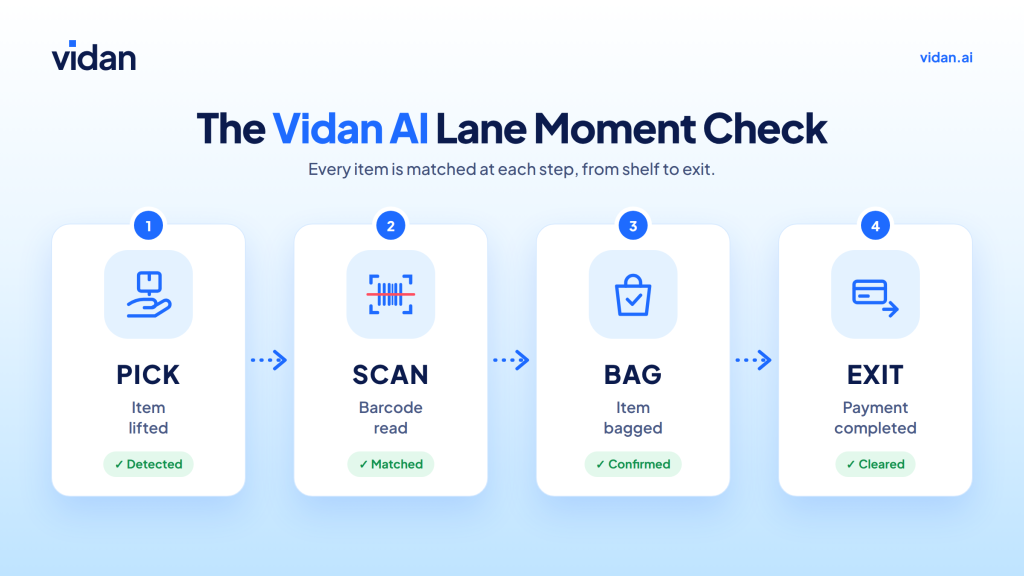
Flag rule: any moment that happens without its partner moment.
- Pick to scan: Every lifted item should produce a scan event.
- Scan to bag: The bagged object should match the scanned product.
- Bag to exit: Bagged items should not exceed paid items.
- Exit: No payment event means no clean exit.
Modern loss prevention technology reads video and register data together. Each lane event gets matched to a scan record. That is what self-checkout theft detection looks like in practice. It reasons about the transaction, not just motion.
AI video analytics for retail can run on compatible cameras you already own. The same analytics cover other store risks. See these seven retail loss prevention use cases beyond shoplifting for more.
How Should Staff Respond to a Flagged Lane?
Detection is half the job. Response decides whether the shopper returns.
Step 1: Approach. Walk to the lane calmly. Keep your hands visible and your tone relaxed.
Step 2: Assist. Offer help first. Most errors end right here.
Step 3: Document. Log the event type and outcome. Save the clip if the pattern repeats.
Step 4: Escalate. Repeat patterns go to your loss prevention team. Staff should never confront a shopper alone.
Sample opener
“Hi, can I help you finish checking out? The scanner can be tricky.”
What should staff avoid?
- Accusatory language.
- Blocking a shopper’s path.
- Chasing someone outside the store.
What Should a Useful Alert Contain?
Speed matters. Clarity matters more.
Strong real-time theft alerts answer three questions: where, what, and how sure.
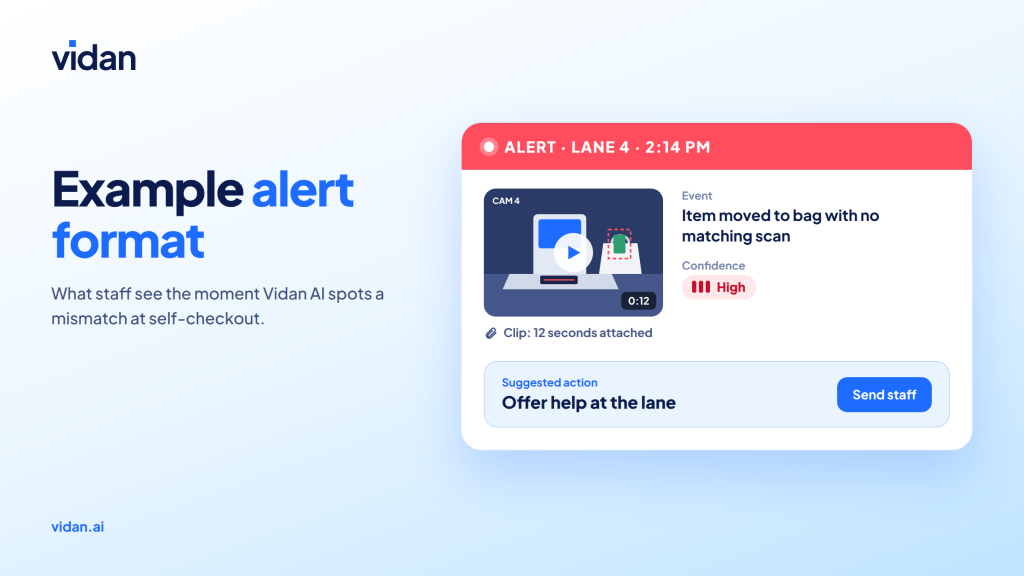
- Name the lane and the event. Staff should know where to walk.
- Attach the clip. Staff judges the moment in seconds.
- Suggest a polite first step. Offering help resolves honest errors fast.
Repeat patterns can then escalate to your loss prevention team.
How Do You Keep Alerts Useful and Staff Calm?
Good loss prevention technology sends fewer, better alerts.
Tune by lane
Busy lanes and quiet lanes need different thresholds. Adjust them by hour and by store.
Review weekly patterns
Look at which events repeat. Pair findings with receipts and attendant notes.
Track alert to outcome
Log whether each alert was an error, a theft, or a false flag. That log sharpens your rules and prevents alert fatigue.
How Does Video AI Compare With Other Lane Controls?
No single piece of retail theft detection technology covers every gap.
Stores that cannot watch every camera can start with retail loss prevention software.
Attendants
Strength: Human judgment and friendly help.
Gap: One person cannot watch every lane.
Weight sensors
Strength: Catch obvious item mismatches.
Gap: Often trigger false stops that frustrate honest shoppers.
Receipt checks and exit alarms
Strength: A last line of defense.
Gap: They act after payment, when the shopper is already leaving.
Video AI
Strength: Checks the whole transaction and creates evidence.
Gap: Needs tuning and clear staff response rules.
Pair video AI with steady self-checkout monitoring from a store lead or central team.
Where Does Vidan AI Fit at the Self-Checkout?
Vidan AI turns the cameras you already have into a lane watcher. We deliver AI loss prevention for retail without disrupting your current setup. Our rule is simple. AI watches. People decide.
What Vidan AI does
- Analyzes suspicious behavior patterns on existing cameras.
- Sends instant alerts to your team.
- Centralizes monitoring across multiple stores.
What your team gets
- Clips tied to each flagged event.
- Encrypted video storage for audits and investigations.
- Integration with existing alarms and operational tools.
Listed compliance
- ISO 27001+ certified, SOC 2 Type II, GDPR, and SAFETY Act Designation.
What Does Self-Checkout Loss Really Cost?
Numbers win budget approval. This worked example is hypothetical, so swap in your own figures.
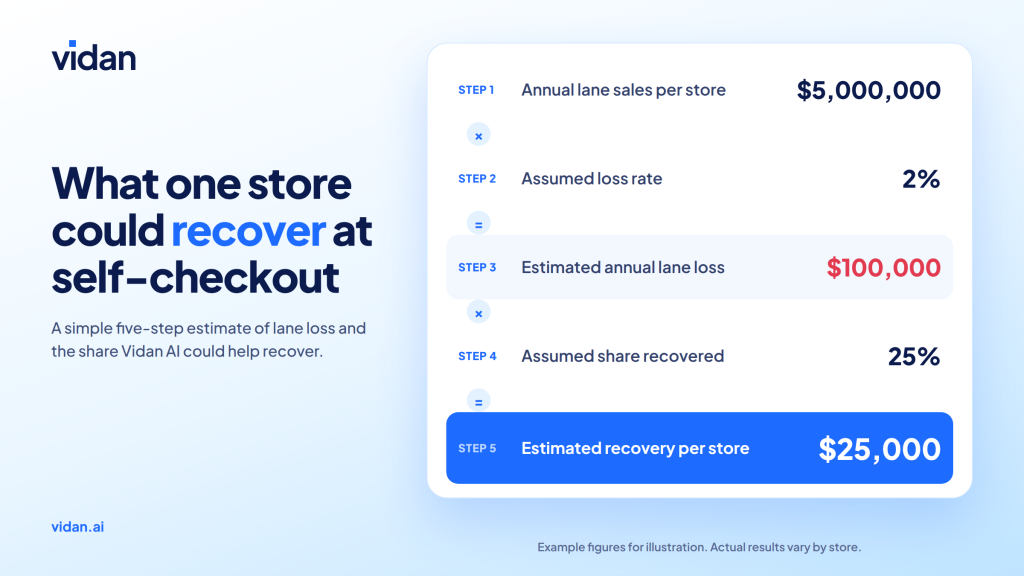
How do you set your baseline?
Pull lane sales, shrink reports, and attendant logs. Use your own loss rate, not an industry average.
How do you estimate recovery?
Run a pilot and count confirmed events. Multiply recovered value by your store count.
What belongs on the cost side?
Include software, cameras, setup, and staff time. Compare against recovery and fewer false stops.
What Does a 30 Day Rollout Look Like?
Week 1: Baseline. Pick three lanes. Record current missed scan and shrink numbers.
Week 2: Connect. Link cameras and choose five event types to detect.
Week 3: Tune. Review every alert. Remove noise and adjust thresholds.
Week 4: Measure. Compare shrink, alert accuracy, and staff response time.
Lane-level results are easy to compare. That makes this retail shrinkage prevention you can prove, not a leap of faith.
What Is the Smartest Next Step for Your Lanes?
The right loss prevention technology does not accuse shoppers. It catches the gap, shows the clip, and lets your team respond with confidence.
Your lanes are already on camera. Make them count.
Stop reviewing footage after the loss. Start catching it during the visit. Talk to the Vidan AI team today and turn your existing cameras into lane watchers.