
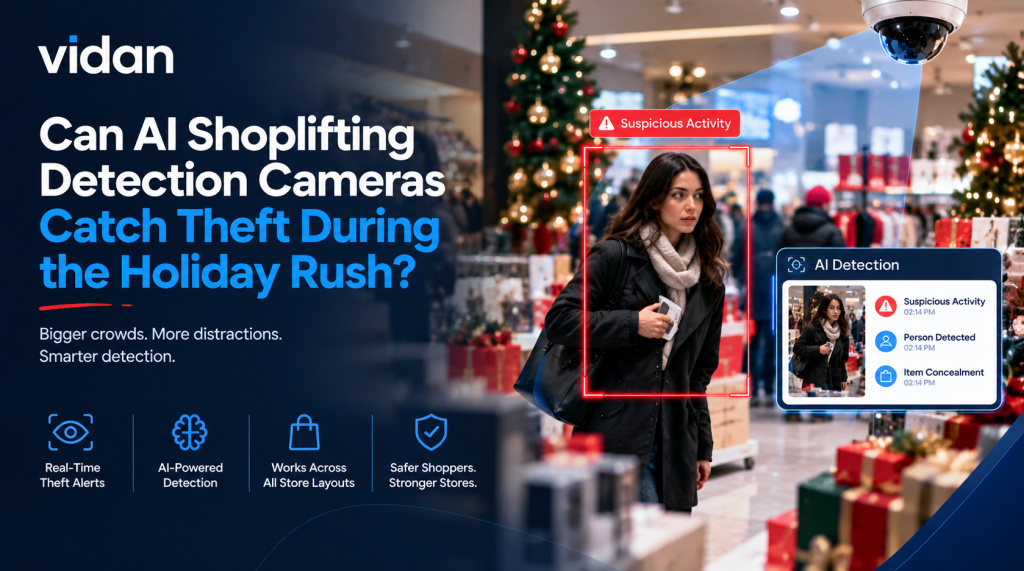
Peak season hides theft in crowds, queues, and new hires. So can AI shoplifting detection cameras catch it? Yes, when they flag the behavior before the person reaches the exit.
Standard cameras record the loss. AI cameras alert your team while it is happening. Here is what they catch, what they miss, and how to prepare before Black Friday on November 27.
Key Terms to Know
- Shrink: Inventory lost to theft, error, fraud, or damage.
- Organized retail crime (ORC): Coordinated theft by groups, often for resale.
- Walkout or pushout theft: A person leaves with unpaid goods, often pushing a loaded cart.
- Dwell time: How long a person stays in one store zone.
- False positive: An alert that flags normal behavior as suspicious.
- Sweethearting: An employee skips scans or gives goods to friends.
How Bad Is Holiday Theft in 2026?
Theft is shifting, not vanishing. These numbers show where the pressure sits.
12.4%
Fewer shoplifting incidents in 2025 than in 2024. Source: NRF Impact of Theft & Violence 2026
50%
Of retailers reported more repeat offenders. Source: same NRF report.
40%
Of retailers reported more organized retail crime incidents. Source: same NRF report.
37%
Of retailers reported more walkout or pushout theft. Source: same NRF report.
17%
Rise in threats or acts of violence during theft events in 2024 versus 2023. Source: NRF Impact of Theft & Violence 2025
57%
Of retail workers felt unsafe going into peak season in a September 2024 survey. Source: Motorola Solutions U.S. Retail Worker Safety Report
65%
Of those workers expected their store to be understaffed. Source: same Motorola Solutions report.
Retail loss prevention teams now chase patterns, not single grabs. Stores that cannot watch every feed need loss prevention software for stores that does the watching.
Why Does Theft Spike During the Holidays?
Three forces collide in November and December.
- Crowds create cover: Dense aisles block sightlines. Staff face one direction while another shopper moves.
- Seasonal hires are still learning: New staff may not know what unusual looks like. Understaffing leaves fewer eyes on the floor.
- Distractions are easy to stage: Teams of two can split roles. One asks questions while the other selects items.
AI cannot fix staffing. It can point the staff you have at the right spot.
How Do AI Shoplifting Detection Cameras Work in a Busy Store?
These systems pair cameras with software that reads video and flags theft behavior. Three steps matter most.
What Does The Software Watch?
CCTV video analytics is software that labels people, movement, and zones in camera footage. It tracks paths through the store. It measures dwell time near high-value shelves. It notes repeat visits and unusual exits.
What Happens When It Spots Something?
The system sends an alert with a short clip. Fast real-time video alerts shrink the gap between event and action. Staff watch the clip first. That prevents confronting the wrong shopper.
Do You Need New Cameras?
Often, no. Vidan AI adds detection to compatible CCTV, so the first step is a camera check.
What Types of Theft Can AI Flag?
Each pattern below pairs a signal with a sensible response.
Concealment and Lingering
Pattern: A person stays near high-value goods and checks sightlines.
Response: Staff greet the shopper and offer help.
Walkouts and Pushouts
Pattern: A loaded cart moves fast toward the exit.
Response: Alert the door team and verify the clip.
Organized Groups
Pattern: Several people enter together, split up, and regroup.
Response: Escalate to the manager and save the clip.
Register and Stockroom Activity
Pattern: Skipped scans, repeated voids, or stockroom visits at odd hours.
Response: Review the clip with the store manager.
AI flags the pattern. People confirm the facts.
What Can AI Catch That a Rush Shift Misses?
Staff is busy. Motion alerts fire on everything. AI looks for patterns.
| Situation | Busy staff | Motion alerts | AI analytics |
| Repeat visits to one aisle | Easy to miss | Not tracked | Can flag |
| Lingering near high-value goods | Noticed only if nearby | Fires on all movement | Can flag by dwell time |
| Group splitting up to distract | Hard to coordinate | Not tracked | Can flag coordinated movement |
| Loaded cart heading to exit | Seen only at the door | Fires like any motion | Can flag in the exit zone |
| Quiet corners and back aisles | Often unwatched | Fires constantly | Can flag unusual presence |
This is suspicious activity detection in practice. It narrows hundreds of motions to a few events. Good AI theft detection also cuts noise. Fewer alerts mean staff trust the ones that arrive.
Well-tuned AI shoplifting detection cameras do not judge intent. They surface patterns for a human to check. For deeper examples, read seven AI video analytics use cases beyond shoplifting.
Where Does Theft Hit During the Holiday Rush?
Use this original Four Zone Holiday Theft Map to place your alerts.
DETECT → Software spots a defined event
VERIFY → A short clip confirms what happened
ALERT → The right person gets an instant phone notice
RESPOND → Staff greet, assist, or escalate
REVIEW → Weekly patterns guide staffing and layout
Pick one alert per zone. Too many rules create noise. Zone-based retail theft monitoring keeps alerts few and specific. Start with the exit and your high-value aisles.
How Does an Alert Move From Camera to Floor?
Follow this five-step path from footage to action.
- The camera captures the zone.
- Analytics labels the person and the movement.
- A rule matches, such as an exit pattern or long dwell time.
- The alert and a short clip reach the assigned responder.
- The responder verifies, then acts or dismisses.
Steps four and five decide the outcome. A strong alert sent to nobody changes nothing.
How Do You Cut False Alerts During Peak Season?
Noise is the fastest way to lose staff trust. Use these fixes.
Problem: Too many alerts at the entrance.
Fix: Narrow the zone to the door threshold.
Problem: Alerts fire on staff areas.
Fix: Exclude staff-only zones from theft rules.
Problem: Crowded queues trigger dwell alerts.
Fix: Raise dwell thresholds near checkout lines.
Problem: Tired staff ignore every alert.
Fix: Use alert tiers. Send urgent events to the door team and routine ones to the manager.
What Should You Set Up Before Black Friday?
Black Friday lands on November 27, 2026. Run this list in the next two weeks.
- Confirm camera views cover entries, high-value aisles, registers, and exits.
- Fix poor lighting and blocked angles.
- Choose an alert owner for every shift.
- Write a two-step response script: verify, then approach.
- Brief seasonal hires on what an alert means.
- Test alerts on day one and tune zones.
- Post clear camera signage.
Shoplifting prevention cameras fail when alerts reach no one. Even strong AI shoplifting detection cameras need a named responder. Choosing hardware? Compare options in this guide to AI security cameras for retail stores.
How Does AI Compare to Guards, Tags, and Motion Alerts?
Each tool covers a different gap.
Security Guards
- Strong at: Human judgment and visible presence.
- Weak at: One person covers one area at a time.
Security Tags
- Strong at: Deterring simple grab-and-run at the door.
- Weak at: They show nothing about behavior before the exit.
Motion Alerts
- Strong at: Low cost and simple setup.
- Weak at: They fire on every movement, so teams tune them out.
AI Analytics
- Strong at: Reading patterns across many cameras at once.
- Weak at: It needs tuning and a human responder.
The best result is layers. AI points guards and staff to the right spot.
Is AI Surveillance Legal and Fair to Shoppers?
This is general guidance, not legal advice. Confirm local rules with counsel.
Do
- Post clear camera signage at entrances.
- Set retention periods and access rules.
- Keep a human in every decision.
- Ask how identity features are handled before enabling them.
Avoid
- Acting on an alert without checking the clip.
- Sharing clips outside your team without a process.
- Using tools your staff cannot explain.
Some states regulate biometric data. Check local rules before turning on any identity feature.
How Do You Know It Is Working?
Start now so tuning finishes before the busiest weekends.
Week one: baseline
Record current incidents, shrink, and response times.
Weeks two and three: tune
Review every alert. Adjust zones, thresholds, and alert tiers.
Week four: judge
Compare results against your baseline.
Track three numbers:
- Response time: Minutes from alert to first action.
- Alert precision: Confirmed events divided by total alerts.
- Shrink trend: This season against the same weeks last year.
How Does Vidan AI Help Stores Through the Holiday Rush?
Vidan AI is built for teams that cannot watch every camera.
Detect: We read your live video for loitering, repeat visits, and exit behavior.
Alert: Your team gets the alert with the related clip.
Review: Staff verify the event, then decide how to respond.
AI retail surveillance from Vidan AI works with compatible CCTV, so you keep your current cameras.
Our view: holiday theft is a response time problem, not a footage problem. Stores already own the footage. They need the signal.
What Can AI Cameras Not Do?
Myth: AI stops every theft.
Reality: It shortens response time. Some theft still gets through.
Myth: More alerts mean better protection.
Reality: Noise burns out staff. Tuned zones beat more rules.
Myth: AI replaces floor staff.
Reality: AI watches. People verify and engage.
Myth: Set it once and forget it.
Reality: Review zones weekly during peak season.
Myth: Any camera setup is automatically compliant.
Reality: Check local privacy rules and signage requirements.
In Conclusion
Holiday theft moves fast. Footage reviewed next week does not help today. AI shoplifting detection cameras give your team the one thing peak season removes: time.
Vidan AI turns your existing CCTV into a system that alerts, shows the clip, and lets your team act.
Black Friday is weeks away. Book a Vidan AI demo, and we will map your zones, cameras, and alert plan.