
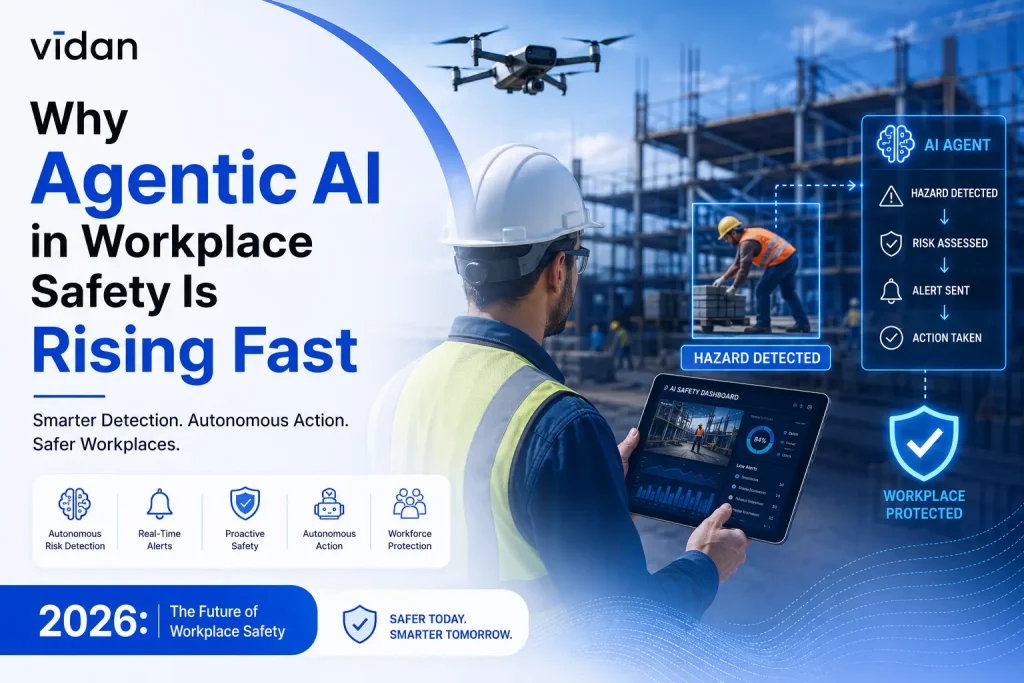
Agentic AI in workplace safety uses autonomous AI agents that watch, reason, and act on their own. Unlike passive cameras, these systems detect hazards, alert teams, and trigger responses without waiting for a human to press a button. In high-risk industries like construction, logistics, and manufacturing, this shift is cutting response times and catching risks before they become incidents.
None of these moments wait for a safety manager to be watching a monitor. They happen in seconds. And for decades, workplace safety technology has been built around the assumption that a human is always watching.
That assumption is breaking down. Agentic AI is stepping into the gap, and high-risk industries are the first to feel the difference.
Key Takeaways
- Agentic AI in workplace safety means AI systems that detect, decide, and act, not just record footage.
- High-risk sectors like construction, warehousing, and manufacturing are adopting agentic tools fastest.
- AI CCTV monitoring is the entry point, but agentic systems go far beyond static camera feeds.
- AI risk management shifts from quarterly audits to real-time, continuous hazard detection.
- Vidan AI builds agentic capabilities directly into physical security infrastructure.
- Real-world examples show fewer near misses and faster incident response times.
- Adoption challenges include governance gaps and unclear ownership of AI decisions.
Why Factories and Job Sites Can No Longer Rely on Human Eyes Alone
Human attention has limits. A security guard watching twelve camera feeds cannot process everything at once. Fatigue sets in. Shifts change. Blind spots appear.
Industry data backs this up. Warehousing and transportation report roughly 4.5 injuries per 100 full-time workers, well above the national average. Construction sites account for nearly one in five fatal workplace injuries in the United States each year. Falls, being struck by equipment, and being caught between machinery remain the leading causes of death on job sites.
These numbers have not moved much despite years of training programs and compliance checklists. The problem is not a lack of rules. It is a lack of eyes that never blink.
The Cost Nobody Puts on a Slide
Workplace injuries carry a real price. Estimates put the average cost of a single incident near $40,000 once you count medical bills, lost productivity, and legal exposure. Multiply that across a facility with recurring near misses, and the math stops looking small.
This is the backdrop against which agentic AI in workplace safety is gaining traction. It is not a trend chasing hype. It is a response to a problem that has resisted every other fix.
What Agentic AI in Workplace Safety Means
Most people hear “AI safety camera” and picture a system that records footage for later review. That is not what is happening anymore.
Agentic AI in workplace safety refers to AI systems built to perceive a situation, reason about the risk it poses, and take independent action. These agents do not simply flag an event. They decide what matters, escalate what is urgent, and in many cases trigger a response themselves.
Think of the difference between a smoke detector and a fire suppression system that also calls the fire department, shuts off gas lines, and unlocks exits automatically. One reacts. The other manages the entire event.
From Passive Cameras to Active Guardians
Traditional CCTV has always had one job. Record. Someone reviews the footage after something goes wrong. That is forensic, not preventive.
Agentic systems flip this model. Here is how the shift plays out in practice.
- A camera detects a worker entering a hazardous zone without protective gear.
- The agent cross-references access logs and shift schedules in real time.
- It determines whether this is a genuine violation or an authorized exception.
- It sends an alert to the nearest supervisor, not a general control room queue.
- If no response comes within a set window, it escalates automatically.
This layered decision process is a major reason why video AI agents are the next big shift in video intelligence technology. The camera stops being a passive witness. It becomes an active participant in preventing harm.
The Anatomy of an Agentic Safety Framework
We built a simple framework to describe how agentic safety systems typically operate across four stages.
- Sense: The system continuously gathers data from cameras, sensors, and access points.
- Reason: The agent evaluates context, comparing what it sees against safety rules and historical patterns.
- Decide: Based on risk severity, the agent chooses whether to log, alert, or intervene.
- Act: The system executes the decision, whether that means notifying a supervisor or triggering a physical response like a locked door.
Each stage runs continuously and in parallel across a facility. No single stage waits for the others to finish before starting again.
Agentic AI in Action Across High-Risk Industries
Numbers matter, but examples make the shift tangible.
Construction
A general contractor in the Gulf region used AI agents to monitor scaffolding zones. The system flagged unsecured harnesses before workers reached height, not after a fall. This kind of prevention is central to why AI Agents in construction risk prevention are more than just smart cameras, since the value comes from stopping an incident, not documenting one.
Warehousing
A logistics operator deployed agentic monitoring near forklift lanes. The system detected a pedestrian in a blind spot and triggered an audible warning before the forklift operator could see the person.
Manufacturing
On a factory floor, agents monitored machine guarding compliance around the clock. Violations dropped noticeably within the first quarter of deployment, according to internal safety reports shared by several manufacturers piloting similar systems.
Retail and Facilities
Loitering near restricted inventory areas triggered automatic alerts, cutting the time between detection and human response from minutes to seconds.
AI Risk Management Gets a Brain
Traditional risk management runs on a cycle. Audit, report, fix, repeat. The cycle might take weeks or months.
AI risk management compresses that cycle into something closer to real time. Instead of discovering a hazard during a quarterly walkthrough, the system flags it the moment it appears.
This does not replace safety officers. It gives them a continuous stream of prioritized, verified alerts instead of a stack of paperwork. Response times improve because decisions happen closer to the moment risk actually occurs.
Where This Gets Harder Than It Sounds
Not every alert deserves the same urgency. A worker briefly stepping into a marked lane is different from someone climbing over a safety barrier. Agentic systems need context, not just motion detection, to avoid alert fatigue among safety teams.
This is exactly why raw AI risk management tools without proper tuning tend to underperform. Context and calibration matter as much as the underlying model.
Why AI CCTV Monitoring Is the Foundation
AI CCTV monitoring deserves credit. It laid the groundwork for everything agentic systems now do. Motion detection, facial recognition, and object tracking gave AI its first real foothold in physical security.
But monitoring alone answers only one question. What happened? Agentic systems answer a harder question. What should happen next?
Modern AI video surveillance platforms increasingly bundle both capabilities together, pairing detection with decision logic. The camera sees. The agent decides. The system acts. That is the natural evolution industry insiders are now describing as the next chapter of physical security.
How Vidan AI Builds Agentic Intelligence Into Physical Security
Here is where Vidan AI’s approach differs from a standard camera vendor.
Vidan AI does not treat cameras as passive recorders waiting for a review team. Every camera in a Vidan AI deployment can run detection logic locally, flag context-specific risks, and route alerts to the right person automatically.
What this looks like day to day:
- For a construction client, that might mean detecting unauthorized equipment operation before an incident occurs.
- For a logistics client, that might mean flagging a blocked fire exit the moment a pallet gets left in the wrong place.
- For a retail client, that might mean catching a shrinkage pattern that a human reviewer would miss across dozens of camera feeds.
Vidan AI also integrates access control into this picture. Physical security only works when who enters a space and what a camera sees are treated as one system, not two separate tools.
The goal is straightforward. Fewer blind spots, faster decisions, and safety systems that keep working even when nobody is staring at a monitor.
The Roadblocks Nobody Talks About
Adoption is accelerating, but it is not friction-free.
- Governance gaps. Many organizations deploy AI agents faster than they build policies to govern them. Industry surveys suggest a majority of companies using AI agents still lack formal security policies covering their use.
- Unclear ownership. When an agent makes a wrong call, who is accountable? Facilities are still working out where human oversight belongs in an otherwise automated loop.
- Integration debt. Legacy camera systems were not built with AI agents in mind. Retrofitting older infrastructure takes time and budget that not every facility has ready.
- Trust building. Safety teams need to see consistent, explainable decisions before they hand more responsibility to an autonomous system. Trust builds slowly and breaks quickly.
None of these issues are reasons to avoid agentic AI. They are reasons to deploy it with a clear plan, proper testing, and a vendor who understands physical security, not just software.
The Bottom Line
Workplace safety has spent decades reacting to incidents after they happen. Agentic AI in workplace safety is the first real shift toward systems that act before harm occurs, not after.
High-risk industries do not have the luxury of waiting for perfect technology. Every day without proactive monitoring is a day when a preventable incident can still happen. Agentic AI closes that gap by enabling safety systems to detect, decide, and respond on their own.
Vidan AI is building that capability into physical security today, not as a future promise but as a working system. Reach out to Vidan AI to see a live demo of agentic safety monitoring built for your industry.