
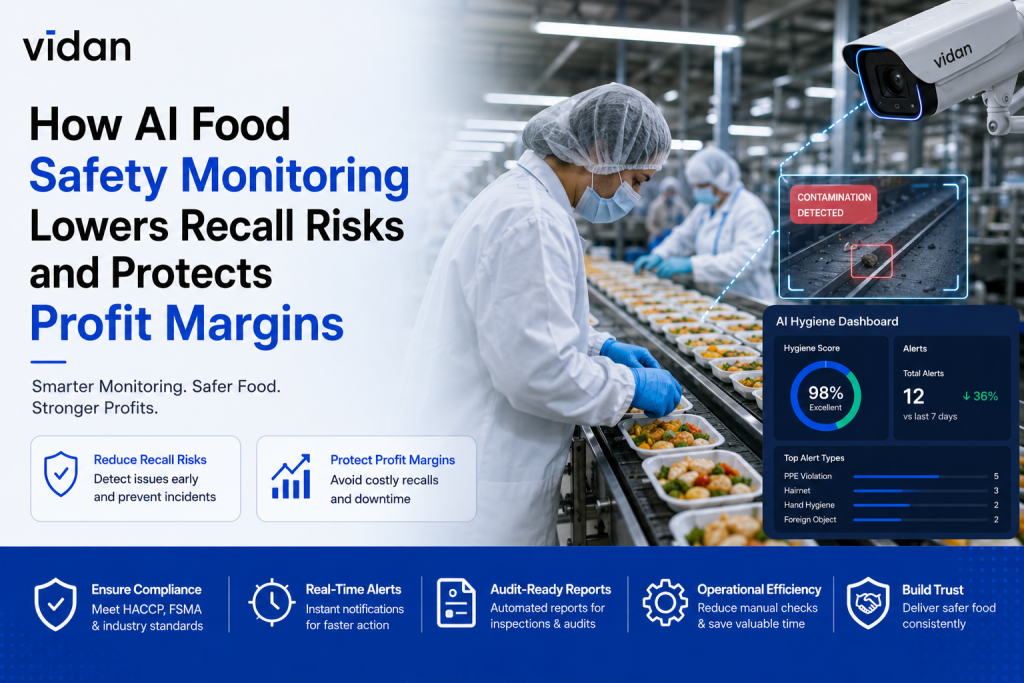
A single recall can erase a year of profit in one week. That is not an exaggeration. It is the math food manufacturing executives live with. AI food safety monitoring is changing that math by catching contamination before it reaches a pallet, a truck, or a headline.
This blog breaks down what AI food safety monitoring actually does, how it lowers recall risk, and why it protects margins better than manual inspection ever could.
The gap in that middle row, detection speed, is the one that decides whether a contamination event stays contained to a single batch or spreads through an entire production run.
Insurance underwriters already factor this in. Facilities with documented Critical Control Point monitoring and current certifications tend to see lower premiums than facilities meaningfully without that infrastructure. That is margin protection that shows up before a single incident ever occurs.
Key Takeaways
- Recalls cost food manufacturers an average of $10 million in direct costs alone, according to the benchmark data from the Food Marketing Institute and the Consumer Brands Association (formerly the Grocery Manufacturers Association).
- Business interruption, not the recall itself, drives nearly half of total recall cost.
- Food safety video analytics shortens the gap between contamination and detection, which is the single most controllable variable in recall economics.
- AI contamination detection works around the clock, unlike manual spot checks that only capture a fraction of a shift.
- Vidan AI builds automated food safety monitoring directly into existing camera infrastructure, so plants do not need to rip and replace hardware.
Quick Answer
AI food safety monitoring uses computer vision and machine learning to watch production lines continuously. It flags hygiene lapses, cross-contamination, and process deviations in real time, before a batch leaves the plant. This lowers recall risk because problems get caught at the source, not after a customer complaint or a lab result weeks later.The Real Cost of a Recall Nobody Puts on the P&L
Executives often plan for the direct cost of a recall. Few plan for what comes after.The Immediate Recall Bill
The Grocery Manufacturers Association and Food Marketing Institute found that direct recall costs average close to $10 million per event. That figure covers retrieval, disposal, and notification. It does not cover what happens next.The Financial Impact Goes Further
More than half of companies that experience a major recall report total financial impact above that $10 million floor. One in twenty companies sees costs exceed $100 million. Business interruption alone accounts for roughly 49 percent of total recall cost, nearly double the operational cleanup itself. The hidden costs can be just as difficult to recover from. Retailer delisting can last six to eighteen months and may require proof of new inspection infrastructure before a retailer reinstates the accountThe Broader Cost of Foodborne Illness
At the national level, foodborne illness costs the United States an estimated $74.7 billion a year in medical care, lost productivity, and long-term health outcomes This is not an abstract public health number. It is part of the pressure driving tighter audits, stricter buyer requirements, and higher insurance premiums across the food supply chain. CDC Foundation These numbers look different when food contamination monitoring becomes continuous instead of periodic.What Is AI Food Safety Monitoring
AI food safety monitoring is a layer of intelligence placed over existing plant operations. It watches for the moments that traditionally slip past manual checks. A glove not changed between raw and ready-to-eat zones. A worker skipping a handwash station. A foreign object on a conveyor belt that moves too fast for the human eye to catch every time. The system does not replace a QA team. It extends their reach. One person cannot watch six lines at once for an entire shift. Cameras paired with an AI food safety system can. Three things separate this from older motion sensor setups.- First, it understands context. It knows the difference between a worker reaching for a tool and a worker crossing into a restricted zone.
- Second, it learns your plant. Every facility has a different layout, different equipment, and different risk points. The system trains on your environment, not a generic template.
- Third, it acts immediately. An alert reaches a supervisor’s phone or a floor display within seconds, not at the end of a shift review.
How Computer Vision Food Safety Systems Catch Contamination in Real Time
Here is the framework we use at Vidan AI to explain how detection actually works on the floor. Think of it as four stages, each one feeding the nextStage 1: Capture
Standard IP cameras already installed in most plants feed continuous video into the platform. No specialty hardware required in most retrofits.Stage 2: Detect
Computer vision food safety models scan every frame against trained risk patterns. This includes hand hygiene lapses, PPE compliance, cross-contact between allergen zones, and unusual object presence on lines.Stage 3: Alert
The moment a risk pattern is confirmed, the system pushes a real-time alert to the right person. No waiting for a shift report or a weekly audit.Stage 4: Verify
Every alert is logged with a timestamped clip. QA teams can review, confirm, and document the event for HACCP records in seconds instead of reconstructing it from memory. This loop is what separates automated food safety monitoring from a camera that simply records footage nobody watches until something goes wrong. If you want the implementation side of this in more depth, our guide on How to Implement AI Hygiene Monitoring in a Food Processing Plant walks through rollout step by step.
🛡️ Food Safety Monitoring
Catch Contamination Before It Costs You
Protect production lines with AI food safety monitoring that watches every shift and flags risks in real time.
Food Safety Solutions Speak with Our Team🥫
Where Food Contamination Monitoring Breaks Down Without AI
Manual inspection is not careless. It is limited by human bandwidth. Here is the comparison plant leaders tell us matters most.| Manual Inspection | AI Food Safety Monitoring |
| Covers a sample of shifts and stations | Covers every shift, every camera, continuously |
| Relies on memory during the audits | Every event is timestamped and stored |
| Detects issues after the fact | Detects issues as they happen |
| Inspector fatigue reduces accuracy late in a shift | System accuracy stays constant |
| Documentation takes hours to compile | Documentation is generated automatically |
The Margin Math Behind AI Contamination Detection
Plant managers do not need convincing that recalls are expensive. CFOs need the return on investment spelled out. Here is a simplified way to think about it.| Cost Category | Without AI Monitoring | With AI Food Safety Monitoring |
| Average recall exposure | Up to $10M+ per event | Contained to a smaller batch or prevented |
| Detection to correction time | Hours to days | Seconds to minutes |
| Documentation labor per audit | Manual compilation | Automated log generation |
| Insurance and audit posture | Standard premiums | Often improved with documented CCP monitoring |
| Retailer relationship risk | Delisting exposure after an incident | Fewer incidents to trigger delisting |