
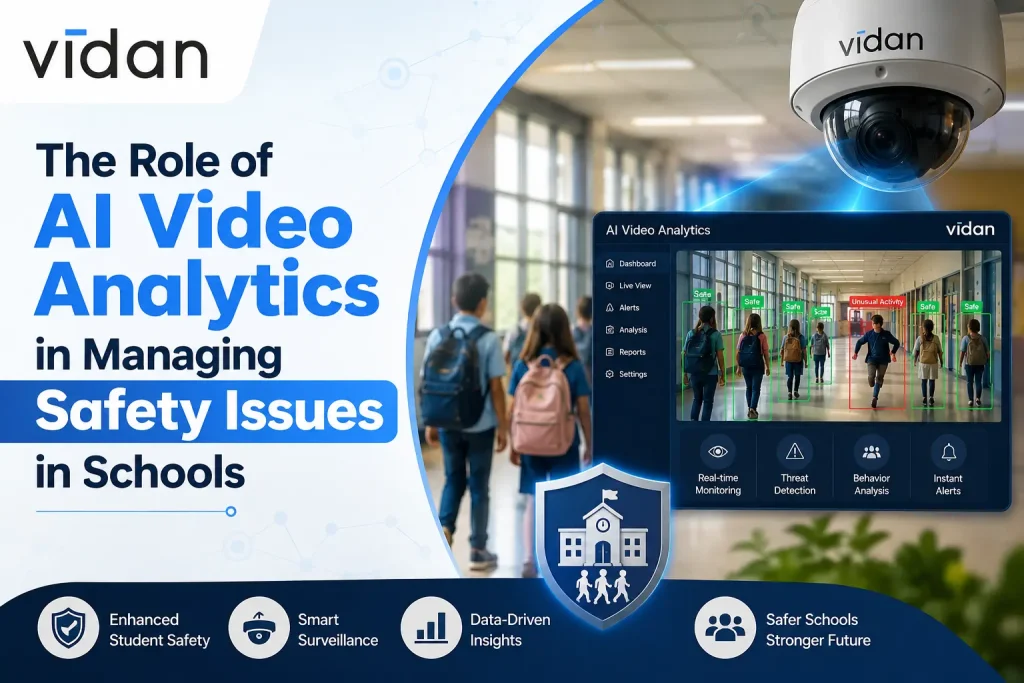
What if your school’s security system is watching but never actually seeing? There is a fundamental difference between surveillance and intelligence. Most schools today have the first. Very few have the second.
Safety issues in schools are not always dramatic. They build. They escalate through patterns that trained systems can recognize, and human observers consistently miss. A student was loitering near a restricted area for the third time this week. A visitor whose movement does not match their stated destination. A group whose body language has shifted from conversation to confrontation in under thirty seconds.
Traditional systems record all of this and flag none of it.
AI video analytics changes the entire equation. It turns passive cameras into an active intelligence infrastructure. It converts footage into behavioral data. And it closes the gap between what is happening on a campus and what administrators actually know in real time.
This is not a technology trend. It is a direct response to the growing complexity of managing safe learning environments at scale.
Why Traditional CCTV Has Hit Its Ceiling
The Core Problem With Passive Surveillance
School security has operated on a flawed assumption for decades. The assumption is that recording an environment is the same as securing it. It is not.
A standard CCTV system captures everything within its field of view. It stores that footage. It makes it available for review. What it cannot do is think. It cannot recognize when a behavior deviates from a normal pattern. It cannot distinguish between a student waiting for a friend and a student casing an entry point. It cannot generate an alert based on what it sees.
Human operators fill that gap in theory. In practice, they cannot.
Three Specific Failures of Traditional Monitoring
- Speed failure: Human operators average 5 to 8 minutes to identify and escalate a flagged situation. Most school incidents escalate in under 90 seconds.
- Consistency failure: AI systems maintain identical analytical performance across every feed at every hour. Human performance degrades across a shift.
- Context failure: Standard cameras capture what is happening. They cannot assess duration, intensity, behavioral deviation, or environmental context.
School safety problems built on these three failure points do not get solved by adding more cameras. They get solved by adding intelligence to the cameras already in place.
What AI Video Analytics Actually Does Inside a School
Rethinking the camera as an analytical tool
Behavioral Detection
AI systems are trained on thousands of real-world behavioral scenarios. They recognize aggression precursors, crowd tension, directional anomalies, and physical posture changes. When a situation matches a known risk pattern, an alert is generated automatically and routed to the appropriate personnel.
Weapon Detection
Visual signature analysis allows modern platforms to identify concealed or visible weapons through standard camera feeds. Even in crowded hallways or partial-obstruction scenarios, the system can flag threat signatures and simultaneously notify security, administration, and law enforcement.
Perimeter Intelligence
Entry and exit monitoring powered by AI tracks who enters the building, through which access point, and at what time. Deviations from expected access patterns trigger immediate review.
Crowd Density Mapping
During assemblies, sporting events, or emergency evacuations, AI systems monitor crowd density and flow in real time. When density exceeds safe thresholds or flow patterns suggest panic, the alert reaches administrators before the situation compounds.
How This Changes Administrator Awareness
School leaders do not need to monitor feeds. They receive structured, actionable alerts with contextual information attached. The decision to act is informed, fast, and based on real-time data rather than a secondhand report.
The Visitor Problem Schools Keep Underestimating
Visitor management is one of the most consistent and underaddressed school safety problems across institutions of every size. Manual sign-in systems, photocopied IDs, and handwritten logs create a security layer that is easy to circumvent and impossible to monitor once a visitor is inside the building.
A school visitor management system powered by AI operates on an entirely different level.
| Traditional Visitor Management | AI-Powered Visitor Management |
| Manual ID check at the front desk | Automated identity verification at the entry point |
| Paper log of name and time | Cross-referenced against watchlists and custody alerts |
| No movement tracking post-entr | Real-time movement monitoring throughout campus |
| No alert if visitor deviates from stated purpose | Proximity alert if a visitor enters unauthorized zones |
| No pattern recognition across visits | Behavioral history flagged on repeat visits |
The operational difference is not subtle. An authorized visitor who enters a school and then moves toward a classroom corridor instead of the main office generates a movement deviation alert. That flag reaches the front desk before the visitor has taken twenty steps in the wrong direction.
For schools managing custody disputes, restraining orders, or previously flagged individuals, this capability is not optional. It is essential.
Behavioral Analytics and the Incidents Nobody Catches in Time
Not every security threat arrives through the front door. Many of the most damaging safety issues in schools develop internally, between students, over time, in spaces that fall outside primary camera coverage.
Bullying and peer aggression follow patterns.
AI behavioral analytics recognizes those patterns before they escalate.
What the System Flags:
- A student whose movement patterns show consistent avoidance of specific corridors, suggesting ongoing intimidation in those spaces
- A group that repeatedly clusters in the same low-visibility location at the same time each day
- Escalating physical proximity between the same individuals across multiple incidents within a defined time window
- Postural and movement changes that indicate a transition from verbal to physical confrontation
What This Is Not:
This is not indiscriminate surveillance of student behavior. Responsible AI implementation in schools is built on proportionality. The system is not designed to monitor friendships, politics, or private conversations. It is designed to recognize behavioral signatures that security professionals associate with risk and surface them before harm occurs.
The ethical framework matters as much as the technology. Schools implementing AI analytics must establish clear data governance policies, retention limits, and access controls. The power of the system is proportional to the responsibility required to deploy it correctly.
Multi-Campus Districts and the Coverage Gap
For large school districts, security has always involved an uncomfortable tradeoff. Centralized teams cannot cover every campus with equal attention. Remote campuses receive less oversight. Response times to satellite locations are slower. Incidents escalate further before district-level awareness.
AI video analytics eliminates that structural imbalance.
Mobile Security Cameras explores how portable AI-enabled infrastructure extends this coverage further, particularly for campuses where fixed camera infrastructure is limited or where temporary coverage is needed for specific events or risk windows.
The Predictive Layer Most Schools Have Not Deployed
To prevent school violence, the security strategy needs to shift from reactive to predictive. That shift requires data. Specifically, it requires data that most schools are already generating but not yet analyzing. Every camera in a school building is producing behavioral and environmental data every second it is operational. AI video analytics converts that passive stream into structured intelligence.
Predictive capabilities that are deployable now:
- Pattern recognition across time: Incidents are not random. They cluster by location, time of day, day of week, and environmental conditions. AI systems identify these clusters and create risk windows that inform staffing and monitoring decisions.
- Behavioral precursor detection: Certain behavioral sequences reliably precede escalation. AI systems trained on real-world incident data recognize these sequences earlier than human observers. Understanding how Theft Detection Video Software applies the same precursor logic in retail environments demonstrates how this approach translates directly to school settings.
- Cross-referencing entry and behavioral data: A student with a flagged behavioral history who enters the building outside of normal hours, through an access point inconsistent with their class schedule, generates a compound alert. Single data points are weak signals. Compound signals are strong ones.
- Environmental anomaly detection: Unusual silence in typically active areas. Rapid dispersal of a crowd. Doors held open longer than access patterns suggest. Each of these is an environmental signal. AI systems are trained to read them.
Infrastructure, Integration, and What Schools Already Have
One of the most persistent misconceptions about AI video analytics is that deploying it requires replacing existing infrastructure entirely. For most schools, that is not accurate.
How AI analytics layers onto existing systems:
ACCESS CONTROL
AI behavioral data integrates with door access logs. The result is a unified picture of movement and identity across the entire building at any given time.
EXISTING CAMERAS
Most enterprise-grade AI platforms are designed to work with existing camera hardware. The intelligence is added at the software and processing layer, not the hardware layer.
COMMUNICATION SYSTEMS
Alerts route to administrator devices, security personnel, and, in critical scenarios, directly to law enforcement communication channels. The system operates inside the existing communication infrastructure.
The question is not whether the technology is accessible. The question is whether the governance, training, and response protocols are in place to use it effectively.
Privacy, Ethics, and the Framework Schools Must Have
The Non-Negotiables of Responsible AI Deployment in Education
The power of AI video analytics carries proportional responsibility. Schools serve a protected population. Surveillance of minors requires a governance framework that is explicit, enforced, and transparent.
Four principles that must be in place before deployment:
- Data minimization: Footage should be analyzed in real time for defined threat detection purposes. Retention of non-incident data should follow strict time limits with documented justification for any extension.
- Transparency: Students, parents, and staff have a right to know what surveillance systems are in place and what their operational purpose is. Informed school communities are not more resistant to AI security. They are more cooperative with it.
- Proportionality: The scope of AI deployment should match the specific security needs of the institution. Not every behavioral analytics capability needs to be active in every part of every campus. Calibrated deployment is responsible deployment.
- Access governance: AI-generated alerts, behavioral flags, and identity data should be accessible only to specifically authorized personnel. Security data is not general administrative data. It requires its own access tier and audit trail.
Schools that treat privacy governance as an afterthought do not just risk public trust. They risk regulatory and legal exposure under student privacy frameworks that vary by jurisdiction but uniformly protect minors.
The Data Layer That Improves More Than Just Safety
School safety solutions built on AI generate a secondary layer of operational data that extends well beyond security applications.
What behavioral and movement data reveal:
FACILITIES INSIGHTS
Corridor flow analysis identifies architectural blind spots and structural bottlenecks. Schools can use this data to make informed decisions about physical infrastructure changes that reduce inherent risk.
STAFFING MODELS
Time-of-day and location-specific incident clustering informs where security personnel should be positioned during high-risk windows rather than distributing them uniformly across the building.
EVENT PLANNING
Historical crowd behavior data from previous school events creates a baseline for density management, access control, and emergency egress planning for future events.
The intersection of security intelligence and operational data is where modern school administration is headed. Institutions that recognize this now will build infrastructure that serves both safety and efficiency simultaneously.
What the Next Generation of School Security Infrastructure Looks Like
Safety issues in schools cannot be resolved through equipment alone. They resolve through the combination of the right technology, the right governance framework, the right training, and leadership that treats security as a strategic priority rather than a compliance obligation.
AI video analytics is one critical layer in that architecture. It is the layer that converts passive recording infrastructure into active intelligence. It closes the gap between what cameras see and what administrators know. It surfaces risk before it escalates. And it gives security personnel the informed, real-time awareness they need to act decisively.
The distinction between a school that watches and a school that knows is no longer a matter of budget alone. The technology is accessible. The frameworks exist. The operational case is clear.