
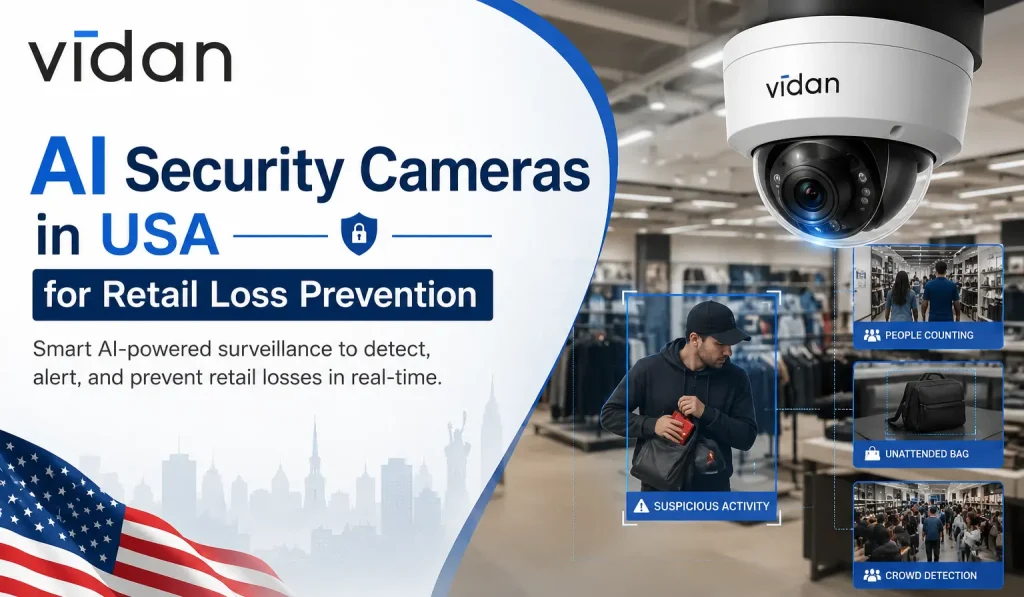
Retailers across the United States lose over $112 billion annually to shrinkage. That number is not slowing down. Shoplifting is more organized. Internal theft is harder to trace. And traditional surveillance systems were never built for the scale of the problem modern retailers face.
AI security cameras in USA are changing that equation completely. Not by recording more footage. But by understanding it in real time, flagging threats the moment they emerge, and giving security teams an edge they never had with passive camera systems.
This is not about smarter hardware. It is about an entirely different approach to physical security.
What You Will Learn in This Blog
- Why traditional retail surveillance is structurally failing
- How AI-powered cameras detect theft before it happens
- The specific threats AI cameras identify that humans miss
- Real operational scenarios where AI surveillance delivers results
- How Vidan AI approaches retail security differently
- What the future of loss prevention looks like in smart retail environments
The Silent Drain Nobody Is Talking About
Walk into any large-format retailer. You will see cameras mounted in every corner. But ask the loss prevention manager how many incidents those cameras helped prevent last month, and the answer will be telling.
Most cameras record. Very few actually protect.
Traditional CCTV systems were designed around one idea: document what happened. They were built for post-incident review, not real-time prevention. A theft occurs, a manager reviews the tape, and a report gets filed. The merchandise is already gone.
The gap between recording and responding is where retail losses live.
Traditional CCTV operates in a reactive mode by design. That is not a product flaw. It is a fundamental architectural limitation. The cameras were never intended to think. They were intended to see.
AI video surveillance USA breaks this model entirely. It transforms every camera from a passive recorder into an active detection engine.
What Threats Can AI Cameras Detect?
What threats can AI cameras detect is one of the most searched questions in retail security right now. The answer is broader than most retailers expect.
Behavioral Anomalies
AI cameras analyze movement patterns. Loitering near high-value merchandise. Unusual dwell time in blind spots. Body language that correlates statistically with theft events. These signals are invisible to human reviewers watching multiple feeds simultaneously, but are immediately flagged by trained AI models.
Concealment Detection
Items moved from shelves into bags, clothing, or strollers without passing through checkout. AI models trained on thousands of concealment scenarios identify these actions in real time, even in crowded environments.
Booster Bag Detection
Organized retail crime groups use signal-blocking bags to bypass EAS tags. AI cameras detect the physical behavior patterns associated with booster bag usage, adding a layer that traditional systems cannot provide.
Internal Theft Patterns
Employee theft accounts for approximately 29% of retail shrinkage. AI surveillance identifies irregular POS behaviors, unusual transaction reversals, and access to restricted areas outside authorized hours.
Crowd Manipulation Tactics
Some organized groups create commotion near one area while another group executes theft elsewhere. AI monitoring across multiple zones simultaneously identifies coordinated behavioral anomalies that a single human observer would miss.
This depth of detection is why AI physical security has become a board-level conversation in major retail chains, not just a technology procurement decision.
Traditional vs. AI Surveillance: A Structural Comparison
| Capability | Traditional CCTV | AI-Powered Cameras |
| Real-time threat detection | No | Yes |
| Behavioral analysis | No | Yes |
| Automated alerts | Limited | Fully automated |
| Multi-zone correlation | Manual review | Simultaneous AI analysis |
| False alarm rate | High (human fatigue) | Significantly reduced |
| Evidence quality | Footage only | Timestamped event data |
| Scalability | Linear | Exponential |
The gap in capability is not incremental. It is generational.
The detailed breakdown of what this transition means operationally is covered comprehensively in The Impact of Security Cameras, which addresses exactly why the shift from passive to active surveillance changes everything for loss prevention teams.
The Architecture Behind Real-Time Detection
Most retailers understand that AI cameras exist. Fewer understand how they function operationally. The architecture matters because it explains why speed and accuracy are simultaneously achievable.
- Edge Processing: AI analysis happens at the camera itself. This eliminates transmission latency. Threat detection occurs in milliseconds, not seconds.
- Model Training Specificity: General AI models produce general results. Leading platforms train models specifically on retail theft scenarios, meaning pattern recognition is calibrated for exactly the environment retailers face.
- Multi-Camera Correlation: Individual camera AI is powerful. System-level AI is exponentially more so. When cameras share behavioral data in real time, the system builds a complete picture across an entire floor. Coordinated theft attempts become immediately visible.
- Alert Prioritization: AI systems learn which alert types produce the highest confirmation rates in a specific environment. Over time, false positive rates drop, and the security team receives fewer, higher-quality alerts worth acting on.
- Integration with Access Control and POS: The most effective AI physical security deployments do not operate in isolation. When surveillance integrates with point-of-sale anomaly detection and access control logs, the system builds behavioral profiles that surface threats invisible to any single data source.
What Vidan AI Does Differently
Most surveillance vendors sell cameras. Some sell software. Very few bring both together with a genuine understanding of the operational environments where security actually breaks down.
Vidan AI was built for environments where the stakes are high and the complexity is real.
Our approach is not about deploying cameras and walking away. It is about designing security architectures that match the actual threat landscape of each environment. A pharmacy faces different organized crime patterns than a home improvement retailer.
Vidan AI’s platform learns the behavioral baseline of each specific environment. What is normal movement for that store, that layout, that customer demographic, at that time of day? Deviations from that specific baseline generate alerts. Not deviations from a generic template.
Our multi-site management capability means retail groups operating dozens or hundreds of locations get unified visibility across every site from a single interface. Incidents at one location inform threat modeling at others. The system gets smarter as the network grows.
The Inventory Intelligence Layer
Loss prevention and inventory management are traditionally treated as separate functions. AI video surveillance is beginning to collapse that division. When cameras can detect not just theft but also misplacement, shrinkage patterns, and stockroom access anomalies, the same system that prevents theft also generates operational intelligence about inventory accuracy.
The implication is significant. A retailer deploying AI security cameras in USA is not just buying a security upgrade. They are buying an operational intelligence platform that generates value across loss prevention, inventory management, compliance, and operational visibility at the same time.
The Layer Before the Floor: Perimeter and Access Security
Most retail theft discussions focus on in-store detection. But serious loss prevention programs start earlier.
Parking Lot and Approach Monitoring
Organized retail crime groups survey target locations before executing. Vehicle loitering, repeated approach passes, and unusual gathering near entrances are all detectable precursors that trained AI systems identify before a group enters the store.
Delivery and Receiving Dock Security
Internal supply chain theft at receiving docks is a significant and systematically underreported loss category. AI cameras monitor dock activity, detect unauthorized individuals, irregular unloading sequences, and vehicles that do not match delivery manifests.
After-Hours Perimeter Behavior
Fence line approaches, door handle testing, and extended loitering near utility access points after closing are behavioral signals that AI video surveillance USA systems flag for immediate response.
The flexible deployment options for perimeter and remote monitoring are covered in Mobile Security Cameras: A Flexible Solution for Remote Monitoring, which is particularly relevant for retailers managing multiple sites or temporary locations.
Beyond Theft: Compliance and Safety as Secondary Value
The same AI camera infrastructure delivers measurable value across compliance and safety functions that matter equally to retail operators.
Occupancy compliance for fire safety requirements is automatically tracked without requiring dedicated staff. Slip and fall incident documentation becomes vastly more reliable when AI systems create timestamped event records independent of manual reporting. Employee safety incidents in parking areas or after-hours access points are detected and documented in real time.
These capabilities transform security infrastructure from a cost center into a compliance and risk management asset with quantifiable value across multiple business functions.
And for organizations still relying on legacy recording-only systems, theft detection video software represents the most accessible entry point into AI-enhanced security without requiring complete infrastructure replacement.
The Security Investment Frame Has Shifted
Five years ago, AI surveillance in retail was a competitive advantage. Today, it is becoming a baseline expectation.
The question is no longer whether to deploy AI security cameras in USA. It is how quickly deployment can be completed and how well it integrates with existing loss prevention operations.
The Only Metric That Actually Matters
Security teams have always had footage. What they have rarely had is certainty. Certainty that the system is watching when no one else is. A coordinated theft attempt is being flagged before the first item leaves the shelf. The evidence is clear, timestamped, and of evidentiary quality before anyone has to ask for it. That is what AI-native surveillance delivers. Not better cameras. Better outcomes.
Vidan AI builds security intelligence platforms for retailers who are done accepting shrinkage as a cost of doing business. If your current system is still in the recording business rather than the protection business, the gap between where you are and where you need to be is one conversation wide.
Reach out to Vidan AI. Not to see a demo. To tell us what you are losing and where. We will show you exactly what stops it.