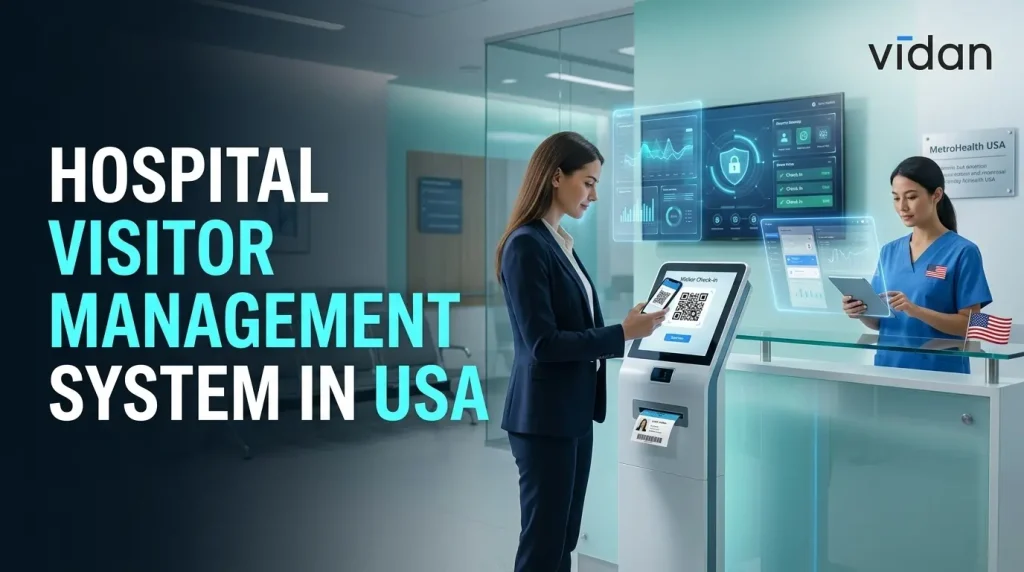
Every day, thousands of people walk through hospital doors. Some are patients. Some are staff. Some are visitors. And some should never have gotten past the front desk. Hospitals in the United States see millions of visitor interactions annually. Yet many facilities still rely on paper logbooks, manual badge systems, and front desk staff stretched too thin to catch every risk.
That gap is dangerous.
A modern hospital visitor management system in USA is not just a digital check-in screen. It is a layered security and compliance engine that protects patients, staff, and data simultaneously. It works in real time, flags threats before they escalate, and keeps every entry point accountable. This blog breaks down exactly what separates an effective system from an outdated one.
What We Cover in This Blog
- Why traditional visitor management fails hospitals
- Core features that define a truly modern system
- How AI and automation are changing access control
- Real compliance benefits for US healthcare facilities
- What Vidan AI brings to hospital visitor security
- FAQs, infographic guide, and a CTA you will not want to skip
Why Traditional Hospital Visitor Systems Are Quietly Failing
The Paper Logbook Problem
Paper sign-in sheets feel harmless. They are not. Anyone can write a fake name. No one verifies ID against watchlists. There is zero audit trail that holds up under compliance review. When an incident happens, paper logs offer almost nothing useful.
Hospitals are high-value targets for theft, patient abduction, and unauthorized data access. A paper logbook at the entrance is the equivalent of leaving the front door unlocked.
Outdated Badges Create New Risks
Printed paper badges expire but are rarely collected. Visitors move freely through wards they should never enter. Staff cannot distinguish yesterday’s visitor from today’s authorized guest.
This is not a hypothetical problem. It is a documented pattern across US hospitals that have faced internal security reviews.
The Core Features That Make a Difference
- Real-Time Identity Verification
Effective visitors management software for hospitals verifies identity at the point of entry. Not after. Not during a manual review later. Modern systems scan government-issued IDs, cross-check against offender registries, and flag restricted individuals before they step past the lobby. This alone eliminates a significant category of preventable incidents.
- Automated Watchlist Screening
A high-performing system connects to national and state-level databases. It runs every visitor name and ID against active watchlists without requiring staff to do anything manually. When a match occurs, the system alerts security staff instantly. This is where
How Hospital Security Technology AI Helps Prevent Unauthorized Access becomes a critical operational asset rather than a luxury upgrade.
- Smart Badge Printing With Expiry Logic
Printed badges should carry embedded expiry data. When a badge is scanned after its valid window, the system flags it. Visitors cannot reuse yesterday’s badge. Contractors cannot extend their access window undetected. Every badge tells the system exactly who it belongs to and when it stops being valid.
- Host Notification and Escort Coordination
A modern system notifies the patient or staff member being visited the moment their guest checks in. It confirms the visit is expected. If no confirmation comes within a defined window, security receives an alert. Unconfirmed visitors do not wander through clinical areas alone.
How AI Is Reshaping Access Control in US Hospitals
Beyond Simple Check-Ins
Traditional check-in software records who entered.
AI-powered systems understand patterns of who should not have entered. Behavioral analytics flag unusual visit frequency. Facial recognition can be integrated where permitted. Anomaly detection catches access patterns that human staff would never notice across thousands of daily entries.
For facilities already investing in
Healthcare Video Surveillance, integrating an AI-powered visitor management layer creates a unified security picture that spans every entry point and corridor.
Predictive Alerts Before Incidents Happen
AI does not just react. It anticipates. If a visitor attempts to access a restricted ward outside their designated zone, the system triggers an alert before they reach the door. If a visitor’s check-in pattern matches a known risk profile, security is notified proactively.
This shift from reactive to predictive security is what separates modern systems from legacy software.
Compliance and HIPAA: The Feature Nobody Talks About Enough
Hospitals in the USA operate under strict regulatory frameworks. HIPAA requires that access to patient areas is controlled and documented. A modern hospital visitor management system in USA creates a complete, tamper-resistant audit trail for every entry. Time stamps, ID data, badge status, escort confirmation and exit records are all stored and retrievable. When a compliance audit happens, that data is ready. When an incident investigation begins, the timeline is already built.
Infection Control Integration
Post-pandemic hospital operations demand health screening at entry. Modern systems incorporate symptom questionnaires, vaccination status checks, and health declaration forms as part of the check-in workflow. Visitors who fail screening criteria are flagged automatically. Staff do not need to make judgment calls under pressure.
Night Vision, Analytics, and the Full Security Stack
A visitor management system works best when it is part of a wider security ecosystem.
Facilities that have explored
How Night Vision Cameras Work in clinical environments understand that 24/7 visibility is not just about daytime foot traffic. Visitor logs paired with after-hours camera coverage close the gap entirely.
When you layer in
AI Video Analytics, the system can match visitor badge scans to camera timestamps, verify that the person who checked in is the same person who walked through a specific door, and flag discrepancies automatically. This is the full security stack that modern hospitals are building right now.
What Effective Visitor Management Does for Patient Experience
Nobody wants to wait twenty minutes at a hospital entrance. Modern systems complete full identity verification in under sixty seconds. Digital pre-registration allows approved visitors to check in via QR code. Security improves. Visitor experience improves. Both happen at the same time.
Family and Patient Confidence
When patients know that their care environment is protected, their confidence in the facility increases. Families feel reassured knowing unauthorized individuals cannot reach vulnerable patients.
That emotional trust is a measurable part of patient satisfaction scores. It also directly supports the kind of environment described in
How Hospital Security Systems AI Is Redefining Patient And Staff Protection.
Multi-Facility and Enterprise-Level Scalability
One System Across Every Location
Hospital networks in the USA often operate across dozens of campuses. A modern visitor management healthcare software platform scales across every location from a single administrative dashboard. Policy changes deploy instantly across the network. Reporting is consolidated. Security teams see the full picture in real time regardless of which campus they are monitoring.
Role-Based Access for Internal Teams
Not every staff member needs access to every visitor record. Modern systems assign role-based permissions so that clinical staff, security teams, and administrators each see only what is relevant to their function.
This keeps sensitive data protected internally while ensuring that the right people have the information they need when they need it.
The Supply Chain Nobody Thinks About: Vendor and Contractor Management
Hospitals receive vendors, maintenance contractors, pharmaceutical reps, and equipment technicians daily. These are not patients. They are not staff. And they are often given more access than they should have without adequate tracking.
Effective visitors management software for hospitals treats contractor management as a distinct workflow. Background check integrations, scheduled access windows, and area-specific permissions ensure that a pharmaceutical delivery driver cannot wander into a clinical records room.
Vidan AI: Built for the Security Demands of Modern Healthcare
Most visitor management platforms were built for corporate offices and retrofitted for healthcare. Vidan AI was designed with healthcare security as the primary use case. Every feature reflects the specific challenges of US hospital environments. HIPAA compliance is built in, not added on. Watchlist screening connects to healthcare-relevant databases. The system architecture anticipates the unpredictability of clinical environments.
Real-Time Alerts That Actually Reach the Right People
Vidan AI does not just generate alerts. It routes them. When a flagged visitor attempts entry, the alert reaches the security team, the duty manager, and the relevant ward coordinator simultaneously. Response time drops. Incidents are contained faster.
Seamless Integration With Existing Hospital Infrastructure
Vidan AI integrates with access control hardware, camera systems, electronic health record platforms, and workforce management tools. Hospitals do not need to replace existing infrastructure. They enhance it. The result is a unified, intelligent security layer that covers every visitor interaction from pre-registration to exit.
Conclusion
Security gaps in visitor management are not just operational problems. They are patient safety failures waiting to happen. The hospitals leading in patient trust, regulatory compliance, and incident prevention are not the ones with the biggest budgets. They are the ones that chose intelligent systems over outdated ones. A modern hospital visitor management system in USA does not just log who walked in. It protects everyone inside.
Vidan AI delivers exactly that protection, built specifically for healthcare, scalable across every facility you operate. Your hospital’s front door is either a security asset or a security liability. Vidan AI makes it an asset.
Book a demo with Vidan AI today and see how your facility can move from reactive to protected in weeks, not years.