
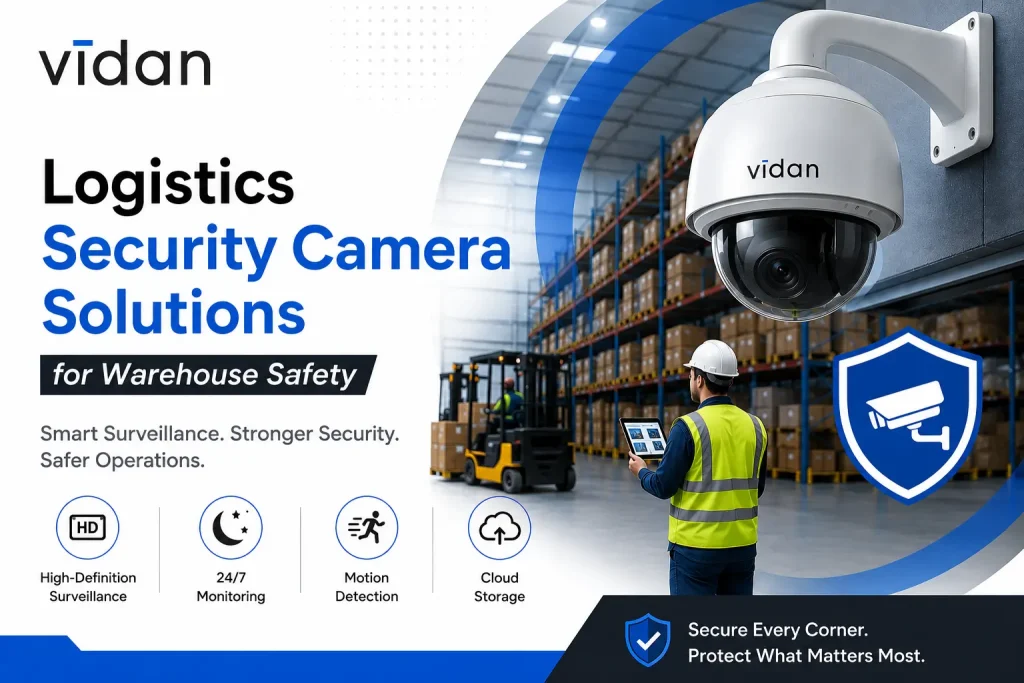
Warehouses lose more inventory to blind spots than to break-ins. A missed angle, a delayed alert, or a guard checking one screen out of twenty can cost thousands overnight. That is the quiet reality behind most warehouse theft and safety incidents, and it is exactly why logistics security camera solutions have become a frontline defense rather than a backup plan.
At Vidan AI, we work with logistics teams who once treated cameras as passive recorders. Today, those same teams rely on smart systems that watch, think, and respond before damage happens. This shift is not a trend. It is a response to rising shrinkage, tighter margins, and growing safety expectations across the supply chain.
Key Takeaways
- Logistics security camera solutions combine AI detection with continuous footage to reduce theft and accidents.
- Logistics video security helps teams catch incidents in real time instead of reviewing them after losses occur.
- Security camera monitoring supports faster response times during shift changes, loading, and after-hours operations.
- Live security camera surveillance gives managers remote visibility across multiple warehouse zones at once.
- Vidan AI builds these systems around real warehouse risks, not generic retail setups.
Why Warehouses Cannot Rely on Guards Alone Anymore
Foot patrols cover ground slowly. A single guard cannot watch every aisle, dock, or loading bay at the same time. This gap is where most incidents slip through, especially during overnight shifts or peak shipping hours.
This is also why many operators now compare Warehouse Security Guards vs. AI Video Analytic approaches before choosing a final setup. Cameras do not replace people. They extend what people can see and react to.
Three Gaps Guards Cannot Close
- Limited visibility across large floor plans
- Fatigue during long or overnight shifts
- Delayed response when multiple incidents happen at once
These gaps are filled by logistics security camera solutions that monitor continuously without losing focus or coverage.
What Makes a Logistics Camera System Work
Not every camera setup delivers results. A wall of screens means little if no one is watching them or if footage only gets reviewed after a loss is reported.
Effective logistics video security depends on three working parts.
- Coverage that eliminates blind spots across docks, aisles, and entry points.
- Detection that flags unusual movement, unauthorized access, or unsafe behavior.
- Response that alerts staff or security teams within seconds, not hours.
When these three work together, a warehouse moves from reactive to preventive. That shift alone can reduce theft-related losses significantly across a single fiscal year.
A Quick Comparison
| Traditional Setup | Smart Logistics Setup |
| Manual review after incidents | Real-time alerts during incidents |
| Fixed camera angles only | AI tracks movement automatically |
| Limited night coverage | Clear visibility after dark |
| Single-site monitoring | Multi-site remote access |
What Happens When a Warehouse Skips Smart Monitoring
Many facilities still run on outdated setups until something forces a change. The cost of waiting is often higher than the cost of upgrading.
Common Consequences of Delayed Upgrades
- Repeated inventory shrinkage that goes unexplained for months
- Slow incident investigations due to poor footage quality
- Rising insurance premiums tied to weak security documentation
- Staff turnover linked to unsafe working conditions
What Changes After Installing a Modern System
- Faster identification of theft patterns within the first quarter
- Reduced insurance costs tied to verified monitoring coverage
- Improved staff accountability without micromanagement
- Clearer audit trails for compliance reviews
Logistics security camera solutions turn these reactive problems into manageable, trackable processes from day one.
How AI Changes the Math on Theft and Loss
Theft in warehouses rarely looks dramatic. It often happens during normal hours, blended into routine activity. A missing pallet here, a mismatched scan there.
Security camera monitoring powered by AI catches these patterns by comparing expected behavior against actual footage. If a worker lingers near a high-value zone outside their normal route, the system flags it instantly.
This is not about distrust. It is about giving managers visibility that they simply cannot maintain manually across a 50,000 square foot facility.
Common Triggers AI Systems Watch For
- Unusual dwell time near valuable inventory
- Doors or gates opened outside scheduled hours
- Vehicles entering restricted zones
- Repeated access attempts by the same individual
Each trigger sends a real-time alert, allowing teams to act before a small issue becomes a major loss.
The Role of Analytics in Reducing Long-Term Costs
Camera systems do more than capture footage. The analytics layer behind the cameras is where real savings happen over time.
How Analytics Lower Operational Costs
- Reduced labor costs come from needing fewer staff dedicated purely to manual monitoring.
- Lower shrinkage rates result from catching theft patterns earlier instead of after quarterly audits.
- Fewer false dispatches happen when AI filters out non-issues before alerting response teams.
- Better insurance terms often follow once providers see documented, active monitoring in place.
A Simple Cost Comparison Over One Year
| Cost Factor | Without Smart Monitoring | With Smart Monitoring |
| Inventory shrinkage | High and inconsistent | Reduced and trackable |
| Security staffing | Higher headcount needed | Leaner team, wider coverage |
| Incident investigation time | Days per case | Hours per case |
| Insurance premium trend | Rising | Often stable or reduced |
Security camera monitoring paired with analytics consistently shows measurable returns within the first operating year for most logistics facilities.
Night Shifts Are Where Most Risk Hides
Daytime operations get the most attention, yet overnight hours carry disproportionate risk. Fewer staff, lower lighting, and slower response times create opportunities for theft or accidents.
Understanding how night vision cameras work helps explain why this gap is closing fast. Infrared and low-light sensors now deliver clear footage even in near-total darkness, removing one of the biggest historical weaknesses in warehouse security.
Vidan AI integrates this capability directly into our logistics security camera solutions, so coverage does not drop once the sun goes down.
Remote Monitoring Changes Who Watches the Warehouse
Operations managers are rarely on site around the clock. Multi-location logistics companies face an even bigger challenge, with teams spread across cities or regions.
Live security camera surveillance solves this by putting footage in the hands of decision makers wherever they are. A manager in one city can review activity from a warehouse three states away, in real time, from a phone or laptop.
This shift also connects directly to remote video monitoring ROI, since fewer on-site security staff are needed while coverage actually improves.
Why Remote Access Matters for Logistics Teams
- Reduces dependency on a single physical security team
- Allows faster cross-site comparisons during audits
- Supports rapid response even when managers are traveling
- Cuts costs tied to maintaining a large in-house security staff
Safety Is Not Optional, and Cameras Prove It
Warehouse incidents are not limited to theft. Forklift accidents, unsafe stacking, and blocked exits remain the leading causes of workplace injury in logistics environments. Meeting warehouse health and safety requirements often means proving that monitoring systems are active and reviewed regularly, not just installed and forgotten.
Logistics security camera solutions help safety officers document compliance, investigate incidents accurately, and identify recurring hazards before they cause injury.
Safety Use Cases Cameras Support
- Verifying forklift operators follow speed and path rules
- Confirming emergency exits remain unblocked
- Reviewing footage after near-miss incidents
- Tracking PPE compliance across shifts
What Decision Makers Should Ask Before Choosing a Vendor
Not all providers build systems with logistics environments in mind. Asking the right questions upfront prevents costly mismatches later.
Questions Worth Asking Any Vendor
- Does the system support multi-site remote access from one dashboard
- How does the AI reduce false alerts instead of just generating more notifications
- What happens to footage storage if internet connectivity drops temporarily
- Can camera placement be customized based on the actual warehouse layout
- What kind of support is available after installation
Red Flags to Watch For
- Vendors offering only generic retail camera packages
- No clear answer on data retention or storage limits
- Limited or no integration with existing access control systems
- Pricing models that hide ongoing monitoring or support fees
A strong vendor relationship matters as much as the hardware itself when implementing logistics security camera solutions across a growing operation.
How Vidan AI Approaches Warehouse Protection Differently
Most camera vendors sell hardware. Vidan AI builds a monitoring philosophy around how logistics teams actually operate.
We start by mapping real risk zones inside a facility rather than placing cameras evenly across walls. Loading docks, high-value storage, and after-hours entry points get priority coverage. From there, our security camera monitoring systems are tuned to reduce false alerts, so teams trust the notifications they receive instead of ignoring them.
This approach has helped logistics operators reduce both shrinkage and safety incidents within the first few months of deployment, based on client feedback across multiple facility types.
What Sets Vidan AI Apart
- Custom camera placement based on actual warehouse layout
- AI tuned to reduce false alarms, not just generate alerts
- Dedicated support for multi-site logistics operations
- Transparent reporting for safety and compliance audits
Building a Connected Security Layer With Alarms and Sensors
Cameras alone tell part of the story. When paired with alarms, access control, and motion sensors, they create a complete picture instead of isolated footage.
How Integration Strengthens Coverage
- Door and gate sensors confirm exactly when an entry point opens, matching that moment to camera footage automatically.
- Motion sensors trigger camera recording in low traffic zones, saving storage while still catching unexpected activity.
- Access control logs pair employee badge swipes with footage, showing not just who entered but what happened after.
- Alarm systems escalate camera alerts into immediate notifications when a triggered sensor matches unusual footage.
Why This Matters for Warehouses
A door alarm without footage only tells you that something happened. A camera without sensor triggers means someone has to actively watch for it. Together, logistics security camera solutions confirm incidents instead of just flagging possibilities.
A Simple Example
A motion sensor detects movement near a restricted storage zone after hours. The connected camera automatically pulls up that exact feed. An alert reaches the manager within seconds, with footage attached, not just a generic notification.
How AI Tells a Real Threat From a False Alarm
False alerts are the fastest way to make a security team stop trusting their system. If every shadow or stray cat triggers a notification, staff eventually start ignoring alerts altogether.
What Causes Most False Alerts
- Lighting changes mistaken for movement
- Small animals or insects triggering motion sensors
- Weather-related shadows or reflections
- Generic motion detection without context
How Smarter AI Filters These Out
- Object classification allows the system to distinguish between a person, a vehicle, or unrelated movement before sending an alert.
- Behavior pattern learning helps the system recognize normal warehouse activity, so routine forklift movement does not trigger unnecessary notifications.
- Zone-specific rules let teams set different sensitivity levels for high-risk areas compared to low-risk zones.
- Time-based logic adjusts alert thresholds depending on shift schedules, flagging activity differently during closed hours versus active shifts.
Why This Improves Over Time
Security camera monitoring systems built on AI continue learning from a facility’s specific patterns. The longer a system runs, the more accurately it separates real risk from routine activity, reducing alert fatigue across the security team.
What Warehouse Camera Systems Cost Over Time
Upfront pricing is only part of the cost conversation. The real value shows up in what a system saves over months and years of operation.
Initial Cost Factors
- Number of cameras needed based on facility size
- Resolution and night vision capability requirements
- Integration costs with existing alarms or access control
- Installation complexity based on building layout
Ongoing Costs to Expect
- Monthly monitoring or software subscription fees
- Cloud storage costs based on retention period
- Periodic maintenance or hardware replacement
- Support and system tuning over time
Where the Savings Come From
- Reduced shrinkage often delivers the fastest visible return, especially in facilities with prior unexplained inventory loss.
- Lower staffing costs appear as fewer personnel are needed for manual monitoring shifts.
- Faster investigations cut down hours spent reviewing footage manually after incidents.
- Insurance adjustments sometimes follow once providers see documented, active live security camera surveillance in place.
A Realistic ROI Timeline
| Timeframe | Typical Impact |
| First 3 months | System tuning, baseline data collection |
| 3 to 6 months | Noticeable drop in unexplained shrinkage |
| 6 to 12 months | Measurable reduction in incident response time |
| 12 months plus | Insurance and staffing cost adjustments become clearer |
Most logistics operators begin seeing measurable returns well within the first year, particularly when prior losses were already significant.
Conclusion
Warehouses do not fail security checks because teams are careless. They fail because visibility runs out before risk does. Logistics security camera solutions close that gap by watching every corner a guard physically cannot.
If your current setup still relies on after-the-fact footage review, it is already behind. Vidan AI builds monitoring systems designed around how your warehouse actually runs, not a generic template.
Request a demo of Vidan AI today and find out what your cameras are currently missing.