
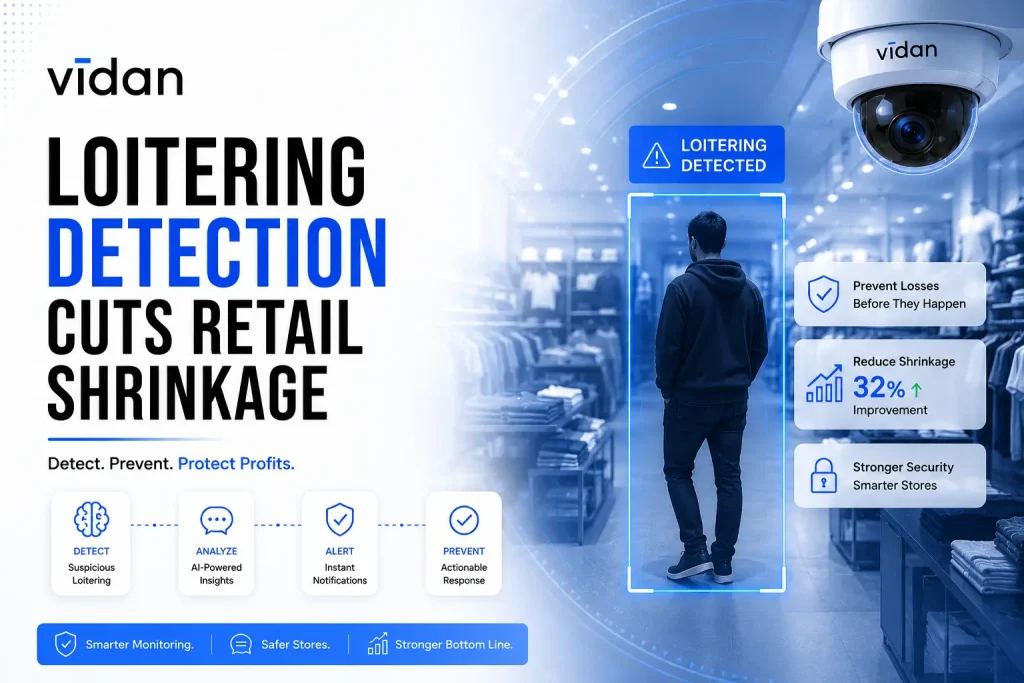
Retail stores lose billions every year. Not from bad products or poor marketing. From people standing in the wrong place at the right time.
Loitering detection is no longer a luxury feature on a camera spec sheet. It is the difference between catching a theft ring before it executes and filing a police report after. Retailers using legacy CCTV systems are watching shrinkage climb while their cameras record everything and prevent nothing.
This blog breaks down exactly how AI changes that equation. And why video AI is becoming the frontline defense against a problem that costs U.S. retailers over $100 billion annually.
Key Terms to Know
- Loitering Detection: An AI-driven function that identifies when a person remains in a defined zone longer than an acceptable threshold and triggers an alert.
- Video AI: Artificial intelligence layered onto camera feeds to analyze behavior, detect anomalies, and generate real-time alerts without human monitoring.
- Video AI Integrated with POS Data: A system that connects camera analytics with point-of-sale transaction records to identify theft patterns that neither system would catch alone.
- Organized Retail Crime (ORC): Coordinated theft operations involving multiple individuals working together. ORC accounts for a significant share of retail shrinkage nationally.
- Shrinkage: The total loss of inventory from theft, fraud, administrative error, or vendor issues. Employee theft and shoplifting account for the largest portions.
- Dwell Time Analysis: A camera analytics feature that tracks how long individuals spend in specific zones. Unusually long dwell times trigger behavioral alerts.
- False Positive Rate: The frequency at which an AI system flags non-threatening behavior as suspicious. Lower false positive rates mean better operational efficiency.
The Loitering Problem Most Retailers Refuse to Take Seriously
Walk into any busy retail environment, and you will find a blind spot hiding in plain sight. It is not a corner with a poor camera angle. It is time itself.
Traditional surveillance captures what happens. It rarely captures what is about to happen. Loitering, by definition, is pre-crime behavior. It is the setup, the coordination, the timing window. And most retail security teams have no system in place to catch it.
What Loitering Actually Looks Like in Retail
Loitering in retail does not look the way most people picture it. It is not a suspicious person standing outside your door in plain sight. In modern retail theft, loitering is tactical.
Here is what it actually looks like:
Pattern 1: The Spotter
One individual enters the store and walks slowly through multiple aisles. They are not shopping. They are mapping camera positions, staff movements, and high-value merchandise locations. This person rarely takes anything.
Pattern 2: The Blocker
In organized groups, one member positions themselves near the staff or loss prevention. Their job is to block sightlines while others act.
Pattern 3: The Timer
A person monitors shift changes, checkout rushes, or store opening and closing windows. They return multiple times before executing. Each visit looks routine. Only AI tracking behavioral history catches the pattern.
Pattern 4: The External Loiterer
Someone waits outside near the entrance or parking area. They are receiving merchandise passed out by an accomplice inside. Without perimeter monitoring, this never gets flagged.
If you want to understand how this threat starts before someone even enters your store, “Why You Should Worry About Loitering and How to Prevent It“ outlines the full range of behaviors that retailers often overlook.
How AI-Powered Loitering Detection Works
AI-powered loitering detection does not simply watch a camera feed. It processes every frame against a behavioral model trained on thousands of hours of retail footage. The system identifies:
- Person detection and tracking across multiple camera angles
- Zone entry and exit timestamps for every individual
- Dwell time per zone compared to behavioral norms
- Movement patterns: pacing, circling, hesitation, repeated return visits
- Group behavior: multiple individuals coordinating movement
When a person exceeds the dwell threshold for a defined zone, an alert fires. Not to a recording server. To a live operator or directly to the floor staff.
The Alert Logic
Not every alert is equal. Vidan AI’s system is built to prioritize alerts by risk level. A single extended dwell in a low-value zone produces a low-priority flag. The same behavior near high-value merchandise, combined with repeated zone entries and abnormal movement patterns, produces an immediate high-priority alert.
This tiered logic dramatically reduces the noise that makes most AI surveillance systems frustrating to use in practice.
Why Camera Placement Matters More Than You Think
AI is only as effective as the infrastructure it sits on. A system trained to detect loitering cannot compensate for blind spots, low-resolution feeds, or inadequate night coverage.
This is why perimeter monitoring is not optional. Perimeter security describes how the zones outside your building directly influence the behavioral patterns inside it.
Organized Retail Crime: The Threat AI Was Built to Counter
Petty shoplifting is a problem. Organized retail crime is a crisis. The distinction matters because ORC operates at a level of coordination that completely defeats traditional security approaches. These are not impulsive individuals taking single items. These are teams executing planned operations across multiple stores in multiple states.
How ORC Rings Use Loitering as a Tactical Tool
Stage 1: Reconnaissance
Team members visit target stores weeks before any theft occurs. They profile staff patterns, identify camera angles, map merchandise locations, and test alarm response times. This looks exactly like normal shopping behavior to the human eye.
Stage 2: Coordination Positioning
On execution day, multiple team members enter at staggered times. Each has a role. Some linger near security infrastructure. Others position near exits. The timing is precise.
Stage 3: Execution and Egress
The actual theft happens fast. What made it possible was everything that happened before. The loitering was the plan.
What Makes ORC So Hard to Catch Without AI
Human staff cannot track multiple individuals across multiple zones simultaneously. They cannot correlate a visit from three weeks ago with behavior happening right now. They cannot cross-reference transaction data with behavioral anomalies in real time.
AI can do all three.
Video AI integrated with POS data is particularly powerful against ORC. Here is why. When a theft occurs at a specific register during a specific transaction window, the system can look backward through camera footage to identify everyone who interacted with that product, that aisle, and that checkout zone in the preceding hour. Patterns that would take a human investigator days to reconstruct appear in minutes.
If your current security setup cannot achieve this, “Signs Your Business Needs Better Retail Asset Protection Technology“ will help you pinpoint what is lacking and explain why it is costing you.
Video AI Integrated with POS Data: The Layer That Changes Everything
Camera systems and point-of-sale systems have historically lived in separate worlds. One captures behavior. One captures transactions. Neither talks to the other. That separation is where organized retail crime thrives.
What the Integration Unlocks
When video AI integrated with POS data and operates as a unified system, the investigative capability changes fundamentally.
Scenario A: The Sweethearting Problem
A cashier repeatedly processes no-sale transactions for the same customer. Individually, neither the camera feed nor the POS log triggers a flag. Combined, the system identifies a behavioral and transactional pattern that points directly to internal theft coordination.
Scenario B: The Return Fraud Loop
High-value items are stolen, then returned for cash at a different location. The POS system sees a legitimate return. The camera system sees a customer. Only the integrated system sees the same person who loitered near that product category three days earlier at a different branch.
Scenario C: The Rush Hour Window
Theft spikes during peak transaction periods when staff attention is split. The integrated system identifies that shrinkage correlates with specific checkout rush windows. Behavioral alerts increase during those windows automatically.
The Operational Benefit Beyond Loss Prevention
Retailers using integrated AI-POS systems report benefits beyond theft reduction. Inventory accuracy improves. Staffing decisions become data-informed. High-risk zones get redesigned based on behavioral heatmaps rather than guesswork.
This is not just a security tool. It is a retail intelligence layer.
The Cost of Doing Nothing: Shrinkage by the Numbers
Before covering what Vidan AI does differently, let us put the problem in hard numbers.
| Shrinkage Category | Percentage of Total Retail Loss |
| Exterior Theft (Shoplifting) | 36% |
| Employee Theft | 29% |
| Administrative Error | 20% |
| Vendor Fraud | 6% |
| Unknown / Unclassified | 9% |
The two categories where loitering detection and video AI have the highest direct impact account for 65% of total retail loss.
For a mid-size retailer generating $10 million in annual revenue, industry average shrinkage rates mean $150,000 to $200,000 in annual losses. AI-powered video surveillance that reduces shrinkage by even 30% pays for itself in the first year.
The question is not whether AI surveillance is worth the investment. The question is how long you can afford to wait.
What Vidan AI Brings to the Retail Security Stack
Most AI surveillance vendors sell cameras with software. Vidan AI is built differently.
Generic AI systems are trained on broad datasets. They detect people and vehicles. They flag motion. They are not built to understand the specific behavioral vocabulary of retail theft.
Vidan AI’s detection models are trained specifically on retail environments. The system understands the difference between a customer who is genuinely browsing and a spotter running reconnaissance. That distinction is not something you can get from an off-the-shelf computer vision solution.
Real Operators Behind Every Alert
Vidan AI combines AI detection with human verification. When the system generates a high-priority alert, a trained remote operator reviews it before action is taken. This removes the two biggest problems with pure-AI surveillance: false positives that erode staff trust and missed events that erode security value.
Your team does not waste time chasing false alarms. And real threats do not slip through because no one was watching.
Seamless Integration Without Overhauling Infrastructure
Most retailers cannot start from scratch. Vidan AI is designed to integrate with existing camera infrastructure wherever possible. You are not buying a new system. You are adding an intelligence layer to what you already have.
Scalable for Single and Multi-Site Operations
Whether you operate one location or a regional chain, the platform scales without requiring proportional increases in security staffing. Multi-site retailers get centralized visibility with location-level granularity.
Proactive Deterrence
The most important distinction. Vidan AI’s system is not designed to help you build a case after a theft occurs. It is designed to interrupt the behavioral chain before the theft happens. Loitering detection is the earliest intervention point in that chain.
Conclusion
Shrinkage accumulates quietly and exploits gaps in traditional security. While Video AI doesn’t eliminate all risks in retail, it removes the invisibility that theft relies on. Tracking behaviour over time and linking camera data with transactions, it allows for proactive responses, fundamentally changing the operational approach.
Loitering detection is not about policing your customers. It is about reading the difference between someone who belongs and someone who is planning. That difference, caught early, is the margin between a profitable operation and a shrinkage problem that quietly drains your bottom line year after year.
Vidan AI exists for retailers who are done absorbing losses that are preventable. The technology is here. The data is clear. The only question left is whether your store is protected before the next coordinated theft walks through your door.