
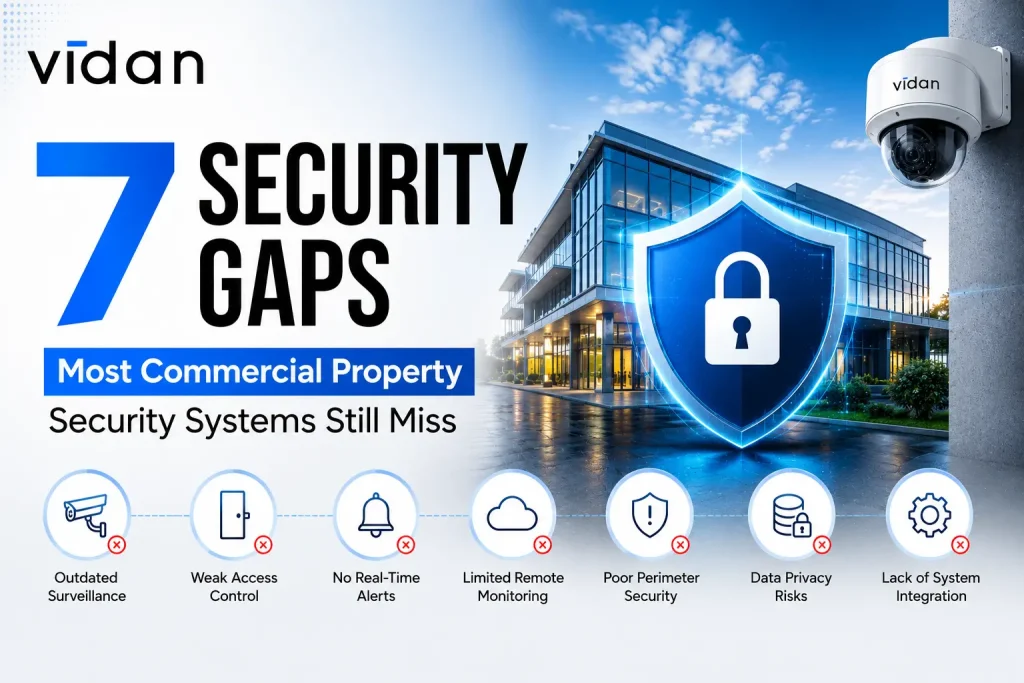
Most facilities pass their annual security audits without issue. The cameras are installed. The access logs are clean. The monitoring contract is renewed. And yet, incidents still happen. A loading dock breach at 2 a.m. A contractor who walked into a restricted zone without a single alert firing. Inventory that disappeared over three weeks before anyone flagged it.
These are not freak events. They are the predictable outcome of gaps that commercial property security systems were never designed to close. Not because the technology does not exist, but because most deployments stop at the bare minimum.
This blog breaks down seven of those gaps. Not as a checklist, but as an honest assessment of where conventional security strategy falls short and what the forward-thinking shift actually looks like.
What You Will Learn in This Blog
- Why perimeter coverage alone is a false sense of security
- The hidden cost of alert fatigue in security operations
- How do after-hours blind spots form even in monitored facilities
- What most systems miss about insider risk
- Where AI closes the gaps that hardware cannot
- How Vidan AI approaches these problems differently
- Practical steps to pressure-test your current setup
Gap 1: Perimeter Cameras Do Not Equal Perimeter Intelligence
Most commercial property security setups treat the perimeter as covered the moment cameras go up. That logic is dangerously incomplete.
A camera records. It does not interpret. It captures footage of someone cutting a fence at 3 a.m., but only after the fact, when someone reviews the clip the next morning.
The gap is not in coverage. It is in cognition.
Modern threats do not announce themselves. Tailgating, slow-entry probing, and repeated perimeter testing over multiple nights are patterns, not single events. Cameras without behavioral analysis cannot connect those dots.
What this looks like in practice: A distribution facility with 40 cameras across its perimeter had zero alerts triggered during a five-week period when a side gate was being tested nightly. No individual event crossed the alarm threshold. The pattern only became visible in hindsight.
That is a system working exactly as designed, and still failing completely.
Gap 2: The Alert Fatigue Trap Most Teams Fall Into
There is a threshold problem baked into most commercial property security systems. They are configured to minimize false positives. In doing so, they create a different failure mode: genuine threats get buried in noise.
Security teams at large commercial sites can receive hundreds of motion alerts per shift. A single busy loading dock can generate dozens of triggers per hour. After a while, alerts become background noise. Response time slips. The threshold for concern rises.
This is not a staffing problem. It is a system design problem.
When every alert looks the same, nothing feels urgent. What facilities need is not fewer alerts but smarter alert prioritization that distinguishes a delivery truck from an unauthorized vehicle attempting access after hours.
The difference between those two events is context. Context requires intelligence, not just motion detection.
Gap 3: After-Hours Coverage Is Thinner Than You Think
Most commercial real estate security setups concentrate resources around business hours. Access control is tightest at 9 a.m. Roving guards patrol peak hours. Camera monitoring is most active when staff are present.
After midnight, the infrastructure is the same, but the human layer thins dramatically.
This is where the exposure concentrates. The majority of high-value commercial property incidents, including break-ins, asset theft, and vandalism, occur between 10 p.m. and 5 a.m. Yet the monitoring posture during those hours often relies on automated alerts that nobody reviews until morning.
Monitoring Construction Site Storage Remotely with Vidan AI addresses exactly this window. Remote AI monitoring that operates without sleep, shift changes, or attention drift fills the gap that after-hours security staffing cannot.
Gap 4: Internal Blind Spots That Access Logs Do Not Capture
Access control systems are excellent at recording who entered a door and when. They are poor at understanding what happened next.
An employee with legitimate access to a server room does not trigger any alert. A contractor with a valid day pass can move through multiple restricted zones without a flag. A vendor who overstays their authorized window often goes unnoticed until someone manually cross-checks logs.
This is the insider risk blind spot. It is one of the most significant gaps in commercial property security best practices and one of the least discussed.
The solution is not more cameras in corridors. It is a behavioral context layered over access data. The question should not only be “did they have access?” but “was this movement pattern normal for this person at this time?”
Why Organizations Are Investing in AI Security Guard Technology in 2026 speaks directly to this shift: from static access rules to dynamic behavioral monitoring that adapts to the actual risk profile of each space.
Gap 5: Retail and Commercial Spaces Are Losing to Slow Detection
In high-footfall environments, the gap between an incident occurring and a response being triggered is measured in minutes. Those minutes are expensive.
Theft Detection Video Software exists precisely because traditional surveillance cannot keep pace with real-time retail or commercial activity. By the time a static camera records a loss event, the window for intervention has closed.
The retail dimension of commercial security is often treated separately from facility security. That is a structural mistake. A commercial property that includes retail, F&B, or high-value display zones needs a unified detection layer that monitors behavioral signals continuously.
Hesitation near high-value fixtures. Repeated entry and exit without purchase. Group movements that screen individual action. These are signals that only AI-driven video analysis can process at scale.
Gap 6: Static Camera Networks Miss Dynamic Threat Patterns
Fixed cameras cover fixed angles. That is an obvious limitation that most facilities accept as a given. What is less obvious is how that static coverage creates exploitable patterns.
Anyone who spends time observing a commercial property can map the blind spots. Delivery drivers know which angles face away from the loading dock. Contractors learn which corridors have no coverage. Over time, these gaps become known quantities to the wrong people.
Mobile Security Cameras address this directly. Deployable coverage that can be repositioned based on evolving risk profiles removes the predictability that fixed networks create. A threat actor cannot map a coverage gap that moves.
This is especially relevant for facilities undergoing renovation, expansion, or temporary operational changes where the fixed network no longer reflects the actual footprint.
Gap 7: No Intelligence Layer Connecting the Dots
This is the gap beneath all other gaps.
Individual systems, access control, video surveillance, alarm triggers, and visitor logs operate in silos. Each generates data. None of them speaks to each other in real time.
A visitor who badges into a lobby, triggers a motion alert in a restricted zone, and is captured on camera near a server rack is three separate data points in three separate systems. Without an intelligence layer, no human operator is likely to connect them before the shift ends.
AI Video Surveillance is not just about better cameras. It is about unifying the data streams that already exist and giving them operational meaning. The intelligence layer that most commercial property security systems lack is not hardware. It is the analytical capability that transforms data into decision-ready insight.
How Vidan AI Thinks About These Gaps Differently
Most security vendors sell infrastructure. Vidan AI builds intelligence. That distinction matters more than it sounds. A camera is only as useful as the analysis running behind it. An access log is only actionable if someone is watching for patterns. An alert only drives outcomes if it reaches the right person with enough context to respond.
Vidan AI’s approach starts from a different question. Not “how do we cover this space?” but “how do we understand what is happening in this space?”
That shift produces a different architecture. One that is built around behavioral context, not just sensor coverage. One that learns what normal looks like for a specific facility and flags deviations before they escalate. One that connects access data, video feeds, and movement patterns into a single operational picture.
For commercial property owners and facility managers who are tired of reactive security, Vidan AI offers something specific: visibility that acts before incidents become reports.
Pressure-Testing Your Current Setup
Before any upgrade conversation, ask these questions about your existing deployment:
- Does your system detect behavioral patterns or only discrete events? If your alerts fire on motion but not on pattern, you are missing the most important signals.
- Can your monitoring team distinguish between a delivery vehicle and a threat vehicle after hours? If the answer involves manual review, your after-hours posture has a gap.
- Are your access control data and video data connected in real time? If they live in separate systems with no shared analysis, your insider risk visibility is limited.
- When did you last physically walk your perimeter to identify camera blind spots? If this has not happened in the last 90 days, your fixed network may no longer reflect your actual footprint.
- What does your escalation path look like at 2 a.m.? If the answer involves someone reviewing footage in the morning, your overnight posture has real exposure.
These are not edge cases. They are the operational baseline that separates facilities that manage risk from those that discover it after the fact.
The Real Cost of Good Enough
There is a version of commercial property security that looks complete from the outside. Cameras everywhere. Contracted monitoring. Annual audits passed. And underneath that surface, quiet vulnerabilities are accumulating.
The facilities that suffer the most significant incidents are rarely those that ignore security. They are the ones who invested in infrastructure without investing in intelligence. They had coverage without context. Alerts without prioritization. Data without analysis.
Commercial property security best practices in 2026 are not about adding more hardware. They are about making existing systems smarter, more connected, and more capable of surfacing the signals that matter before they become incidents.
The gap between a facility that feels secure and one that actually is secure is often not measured in cameras or guards. It is measured in the quality of the intelligence layer sitting behind all of it.
In Conclusion
You do not need a complete overhaul to close these gaps. You need an honest assessment of where your current deployment stops and where risk begins.
Vidan AI works with commercial property teams to identify exactly those points. Not with a generic audit template, but with site-specific analysis that maps your actual coverage against your actual risk profile. If you are ready to move from reactive to predictive, from coverage to intelligence, the conversation starts with a single question: What is your current system missing? Find out. Before something else does.